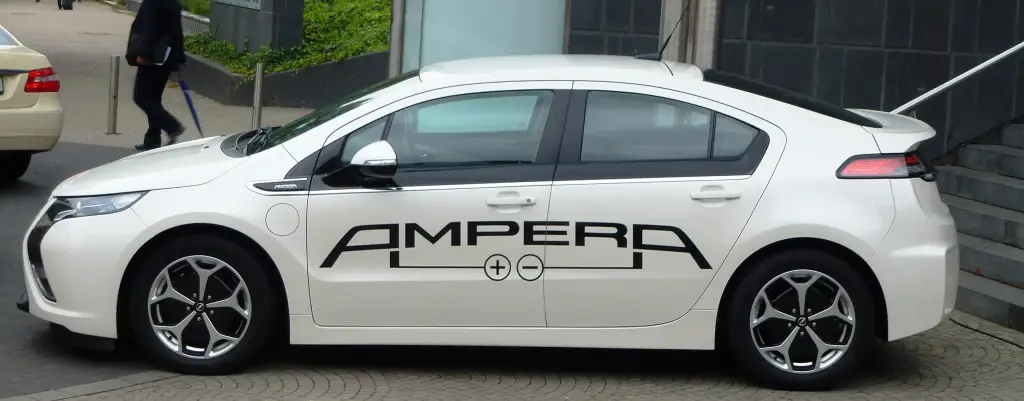
The Opel Ampera was Opel’s version of the Chevrolet Volt, sold in a number of European markets with visual changes to set it apart from the Chevrolet. General Motors calls the layout an extended-range electric car: the wheels are driven by an electric motor, and a small petrol engine runs a generator when the battery is empty.
Opel Ampera at a glance
| Maker | Opel, a General Motors brand |
|---|---|
| Based on | Chevrolet Volt, first generation |
| Built at | Detroit/Hamtramck Assembly |
| Volt production began | 30 November 2010 |
| Battery | lithium-ion, 16 kWh |
| Target electric range | 65 km (40 miles) |
| Layout | electric motor, battery pack and a generator set |
| Range extender | small petrol engine driving a generator |
| Charging | from the mains, plug-in |
| Body | five-door liftback |
Based on one source, the English Wikipedia article on the first-generation Chevrolet Volt, which covers the Opel Ampera as the European version of the same car.
History of the Opel Ampera
The Voltec idea
In 2006, under GM vice-president Robert Lutz, General Motors began work on a car that would repair its image after the failure of the EV1. The project created a family of electric powertrain components called E-Flex, later Voltec, able to take electricity from petrol, diesel, ethanol or a fuel cell. A lithium-ion battery of 16 kWh was chosen to give a target electric range of 65 km. The drivetrain that resulted consists of an electric motor, the battery pack and a generator set built around a small combustion engine.
From Volt to Ampera
Series production of the Volt began at Detroit/Hamtramck Assembly on 30 November 2010. In Australasia the same car was sold as the Holden Volt between 2012 and 2015. In numerous European markets the Opel and Vauxhall Ampera was introduced instead, with a number of visual modifications to distinguish it from the Chevrolet; the Volt itself continued to be sold in Europe in smaller numbers. The Ampera is a five-door liftback.
How it drives
The car runs as a battery electric vehicle until the battery falls to a set threshold, at which point the petrol engine starts a generator to extend the range. At high speed the engine can be linked mechanically to the generator set through a clutch, which improves efficiency by 10 to 15 per cent. Regenerative braking adds to the electricity on board. Opel does not call the Ampera a hybrid, preferring the term extended-range electric vehicle, although under the SAE definition the combination of an engine, two electric motors and a battery that can be charged from the mains makes it a plug-in hybrid. In charge-depleting mode it can run for roughly 40 to 80 km on electricity alone.
Design and features
- Electric first: a 16 kWh lithium-ion battery gives a target range of 65 km before the engine is needed.
- Range extender: a small petrol engine runs a generator, so a long trip does not depend on charging points.
- High-speed clutch: the engine can drive the generator set directly at speed, improving efficiency by 10 to 15 per cent.
- Regenerative braking: energy from slowing down goes back into the battery.
Opel Ampera versions
- Opel Ampera: the European Opel version with its own front and rear styling.
- Vauxhall Ampera: the same car for the British market.
- Chevrolet Volt: the original American version, also sold in Europe in smaller numbers.
- Holden Volt: the Australasian version, built between 2012 and 2015.
The Ampera was one of the first electric cars in the Opel range, alongside the later Insignia in the large family class. More cars are in the Opel collection.
Sources
- Chevrolet Volt (first generation), English Wikipedia: battery, powertrain, production, Ampera version