The Oliver 70 was a series of large row-crop tractors built by the Oliver Farm Equipment Company from 1935 to 1967. Introduced as the Oliver Hart-Parr 70 with a six-cylinder engine, it was progressively renamed the 77, Super 77 and 770, keeping the same basic machine with styling, power and equipment upgrades.
Oliver 70 at a glance
| Maker | Oliver Farm Equipment Company, Charles City, Iowa |
|---|---|
| Series production | 1935–1967 |
| First model | Oliver Hart-Parr 70, 1935 |
| Engine | six-cylinder, 200 cu in (3,300 cc) |
| Power at launch | 33 hp (25 kW) |
| Transmissions | four or six gears |
| Body versions | row-crop, standard, orchard and high-crop |
| Fuel | 70-octane gasoline; kerosene/distillate in the KD |
| Colours | green body with red trim |
| Canadian names | Cockshutt Hart-Parr, then Cockshutt 70 and 770 |
| Series models | 70, 77, Super 77 and 770 |
| Super 77 power | 44 hp (33 kW) |
Based on one source: the English Wikipedia article on the Oliver 70, which also covers the 77, Super 77 and 770 in sections.
History of the Oliver 70
1935: the Oliver Hart-Parr 70
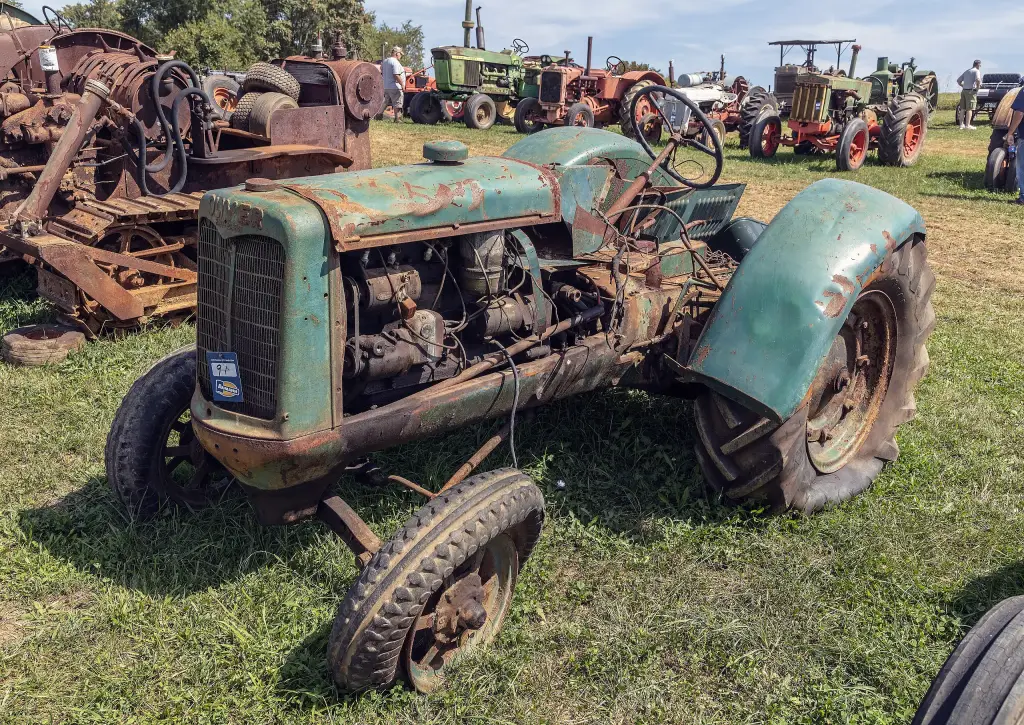
The Oliver Hart-Parr 70 was introduced in 1935 with an unprecedented six-cylinder engine. It offered options for an electric starter and lights, and the 200-cubic-inch (3,300 cc) engine developed 33 horsepower (25 kW) with four and six-gear transmissions. Row-crop, standard, orchard and high-crop versions were built. The HC engine ran on 70-octane gasoline, which gave the series its name, while the KD version operated on kerosene and distillate. The tractors were styled with automobile-like full hood enclosures and car-like controls. A competition decided the paint scheme by public voting at county fairs, settling on a green body with red trim, a colour that continued throughout Oliver production. The 70 was built in Charles City, Iowa, but was outsold by the less expensive Ford 9N. From 1935 it was marketed in Canada by Cockshutt as the Cockshutt Hart-Parr.
1937: the styled Oliver 70
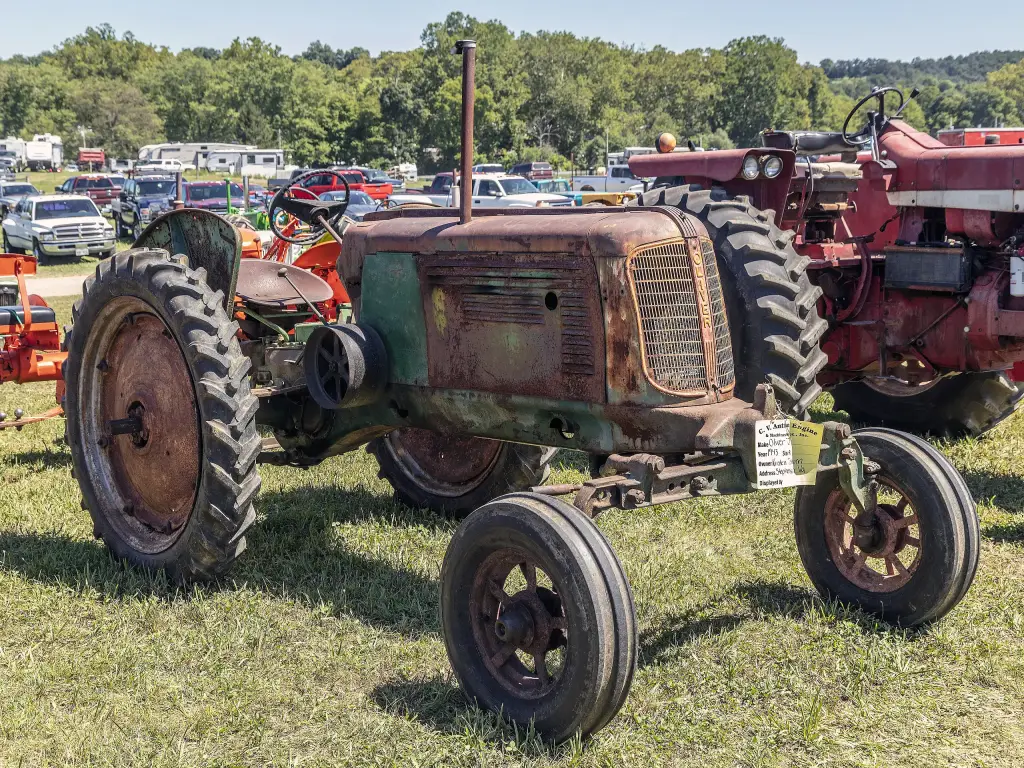
The 70 was restyled in 1937 with streamlined sheet metal. The Hart-Parr branding was dropped and the tractors were sold entirely as Olivers, while in Canada they were marketed as Cockshutts. Row-crop, standard, orchard and high-clearance models continued, and an airport version was added. The newer 70s used standardised configurations for hitch and PTO equipment. The model cost about $3,000 in 1954. The styled tractor was introduced in Canada at the same time as the Cockshutt 70, and all were built in Charles City.
1947: the Oliver 77
The Oliver 77 replaced the 70 in 1947 with minimal changes apart from styling updates, a standard three-point hitch and an option for an electric equipment lift. Rated for three 14-inch plows, it was initially offered with gasoline and kerosene/distillate engines. The kerosene model was replaced by a diesel in 1949, and an LP gas version followed in 1952. Row-crop, standard and orchard models were available until production ended in 1954, when the price was about $3,000.
1954: the Oliver Super 77
The Super 77 was introduced in 1954. The six-cylinder engine continued with 216 cubic inches (3,540 cc) and 44 horsepower (33 kW). The engine compartment was no longer fully shrouded with bodywork. Versions included row-crop, standard (Super 77-S), orchard (Super 77-O), high-crop and industrial configurations. In 1958 it sold for about $3,500.
1958–1967: the Oliver 770
A three-number sequence arrived in 1958 with the Oliver 770. It was more squared-off in appearance, kept the green body and replaced the earlier yellow and red highlights with a green-tinged white for grilles and wheels. The engines remained the same but with a slightly higher rpm and compression ratio, giving about 10 percent more power, and the transmission was offered with a torque amplifier. The 770 was sold as the Cockshutt 770 in Canada and produced until 1967, by which time the Oliver brand had been absorbed into White. The 1967 price was about $4,345, and an industrial version was built from 1958 to 1967.
Design and features
- Six-cylinder power: the 70 launched with a 200 cu in engine and 33 hp, at a time when four-cylinder rivals were the norm.
- Automobile-inspired styling: full hood enclosures and car-like controls gave the tractor a streamlined look.
- A public paint vote: county fair visitors chose the green body and red trim that Oliver kept for years.
- Four body styles: row-crop, standard, orchard and high-crop versions, with an airport model added in 1937.
- Continuous development: the 77 gained a three-point hitch, the Super 77 more power, and the 770 a torque amplifier.
Oliver 70 versions
- Oliver Hart-Parr 70 (1935–1937): the original six-cylinder model, also sold in Canada as the Cockshutt Hart-Parr.
- Styled Oliver 70 (1937–1947): streamlined sheet metal, Oliver-only branding and an airport version.
- Oliver 77 (1947–1954): standard three-point hitch, optional electric lift, diesel from 1949 and LP gas from 1952.
- Oliver Super 77 (1954–1958): 216 cu in, 44 hp, row-crop, standard, orchard, high-crop and industrial versions.
- Oliver 770 (1958–1967): squared-off styling, about 10 percent more power and an optional torque amplifier.
The smaller four-cylinder member of the family is the Oliver 60, while the heavy line is covered by the Oliver 80. More Oliver tractors are in the Oliver collection.
Video: Oliver 70 For Sale
Video on YouTube.
Sources
- Oliver 70, English Wikipedia: specifications, models, prices