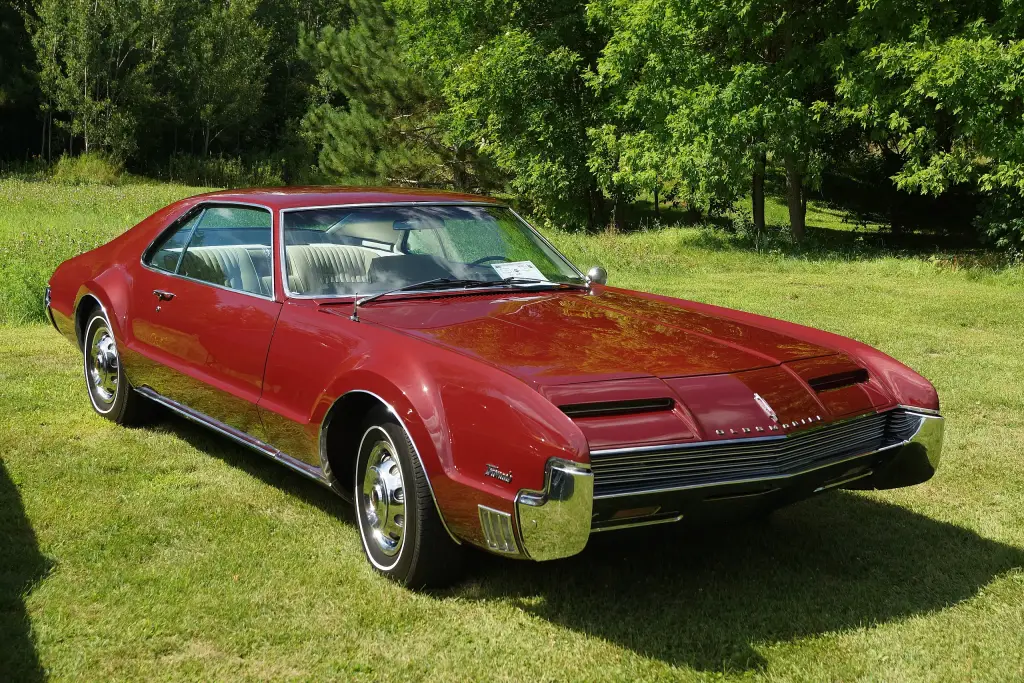
The Oldsmobile Toronado was a personal luxury car built from 1966 to 1992 over four generations. It was the first American-produced front-wheel-drive automobile since the Cord 810 and 812 of 1937, thanks to a transaxle version of GM’s Turbo-Hydramatic transmission.
Oldsmobile Toronado at a glance
| Maker | Oldsmobile Division, General Motors |
|---|---|
| Production | 1966–1992, four generations |
| Class | personal luxury car |
| Platform | GM E-body |
| Layout | front-wheel drive |
| 1966 engine | 425 cu in Super Rocket V8, 385 hp, 475 lb·ft |
| Transmission | TH425 three-speed automatic transaxle |
| Final drive | Hy-Vo chain, 2 in wide, on 7.5 in sprockets |
| Front suspension | torsion bars with double wishbones |
| 0–60 mph | 9.5 seconds |
| Name | chosen from a 1963 Chevrolet show car |
| Significance | first US front-wheel-drive car since 1937 |
Based on one source: the English Wikipedia article on the Oldsmobile Toronado.
History of the Oldsmobile Toronado
A design painting becomes a car
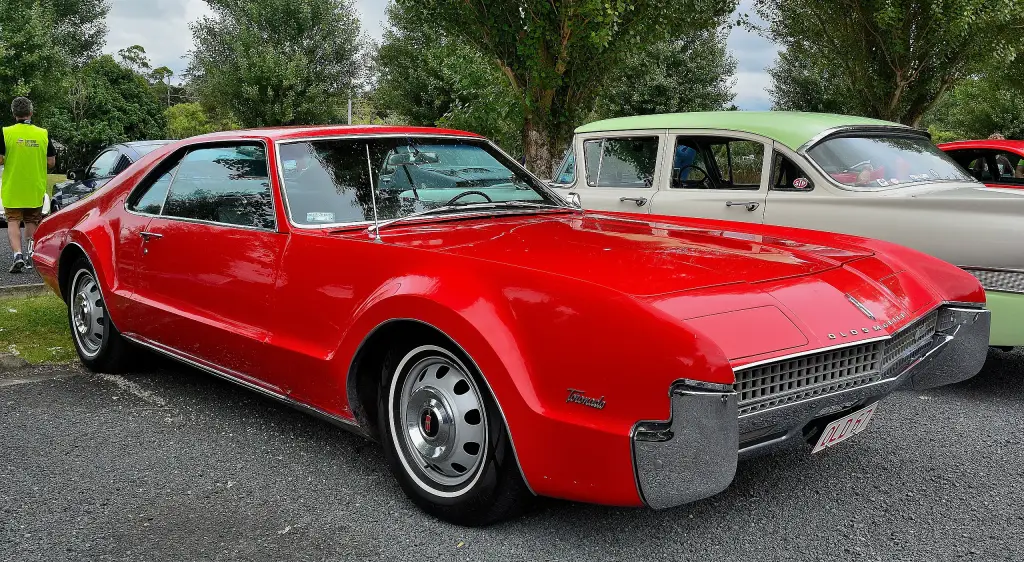
The Toronado began in 1962 as a design painting by Oldsmobile stylist David North, a compact sports and personal car never meant for production. Weeks later the division was told it could build a personal car for 1966 in the Riviera and Thunderbird class, and North’s design was chosen. For economy the car shared the E-body shell with the redesigned 1966 Buick Riviera, which was much larger than North had intended, and attempts to put it on the smaller A-body were overruled on cost. Oldsmobile had worked on front-wheel drive since 1958 under engineer John Beltz, who had also originated the 4-4-2.
The Unitized Power Package
The powertrain, called the Unitized Power Package, fitted a Rocket V8 and transmission into an engine bay no larger than that of a conventional rear-drive car, and its components covered 1.5 million test miles during seven years of development; it was later used almost unchanged in the GMC motorhome. The engine was a performance version of the 425 cu in Super Rocket V8 rated at 385 hp and 475 lb·ft, ten more horsepower than the Starfire version and twenty more than the standard Ninety-Eight engine. The TH425 transaxle separated the torque converter from the planetary gearset and drove it through a 2-inch Hy-Vo silent chain on 7.5-inch sprockets, sharing many parts with the rear-drive TH400. Firestone designed a special 8.85 by 15 inch tyre for the car. Front suspension used torsion bars, the first GM passenger car application in the United States, with unequal-length double wishbones, while the rear was a beam axle on single leaf springs with one vertical and one horizontal shock absorber. Brakes were 11-inch drums, generally seen as the car’s weak point; vented front discs became an option in 1967. The flat floor was a benefit of the layout, but the fastback roofline restricted rear headroom, and the 0–60 mph time was 9.5 seconds.
Four generations
The Toronado stayed in production for 26 years over four generations, sharing the E platform for most of that time with the Buick Riviera and, in front-wheel-drive form, the 1967 Cadillac Eldorado. Its name had no earlier meaning and was originally chosen for a 1963 Chevrolet show car.
Design and features
- Front-wheel drive: the first American front-drive car since the Cord 810 and 812.
- TH425 transaxle: torque converter driving the gearset by a Hy-Vo chain.
- Torsion-bar suspension: the first GM passenger car use of torsion bars in the US.
- Flat floor: a packaging benefit of the Unitized Power Package.
Oldsmobile Toronado versions
- First generation (1966–1970): the original 425 cu in front-drive coupe.
- Second generation (1971–1978): the later E-body car.
- Third generation (1979–1985): the downsized Toronado.
- Fourth generation (1986–1992): the final car, including the Trofeo version.
The Toronado sat at the top of the Oldsmobile range with the 98 and was eventually replaced by the Aurora. More models are in the Oldsmobile collection.
Video: Toronado 66
Video by FreakNick66 on YouTube.
Sources
- Oldsmobile Toronado, English Wikipedia: origins, powertrain, chassis, generations