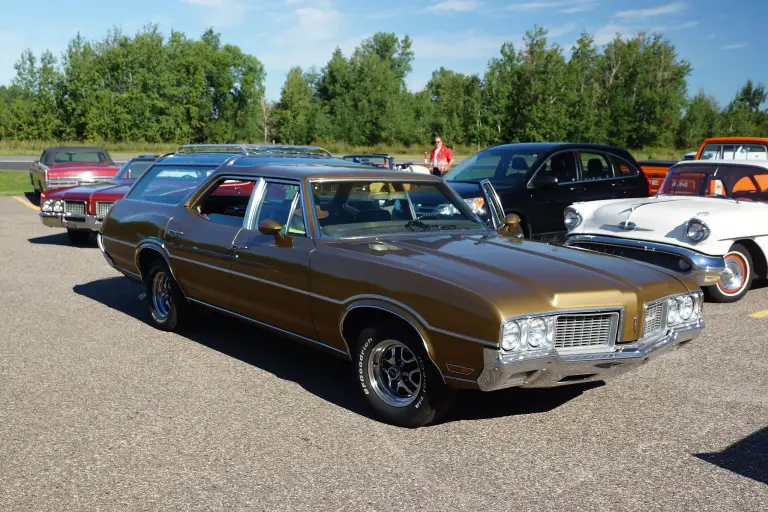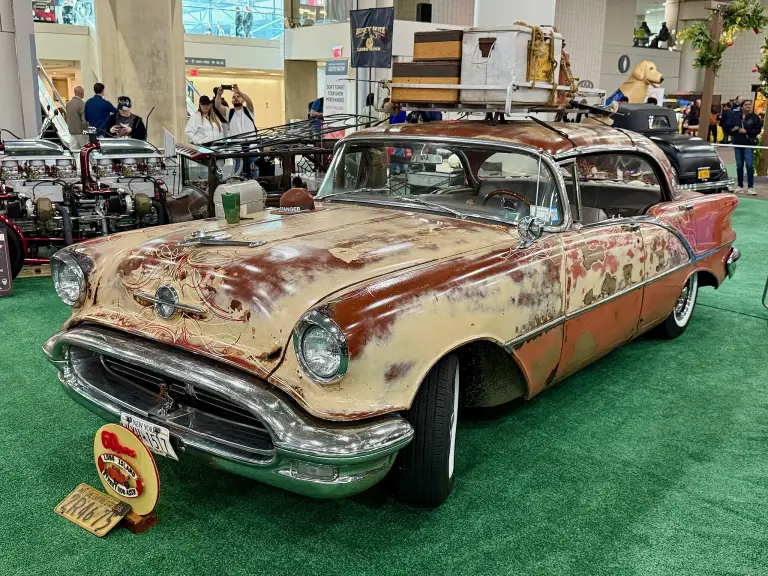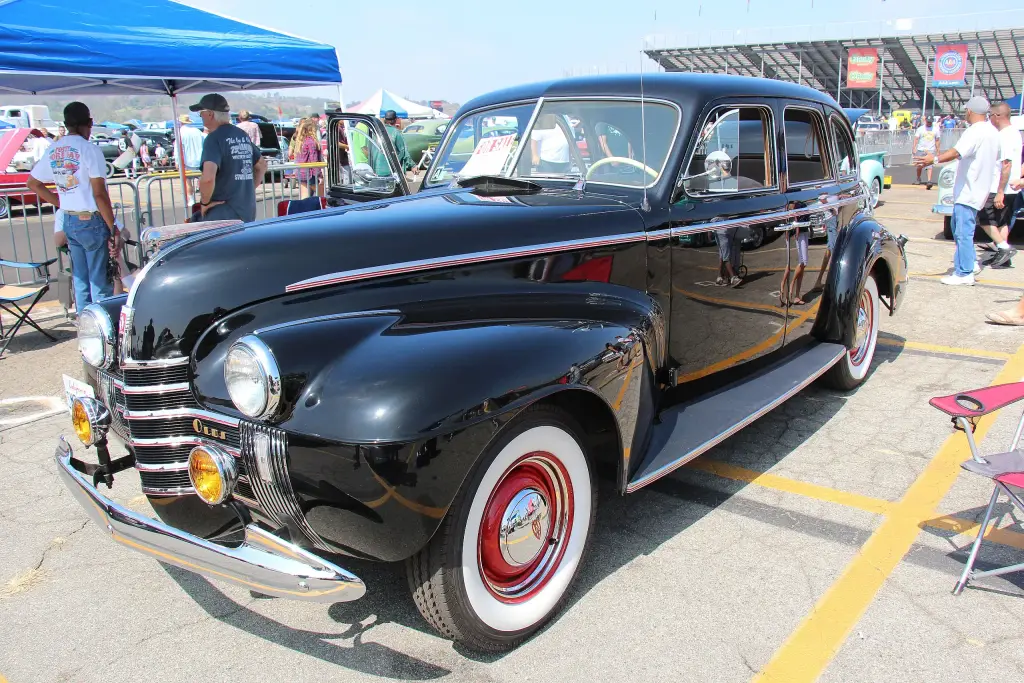
The Oldsmobile Series 70 was the mid-range full-size Oldsmobile from 1939 to 1950. It used the GM B-body, took the name Dynamic in 1940, was split into the six-cylinder 76 and eight-cylinder 78 in 1941, and finally made way for the Rocket V8-powered 88.
Oldsmobile Series 70 at a glance
| Maker | Oldsmobile Division, General Motors |
|---|---|
| Production | 1939–1950 model years |
| Class | full-size mid-range car |
| Platform | GM B-body |
| Name | Series 70, the “Dynamic” |
| Split in 1941 | 76 with a straight six, 78 with a straight eight |
| 1946 body styles | two-door Club Sedan and four-door Sedan |
| 1946 Dynamic 70 sedan | $1,568, 25,528 built |
| 1946 DeLuxe sedan | $1,678, 5,118 built |
| 1947 output | 38,152 Club Sedans and 30,841 four-door sedans |
| Electrical system | 6 volts |
| Final year | 1950, as the Seventy-Six |
History of the Oldsmobile Series 70
1939–1940: from Series L to Dynamic
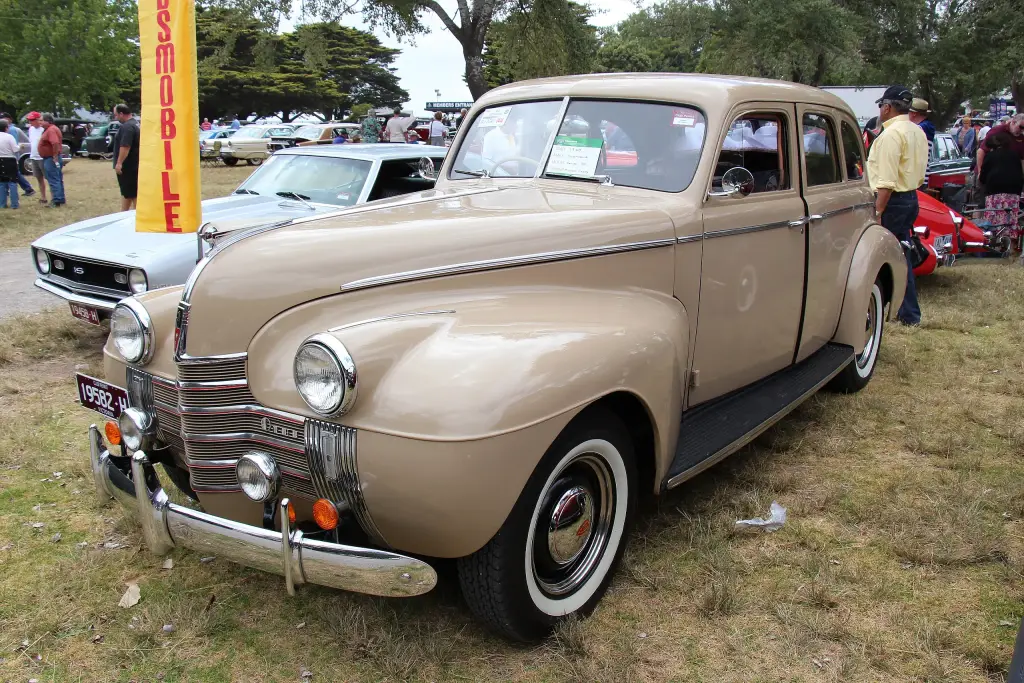
The Series 70 replaced the straight-eight Series L in 1939 and used the GM B-body, one step above the A-body Series 60. In 1940 the larger C-body arrived as the Series 90, and the three series were given names for the first time: the Series 60, 70 and 90 became the Special, Dynamic and Custom Cruiser. The fully clutchless Hydramatic automatic transmission made its debut in October 1939 for the 1940 cars.
1941–1948: the 76 and 78
In 1941 both engines were offered in each series, and the second digit showed the number of cylinders, so the Dynamic 70 became the Dynamic 76 and 78. From 1942 sales literature called the series the Dynamic Cruiser 76 and 78. After the wartime pause, the 1946 Dynamic Cruiser was Oldsmobile’s mid-priced model, offered as a two-door Club Sedan and a four-door Sedan. Equipment was modest, with a 6-volt electrical system, Bedford cord or broadcloth upholstery, dual sun visors, dual electric wipers and an automatic choke; the DeLuxe package added carpeted floor-mat inserts, full instruments and an electric clock. The standard car rode on 16-inch wheels and the DeLuxe on 15-inch wheels. The Dynamic 70 four-door sedan listed at $1,568 and the DeLuxe at $1,678, and the series was Oldsmobile’s most popular, with 38,152 Club Sedans and 30,841 four-door sedans built. The Dynamic 76 was also assembled in Australia, with fewer than 120 thought to have been made in 1947.
1949–1950: the Seventy-Six and the 88
The 1949 Futuramic styling reached the A-body, and the old Series 60 was replaced by the Seventy-Six, now spelled out and available only with the straight six on a 119.5 in wheelbase. The straight-eight 78 was retired when the Rocket V8-powered 88 arrived in 1949 and took over its platform. The Seventy-Six continued for 1950 as Oldsmobile’s entry model before being dropped, ending the numbered series below the 98.
Design and features
- GM B-body: a size above the entry-level A-body and below the C-body 98.
- Two engines, two numbers: the 76 had a straight six and the 78 a straight eight.
- DeLuxe trim: full instruments, an electric clock and carpeted mat inserts.
- Popular mid-range car: the Dynamic outsold both the Special and the Custom Cruiser in 1947.
Oldsmobile Series 70 versions
- Dynamic 70 (1940–1941): the first named version of the series.
- Dynamic 76: the six-cylinder car, also assembled in Australia.
- Dynamic 78: the straight-eight version, retired in 1949.
- Seventy-Six (1949–1950): the final, Futuramic-styled entry model.
The Series 70 sat above the Series 60 and below the 98; its place in the range passed to the 88. More models are in the Oldsmobile collection.
Sources
- Oldsmobile Series 70, English Wikipedia: history, models, prices, production
- Oldsmobile 70, German Wikipedia: production years, 76 and 78