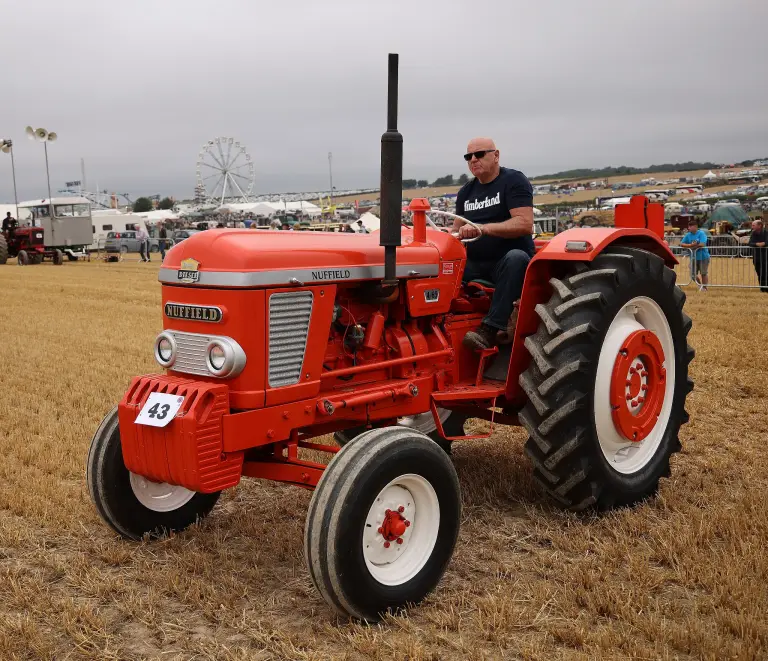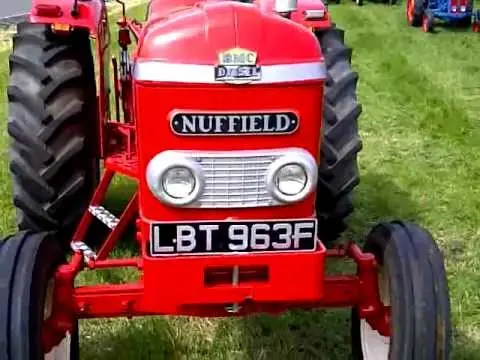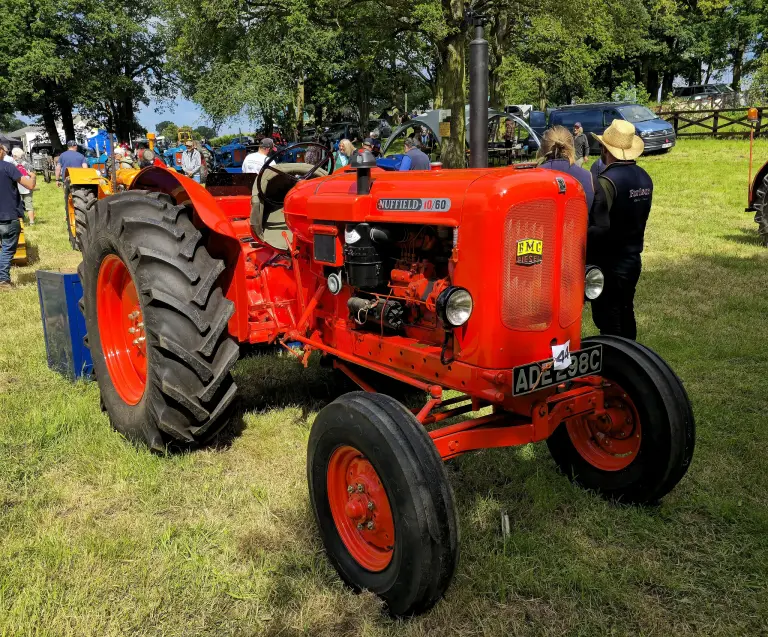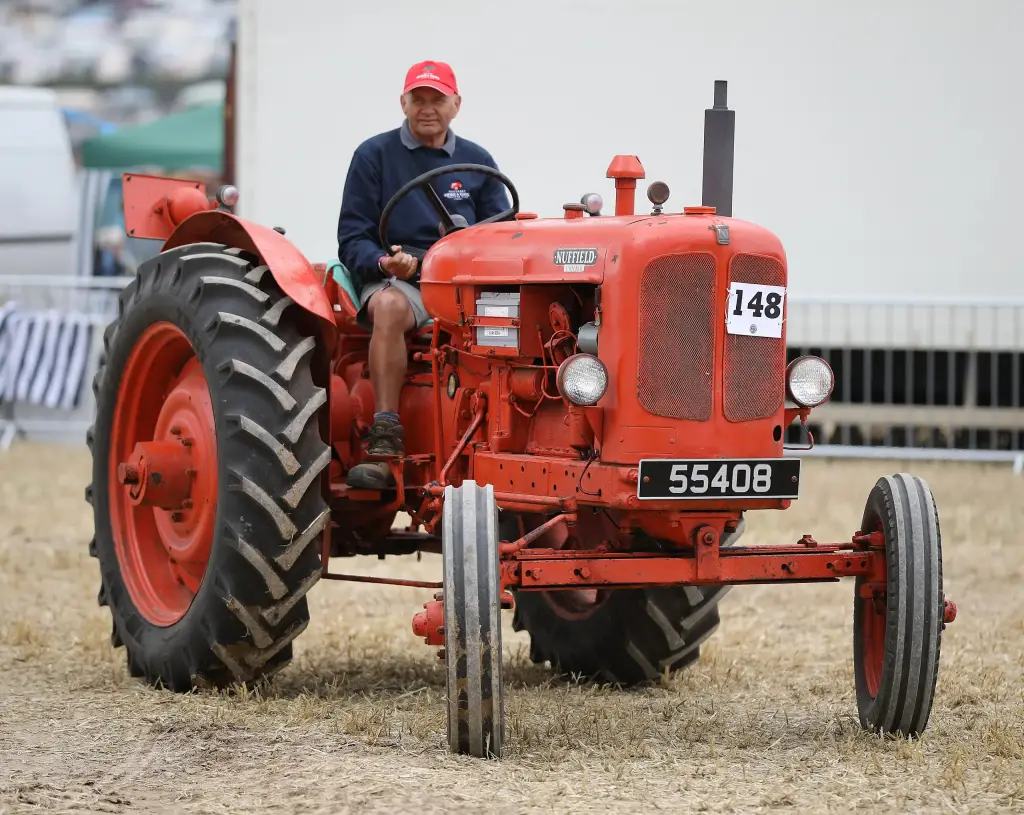
The Nuffield Universal was the first tractor to carry the Nuffield name. Launched at the Smithfield Show in December 1948 and built in Birmingham, it was offered with a petrol-paraffin engine and, from 1950, with diesel and petrol units, and it stayed in production until 1961.
Nuffield Universal at a glance
| Maker | Agricultural Division, Morris Motors, Birmingham |
|---|---|
| Production | 1948–1961 |
| Launched | Smithfield Show, December 1948 |
| Designer | Dr H. E. Merritt |
| Petrol-paraffin engine | 42 hp, based on the Morris Commercial four-cylinder lorry engine |
| First diesel | 38 hp Perkins P4 (TA) |
| BMC diesel | 45 hp from 1954, badged “BMC Diesel” |
| Gearbox | five speeds |
| Colour | “Poppy Orange” |
| Variants | M3, M4, DM4, PM4, 3DL, 4DM |
| Built | 5,008 M3/M4; 7,545 DM4; 3,653 PM4 |
| Successors | 3/42 and 4/60 from 1961 |
Based on one source, the English Wikipedia article on the Nuffield Universal.
History of the Nuffield Universal
In 1945, as part of its post-war recovery plans, the British Government approached the Nuffield Organisation and suggested that it design and build a new all-British tractor. Morris Motors accepted the idea, and in 1946 its vice-chairman Sir Miles Thomas told the I.S.M.A. at Hull that “Nuffield to Make Tractors”. The design was the work of Dr H. E. Merritt, a former David Brown tractor designer who had worked on the David Brown 50D and had been involved in tank design during the war, which is why the Nuffield followed the layout of the new David Brown tractors.
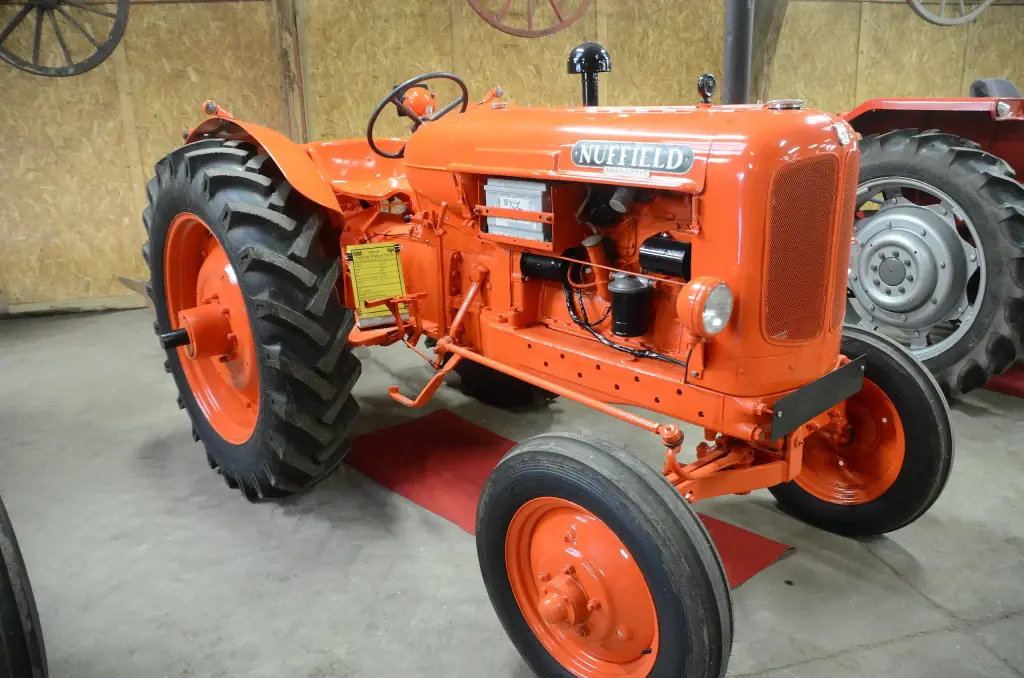
Tractor manufacture was set up in the former Wolseley factory in Birmingham, because car production had recently been moved to Cowley. A prototype was running by May 1946 and a further twelve were built before the end of that year, culminating in a demonstration at Pershore in December. Steel shortages then held the project back, and series production only began in 1948, with the Nuffield Universal launched at the Smithfield Show that December. The tractors were finished in a bright red-orange that the company called “Poppy Orange”, close in hue to the American Allis-Chalmers machines.
The first models were the four-wheeled Universal M4 and the tricycle-wheeled M3, intended for row-crop work; both used a five-speed gearbox and a 42 hp engine derived from the side-valve Morris Commercial four-cylinder lorry unit, running on tractor vaporising oil. Extras were charged for, a horn and lights costing £9. The first diesel followed in 1950: the DM4 used a 38 hp Perkins P4 (TA), and after Morris Motors became part of the British Motor Corporation in 1951 the Perkins engine was retained until 1954, when it gave way to a 45 hp BMC diesel; tractors with the new engine carried a “BMC Diesel” badge. A petrol version, the PM4, was sold alongside it.
Production was for the home market at first, but by 1950 export opportunities were being pursued. In the United States Nuffield tractors were imported and rebadged by Long Manufacturing; in the Netherlands they were first imported by Bautz and the Nuffield 4 was sold as the Nuffield “Vier”; in Spain the tractors were branded Sava Nuffield. The Universal range was steadily extended: the Universal 3 (3DL) and Universal 4 (4DM) of 1952–1961 replaced the earlier engines with a 2.55-litre three-cylinder of 37 hp and a 3.4-litre four-cylinder of 53 hp respectively. In 1961 the Universal gave way to the 3/42 and 4/60, the first Nuffield tractors to be built at Bathgate in Scotland.
Design and features
- A government brief: the Universal was designed after Whitehall asked the Nuffield Organisation for an all-British tractor in 1945.
- Two layouts: the M4 on four wheels and the tricycle M3 for row-crop work, both with a five-speed gearbox.
- Petrol-paraffin first: the original 42 hp engine ran on tractor vaporising oil, a cheap fuel of the period.
- Diesel from 1950: a Perkins P4 first, then a 45 hp BMC diesel badged “BMC Diesel”.
- Poppy Orange paint: a bright red-orange that became the Nuffield signature until 1969.
Nuffield Universal versions
- M4 (1948–1961): conventional four-wheel model with the 42 hp petrol-paraffin engine.
- M3 (1948–1961): single front wheel for row-crop work; 5,008 M3 and M4 tractors built in all.
- DM4 (1950–1961): diesel version, 38 hp Perkins P4 then 45 hp BMC; 7,545 built.
- PM4 (1950–1961): petrol version with a 48 hp engine; 3,653 built.
- Universal 3 / 3DL (1952–1961): 2.55-litre three-cylinder, 37 hp.
- Universal 4 / 4DM (1952–1961): 3.4-litre four-cylinder, 53 hp.
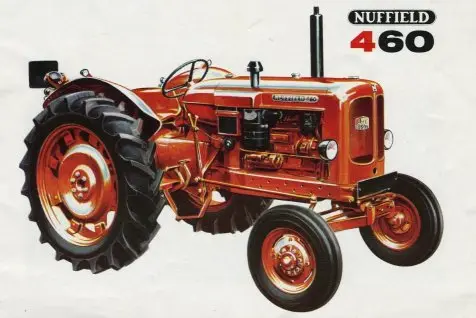
The Universal was replaced by the four-cylinder Nuffield 460 generation and, later, by the 10 series. The four-cylinder versions are described on the Nuffield 4 page, and more tractors are in the Nuffield collection.
Video: Nuffield Universal four cold start
Video on YouTube.
Sources
- Nuffield Universal, English Wikipedia: history, engines, variants, production figures