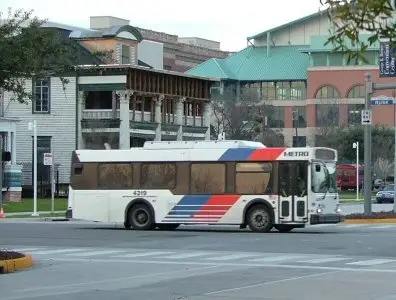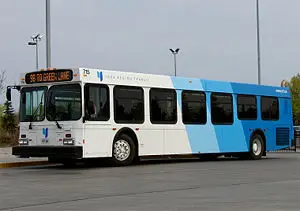
The New Flyer D60LF is the articulated member of New Flyer’s Low Floor family: a 60-foot diesel bus with a joint in the middle, built for routes that need the capacity of an articulated vehicle but the easy boarding of a low floor. It was the first low-floor articulated bus in North America.
New Flyer D60LF at a glance
| Maker | New Flyer Industries |
|---|---|
| Class | low-floor articulated transit bus |
| Family | New Flyer Low Floor, 1991–2014 |
| Variant code | D diesel, 60 feet, LF low floor |
| Length | 60 feet nominal, articulated |
| Body style | original Low Floor |
| Assembly | Grand Forks, North Dakota |
| First articulated Low Floor | 1995, according to New Flyer |
| First sale | 1996, ex-demonstration unit to Strathcona County Transit, Alberta |
| Position | longest of the four Low Floor lengths |
The D60LF is described within the English Wikipedia article on the Low Floor series, so this page is based on one source.
History of the New Flyer D60LF
From a Dutch bus
The Low Floor family was derived from the B85 and B86, buses built from 1984 to 1988 by Den Oudsten of the Netherlands, which owned New Flyer from 1986 to 2002. A B85 was sent to the United States for testing in 1988 and became the basis of the range. Production started in 1991 at New Flyer’s plant in Grand Forks, North Dakota, with the 40-foot D40LF.
1995–1996: the articulated low floor
The articulated version followed within a few years. New Flyer lists the D60LF of 1995 as the first low-floor articulated bus built for the North American market. The first example sold was an ex-demonstration unit, delivered in 1996 to Strathcona County Transit in Alberta. That timing put New Flyer ahead of the other North American builders in a class of bus that would become standard on high-demand urban corridors.
Body styles and the end of the line
Like the rest of the family, the D60LF was offered in the original Low Floor body and later in the Restyled and Advanced styles introduced in 2005. New Flyer had already tried to replace the whole Low Floor line with the Invero series in 1999, but few Inveros were sold and the model was dropped in 2007. The real successor was the Xcelsior series of 2008. The LFA style ended in 2010, the original Low Floor style in 2013 and the LFR in 2014, which closed the Low Floor programme.
Design and features
- 60-foot articulated body: two sections joined in the middle, the longest of the four Low Floor nominal lengths from 30 to 60 feet.
- Low floor: step-free boarding along the passenger area, the feature that defined the whole family.
- Diesel power: the D prefix marks the conventional diesel version of the articulated bus.
- First of its kind: named by New Flyer as the first low-floor articulated bus in the North American market.
New Flyer D60LF versions
- D60LF: diesel, 60-foot articulated, original styling.
- DE60LF: diesel-electric hybrid articulated bus, listed by New Flyer as the first hybrid articulated bus, from 2002.
- DE60LFR: the diesel-electric hybrid articulated bus with the Restyled body.
- E60LFR: the articulated trolleybus version of the Restyled body.
The 40-foot member of the family, and the most common one, is the D40LF; the short rigid version is the D30LF. The earlier high-floor articulated bus is covered with the D40HF, and the whole range is in the New Flyer collection.
Video: Vancouver Translink 1998 New Flyer D60LF B8012
Video on YouTube.
Sources
- New Flyer Low Floor, English Wikipedia: design origin, production, first articulated unit, body styles, end of production