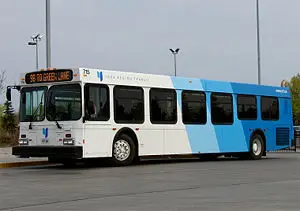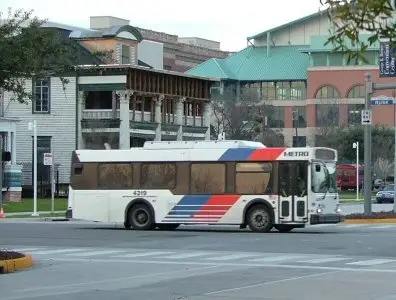
The New Flyer D30LF is the 30-foot version of New Flyer’s Low Floor transit bus. In a family built in four nominal lengths from 30 to 60 feet, it was the compact end of the range.
New Flyer D30LF at a glance
| Maker | New Flyer Industries |
|---|---|
| Class | low-floor transit bus |
| Family | New Flyer Low Floor, 1991–2014 |
| Variant code | D diesel, 30 feet, LF low floor |
| Length | 30 feet nominal, rigid |
| Body style | original Low Floor |
| Assembly | Grand Forks, North Dakota |
| Family lengths | four, from 30 to 60 feet |
| Variants in family | 38 |
| Position | the shortest Low Floor length |
The D30LF is described within the English Wikipedia article on the Low Floor series, so this page is based on one source.
History of the New Flyer D30LF
A family in four lengths
The New Flyer Low Floor was a range rather than a single bus. It was sold in four nominal lengths, from 30 to 60 feet, in three body styles and with several powertrains, and the factory listed 38 individual variants. Each variant was named for its powertrain, its length and its body style: the D stands for diesel, the number for the nominal length in feet and LF for Low Floor. The D30LF therefore sits at the short end of the range, below the longer rigid buses and the 60-foot articulated one.
Dutch origins, American production
The design came from the B85 and B86, European buses built from 1984 to 1988 by Den Oudsten, the Dutch company that owned New Flyer from 1986 to 2002. A B85 was tested in the United States in 1988 and formed the basis of the Low Floor. Production began in 1991 at the Grand Forks plant in North Dakota, and the first bus built was a D40LF delivered to the Port Authority of New York and New Jersey in 1992. The 40-foot bus was the first low-floor bus sold in the United States and Canada, and the shorter 30-foot model followed in the same programme.
Two more body styles, then the end
In 2005 New Flyer added the Restyled (LFR) and Advanced (LFA) bodies, the second aimed at bus rapid transit, and sold them alongside the original style. The Low Floor was meant to be replaced by the Invero of 1999, but that model sold poorly and was dropped in 2007. The Xcelsior series of 2008 became the real successor. The LFA body ended in 2010, the original Low Floor style in 2013 and the LFR in 2014, when the whole Low Floor family went out of production.
Design and features
- 30-foot body: the shortest of the four Low Floor lengths, a rigid bus without an articulation joint.
- Low floor: step-free boarding, the defining feature of the family and the reason transit agencies moved away from high-floor buses.
- Diesel power: the D prefix marks the conventional diesel version; the family also offered natural gas and hybrid electric variants.
- Original styling: the first Low Floor body, produced until 2013 alongside the later Restyled and Advanced styles.
New Flyer D30LF versions
- D30LF: diesel, 30-foot rigid, original styling.
- D60LF: the 60-foot articulated diesel.
- Restyled and Advanced bodies: the LFR and LFA styles added in 2005.
The 40-foot and articulated members of the same range are the D40LF and the D60LF; the earlier high-floor bus is the D40HF. More buses are in the New Flyer collection.
Sources
- New Flyer Low Floor, English Wikipedia: naming scheme, lengths, production dates, body styles