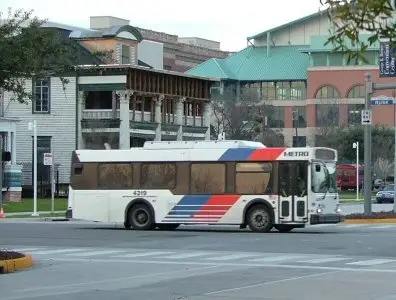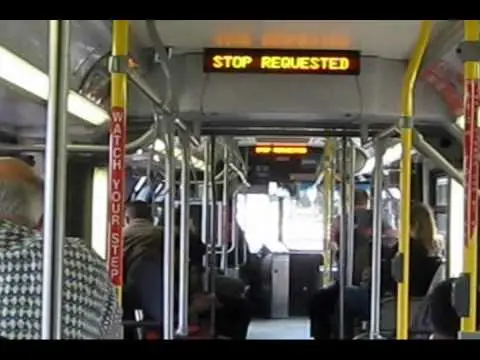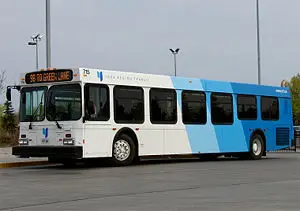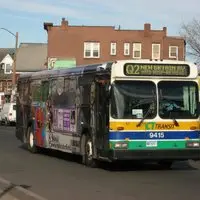
The New Flyer D40HF is the 40-foot rigid diesel member of New Flyer’s High Floor line, the conventional transit bus family that the company built from 1987. It has a stepped floor in the traditional way, an engine at the rear, and a body assembled on a tubular side frame.
New Flyer D40HF at a glance
| Maker | New Flyer Industries |
|---|---|
| Class | high-floor transit bus |
| Family | New Flyer High Floor, 1987–2006 |
| Model code | D40, a 40-foot rigid diesel |
| Length | 40 feet nominal, rigid |
| Powertrain | rear-mounted diesel, V- or T-drive |
| Body | tubular side frame with aluminium or fibreglass panels |
| First deliveries | 1987, Toronto Transit Commission and Winnipeg Transit |
| Diesel rigid production | to 1996 |
| Family production | to 1999 for natural gas, early 2006 for the articulated bus |
The D40HF is the 40-foot rigid diesel member of the High Floor line described in the English Wikipedia article on that series, so this page is based on one source.
History of the New Flyer D40HF
1987: the first High Floors
New Flyer’s High Floor range covered 35-foot and 40-foot rigid buses and a 60-foot articulated model. The first buses were D40-87s, delivered in 1987 to the Toronto Transit Commission and Winnipeg Transit. In the early numbering the last two digits gave the model year, so a D40-88 was a 40-foot rigid high-floor bus with conventional diesel power built in 1988. That suffix was used from 1987 to 1990; after that the model number stood alone, while the low-floor buses that followed in 1991 carried the LF suffix. The articulated D60 high floor was named Galaxy, though the name was not widely used.
How the bus was built
The High Floor used a tubular side construction clad in aluminium or fibreglass panels. The wheel housings were stainless steel, and buyers could have stainless steel or fibreglass stepwells. To save weight, the roof and the front and rear panels were made of fibreglass. Every bus had its engine at the rear, driving through either a V-drive or a T-drive coupling to the rear axle. In the articulated D60 the pusher layout meant the joint needed an anti-jackknifing feature.
Overtaken by the low floor
The High Floor was joined in 1991 by the Low Floor, which looked similar from outside but had no steps at the doors. The low-floor bus proved far more popular with transit agencies. New Flyer stopped the diesel rigid High Floor in 1996, while natural-gas high-floor buses continued until 1999 and the articulated version until early 2006. Among the High Floor customers, AC Transit was the first to take the D35-88 in 1988, together with Santa Cruz METRO, and the first to take the articulated D60 in 1989. Natural-gas deliveries began in 1995 with the C40 for BC Transit, Los Angeles County Metropolitan Transportation Authority and San Diego Metropolitan Transit System, and the L40 for Sun Metro in El Paso.
Design and features
- 40-foot rigid body: the standard city-bus length of the range, between the 35-foot and the 60-foot articulated models.
- Rear engine: a conventional diesel mounted at the back, coupled by a V-drive or a T-drive.
- Tubular side frame: aluminium or fibreglass panels over a tubular structure, with stainless steel wheel housings.
- Lightweight top: fibreglass roof, front and rear panels kept the weight down.
- Conventional floor: steps at the doors, the layout that the Low Floor series replaced.
New Flyer D40HF versions
- D40-87: the first 40-foot rigid diesel, built in 1987.
- D40-88 and later D40: the same bus with the model-year suffix, then without it after 1990.
- D35-88: the 35-foot rigid version, first sold to AC Transit in 1988.
- C40 and L40: natural-gas versions of the 40-foot bus, delivered from 1995.
- D60 Galaxy: the 60-foot articulated high-floor bus.
The bus that replaced this generation is the D40LF; the articulated low-floor model is the D60LF, and the short one is the D30LF. The rest of the range is in the New Flyer collection.
Video: 1990 NewFlyer D40HF Ex-OCTA # 5114 ( retired )
Video on YouTube.
Sources
- New Flyer High Floor, English Wikipedia: production dates, model codes, construction, first customers