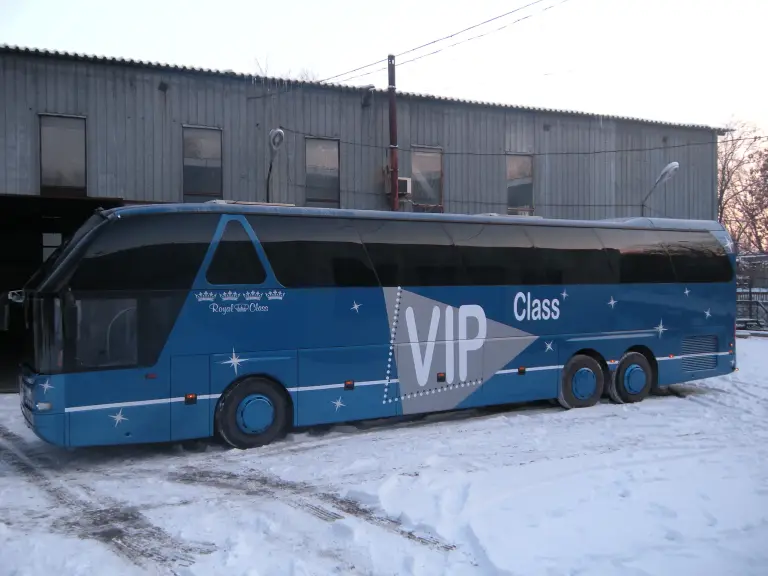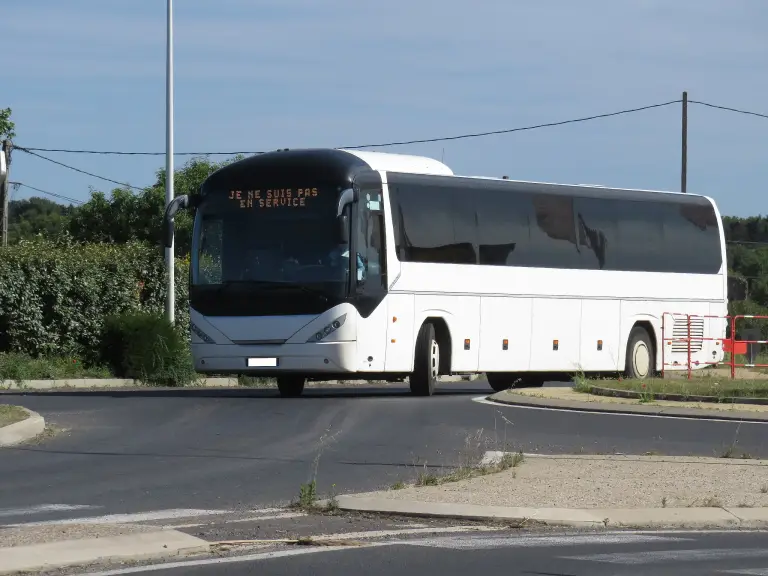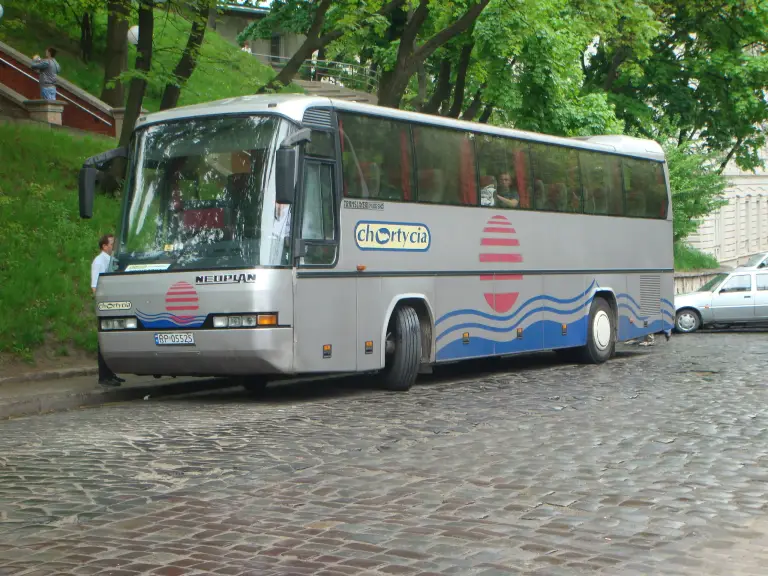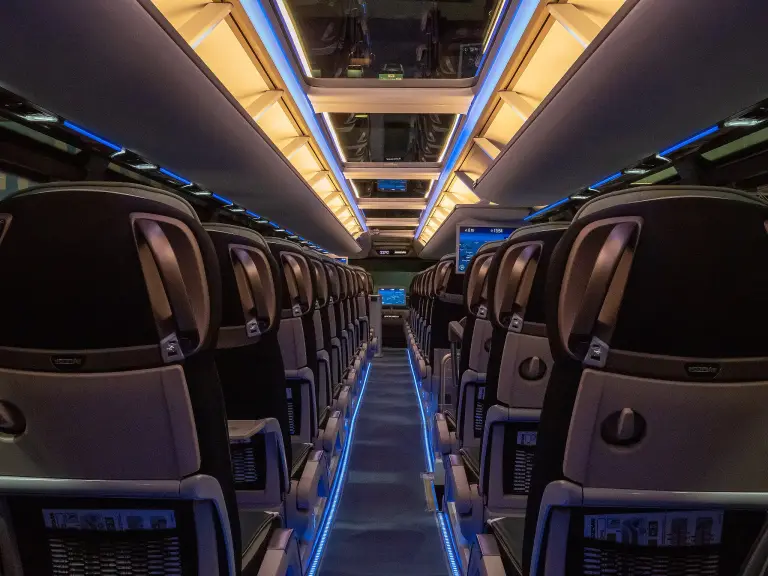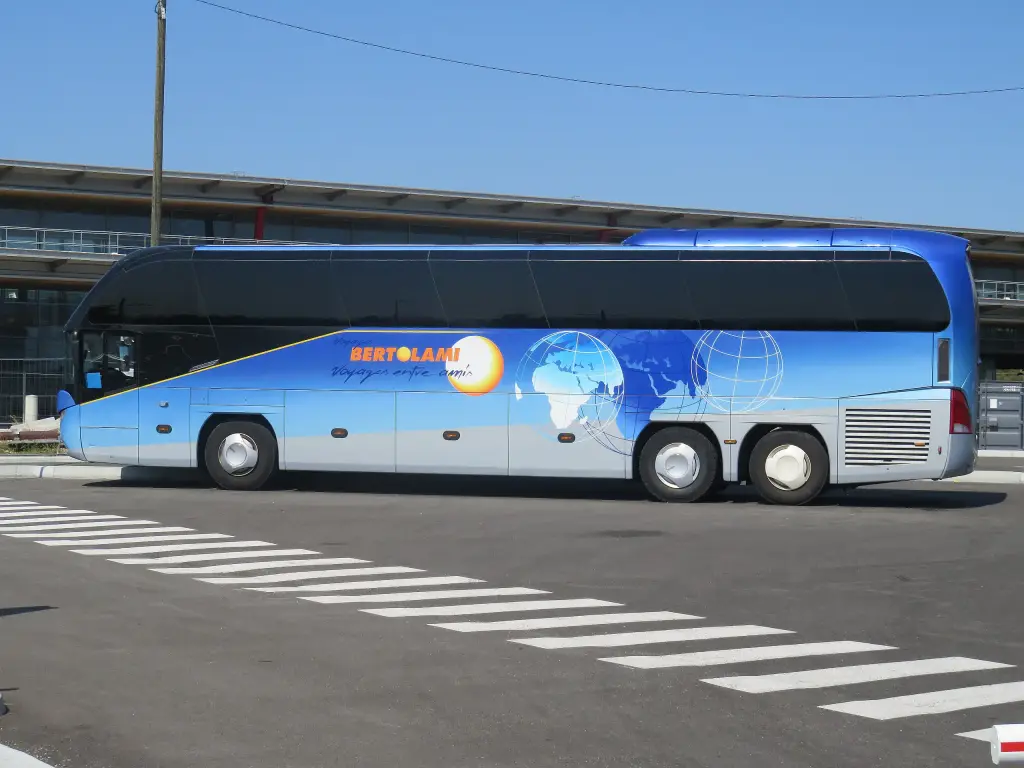
The Neoplan Cityliner is a high-deck touring coach that has been built since 1971, first by Gottlob Auwärter in Stuttgart and later by Neoplan under MAN ownership. Its passenger floor sits above the driver’s cab, and the raised seating gave travellers a better view and enough space below the floor for a toilet, a kitchen and more than ten cubic metres of luggage.
Neoplan Cityliner at a glance
| Maker | Neoplan, Gottlob Auwärter, Stuttgart; MAN after 2001 |
|---|---|
| Class | high-deck touring coach |
| First shown | 20th International Omnibus Week, Monaco, 1971 |
| Height | 3.55 m from 1973 |
| Boot | over 10 m³ at first; 15.6 m³ with the Cityliner-Hoch of 1990 |
| Third Cityliner built | early 1992 |
| US production | Lamar, Colorado, from 1986 |
| Platin-Edition | 1995, 60 vehicles |
| Built by 2006 | more than 6,500 |
| Latest generation | 2006, based on the Starliner II |
| Award | Coach of the Year 2022, chosen in October 2021 |
The model history follows the German Wikipedia article on the Cityliner; the English article on Neoplan supplies the company background.
History of the Neoplan Cityliner
1970s: the high deck arrives
The Cityliner was presented at the 20th International Omnibus Week in Monaco in 1971. Its passenger compartment sat high, with the upper part of the side windows curved, so passengers looked over the traffic instead of at it. The layout gave the German term Hochdecker to the whole industry. The height allowed a luggage bay of more than ten cubic metres and let Neoplan fit the toilet and kitchen under the floor, which freed space for two extra passenger seats. In 1973 the coach grew to 3.55 m, received glued side windows and a one-piece upper windscreen, and a three-axle version with air conditioning and double glazing joined the range. At first Neoplan distinguished a Cityliner for city tours, with a sliding roof, from an Intercityliner for longer journeys; because Deutsche Bundesbahn claimed the Intercity name, the company used only Cityliner from 1974.
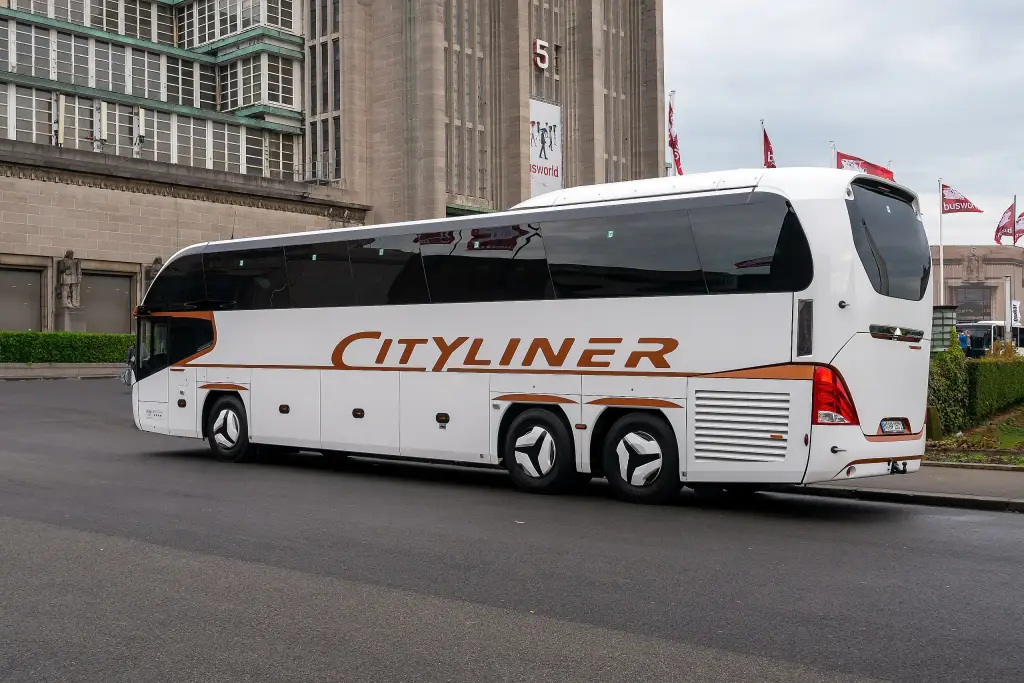
1980s: the fourth generation
A revised Neoplan range in 1981 brought a new front, new wheel arches, a rounded lower body edge and a closed, rollover-resistant rear to the Cityliner. For the company’s 50th anniversary in 1985 the fourth generation arrived with a rear compact air-conditioning unit and electronic automatic control, energy-absorbing PUR bumpers front and rear, and polyellipsoid headlights, used for the first time in bus building. In 1986 production for the United States began at the Neoplan plant in Lamar, Colorado, with a 13.7 m three-axle version.
1990s: editions and variants
In 1990 the range gained the Cityliner-Hoch, 16 cm taller, with the luggage bay enlarged to 15.6 m³. The three-thousandth Cityliner was built in early 1992. Updates in 1993 and 1994 brought a redesigned dashboard and a revised air-conditioning system together with a changed front and rear; twin headlamp units gave way to triple units, and coaches longer than 12 m appeared, among them the 15 m N118/3(H). For the 60th anniversary in 1995 Neoplan built the Platin-Edition, 60 coaches in stainless-steel look with a driver’s door, laser distance control, seat belts at every seat, satellite navigation, a hands-free phone and a video system. A 13.7 m variant, the N116/3HL, joined the programme in 1996, taking it to eight versions, and from 1998 the Cityliner was also built under licence in Mexico and South Africa, later in China.
After 2000: N1116 and the 2006 generation
A Cityliner 2000 study was shown at the IAA in 2000. With Euro 3 in 2001 the programme was cut to three variants — the 12 m N1116, the 12 m three-axle N1116/3 and the 13.7 m three-axle N1116/3HL — carrying the fifth-generation updates with triple round headlamp units and a trapezoidal rear window. In 2003 the Comfort series reached the Cityliner with the 12.84 m Cityliner HC. The Edition 2006 marked 35 years of the model with a special paint finish; by then more than 6,500 Cityliners had been built, and the edition closed the chapter on the Auwärter-developed base. In July 2006 Neoplan presented a new Cityliner generation on the chassis platform of the Starliner II, with diamond-cut side windows instead of the former curved shape. In October 2021 the Cityliner was chosen Coach of the Year 2022.
Design and features
- Raised passenger deck: the floor above the driver’s cab improves the view and creates room underneath for service equipment.
- Split windscreen: a horizontally divided screen with the upper pane leaning back, and slanted side-window pillars, run through every generation.
- Underfloor fitting: toilet and kitchen below the passenger floor released space for extra seats.
- Glass-fibre reinforced plastic: the 1971 coach used GRP body sections, the first use of the technique according to the English Wikipedia article on Neoplan.
- Continuous updating: a new front in 1981, a compact rear climate unit in 1985, triple headlamps in the 1990s and a new platform in 2006.
Neoplan Cityliner versions
- Cityliner (1971 onwards): the standard high-deck coach, with a sliding roof for city tours in the early years.
- Intercityliner (to 1974): the long-distance version, dropped when the Intercity name went to Deutsche Bundesbahn.
- Cityliner-Hoch (1990): 16 cm taller, with a 15.6 m³ luggage bay.
- Platin-Edition (1995): 60 coaches with stainless-steel trim and a driver’s door.
- N1116 range (2001): three Euro 3 variants from 12 m to 13.7 m.
- Cityliner HC (2003): a 12.84 m High Comfort three-axle coach.
- 2006 generation: built on the Starliner II platform with diamond-cut side windows.
The Cityliner sat below the Starliner as Neoplan’s volume touring coach, and its later generation shared that model’s platform. For the double-deck alternative see the Skyliner, and for the rest of the range the Neoplan collection.
Sources
- Neoplan Cityliner, German Wikipedia: generations, dates, editions, production totals
- Neoplan, English Wikipedia: 1971 introduction, floor layout, GRP body