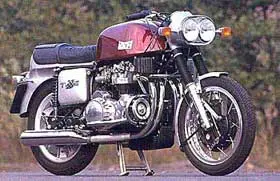
The Münch 4 was the four-cylinder motorcycle with which Friedel Münch turned a German car engine into one of the fastest and most expensive bikes of its day. The first machines of 1966 used a 996 cc NSU engine; from 1968 the model took the 1,177 cc unit of the NSU 1200 TTS and was called the Münch 4 1200 TTS. Every one was hand-built to order in Nieder-Florstadt, near Friedberg in West Germany, and fewer than 500 are thought to have been made.
Münch 4 at a glance
| Maker | Friedel Münch, Nieder-Florstadt, West Germany |
|---|---|
| Production | hand-built to order; the Münch 4 1200 TTS from 1968 |
| Engine, 1966 | 996 cc NSU air-cooled four, chain-driven single overhead camshaft |
| Engine, 1968 | 1,177 cc NSU TTS car engine |
| Power | 43 or 52 hp on early machines; 88 hp on the 1200 TTS; 100 hp with injection |
| Carburettors | one, two or four on early machines; two Weber 40DCOE on the 1200 TTS; Kugelfischer mechanical injection by 1973 |
| Frame | brazed steel tube, based on Norton Featherbed principles |
| Transmission | four-speed gearbox, gear primary drive, enclosed chain final drive |
| Brakes and wheels | 10 in (250 mm) front drum; cast magnesium rear wheel |
| Weight and speed | about 650 lb for the later machines (480 lb in 1966); 115 mph in 1966 |
| Price | $3,995 in 1969, against $1,695 for a BMW R69S |
| Estimated built | fewer than 500 |
Based on one source: the English Wikipedia article on Münch motorcycles, which covers the Münch 4 in its production section.
History of the Münch 4
From Horex to the first Mammut
Friedel Münch began as a mechanic and engine tuner in the late 1940s, working mainly on Horex motorcycles. The Horex factory noticed how well his home-tuned racers went and gave him a job in its competition department. When Horex stopped building motorcycles in 1956, Münch bought up the remaining stocks of machines and spares and sold race-tuned Horex cafe racers from his workshop in Altenstadt. In 1966 he received a commission from Jean Murit, a former sidecar racer and then president of the BMW Club of France, for a special to ride at the head of the procession from Val d’Isère to the Col de l’Iseran. Münch built it around a 996 cc air-cooled NSU car engine with a chain-driven single overhead camshaft, in a brazed steel tube frame following Norton Featherbed principles. Buyers could order one, two or four carburettors with 43 or 52 hp, a four-speed gearbox, gear primary drive, an enclosed chain and one of Münch’s 10 in (250 mm) front brakes.
The Münch 4 1200 TTS
In 1968 Münch replaced the 996 cc unit with the new 1,177 cc NSU TTS car engine and called the result the Münch 4 1200 TTS. With 88 hp the machine broke the heavy-duty spokes of its rear wheel, so Münch designed a much stronger cast magnesium wheel, keeping a spoked wire wheel at the front. The fuel tank and side panels were hand-hammered aluminium, while the seat, headlamp binnacle, wheels and brakes were magnesium. Even so the machine weighed 650 lb. The name Mammut was never used officially, because Maschinenfabrik Berner & Co held the copyright after using it in the interwar years, so Münch’s motorcycles were sold as Münch TT. In the United States the entrepreneur Floyd Clymer invested from 1968 and marketed the bike as the Clymer-Münch Mammoth IV under the slogan “Built up to a standard, not down to a price”; he died before serious production could begin.
Price, injection and survivors
Hand-built machines were always expensive. In 1969 a Münch sold for $3,995 while a BMW R69S cost $1,695, and a $1,000 initial payment secured an order that included duty, excise tax and air freight to any location in the United States. The 1200 TTS came with a pair of Weber 40DCOE carburettors; by 1973 Kugelfischer mechanical fuel injection was available on the 1200 TTS-E (Einspritzer), raising output to 100 hp. It is estimated that fewer than 500 machines were produced in all. Owners included Jay Leno and Malcolm Forbes, who had two and gave one to Elizabeth Taylor; George Barber’s 1972 Mammut TTS is displayed at the Barber Motorsports Museum in Leeds, Alabama, and a Münch 1200 TTS carried Gérard Depardieu through the 2010 film Mammuth.
Design and features
- Car engine: a four-cylinder NSU unit adapted to a motorcycle, 996 cc in 1966 and 1,177 cc from 1968.
- Cast magnesium rear wheel: designed after the 88 hp engine broke the heavy-duty spokes of the spoked wheel.
- Lightweight bodywork: hand-hammered aluminium for the tank and side panels, magnesium for the seat, headlamp binnacle and brakes.
- Big front brake: Münch’s 10 in (250 mm) drum, cast in magnesium.
- Built to order: hand-built in Nieder-Florstadt and priced well above a top-of-the-range BMW.
Münch 4 versions
- First Münch (1966): 996 cc NSU engine with 43 or 52 hp, 115 mph, sold as the Münch TT.
- Münch 4 1200 TTS (1968): 1,177 cc NSU TTS engine, 88 hp, cast magnesium rear wheel and aluminium tank.
- Clymer-Münch Mammoth IV: the version marketed in the United States by Floyd Clymer from 1968.
- 1200 TTS-E (by 1973): Kugelfischer mechanical fuel injection and 100 hp.
The 1,177 cc engine came from the NSU 1200 TTS car, and Münch learned his trade on Horex motorcycles. More machines are in the Münch collection.
Video: 45 Jahre Münch Motorräder, Hessenschau
Video on YouTube.
Sources
- Münch (motorcycles), English Wikipedia: history, engine, production, price