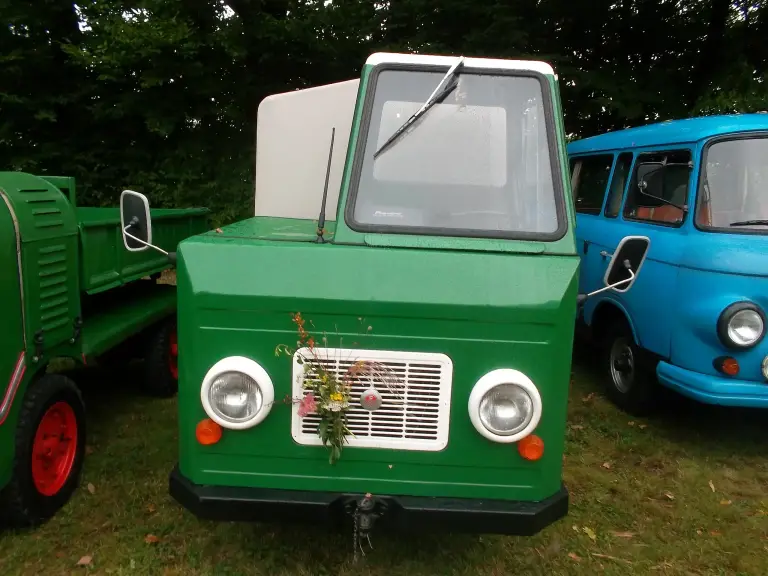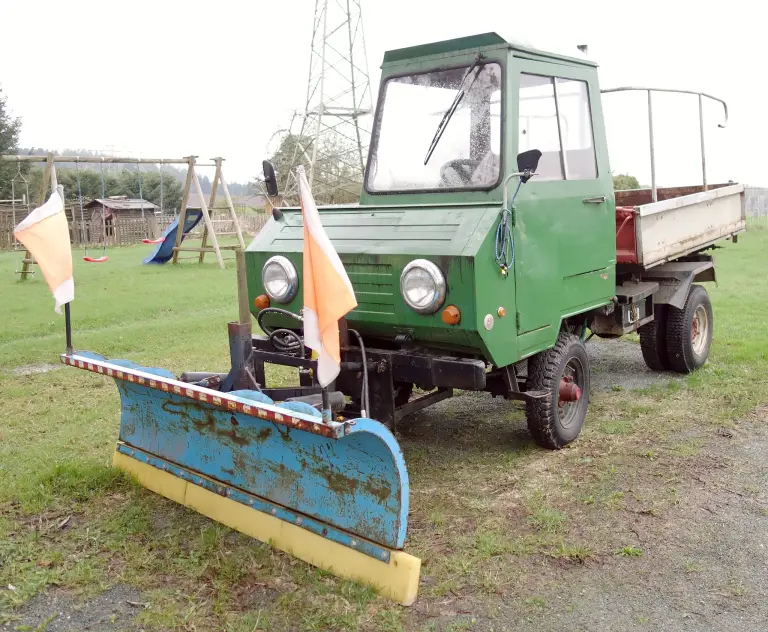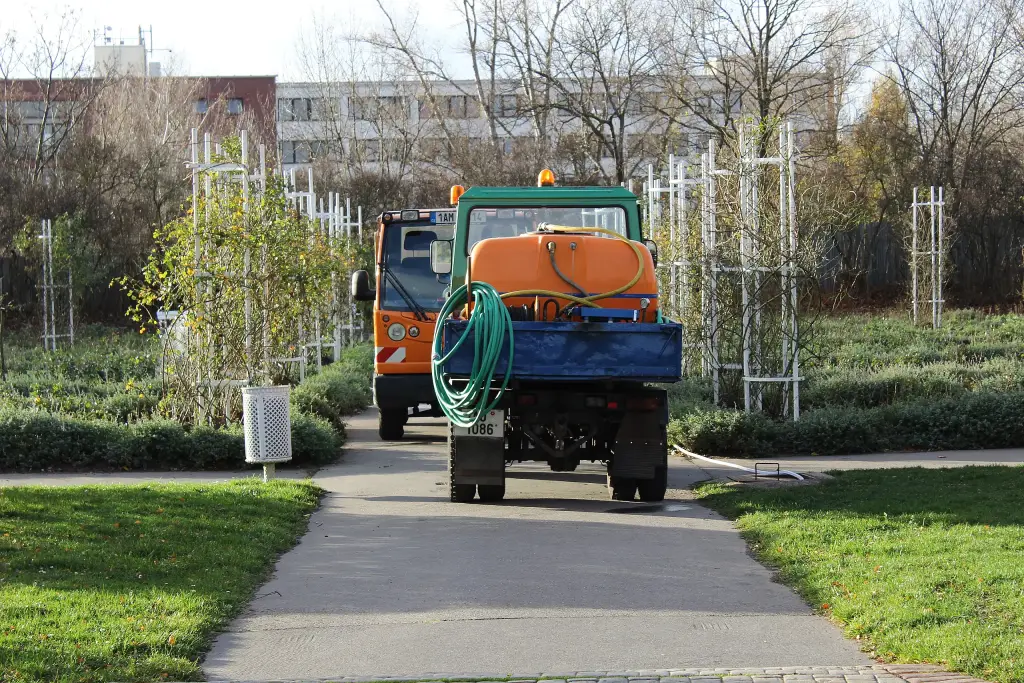
The Multicar 25 was the fifth series of the Waltershausen mini truck and the direct successor of the Multicar 24. Presented at the Leipzig autumn fair in 1978, it offered a more comfortable cab, a 45 hp diesel and bodies that could be changed within an hour. It stayed in production until 1991, and with the transitional Model 91 it reached a total of 100,546 vehicles.
Multicar 25 at a glance
| Maker | VEB Fahrzeugwerk Waltershausen |
|---|---|
| Production | 1978–1991, Model 91 until 1992 |
| Predecessor | Multicar 24 |
| Successor | Multicar 26 |
| Payload | 2 tonnes, fifth series |
| Engine | 4 VD 8.8/8.5-2 SRF four-cylinder diesel, 45 hp (33 kW) |
| Engine from 1985 | 2238 cc, 46 hp (34 kW) |
| Model 91 engine | Volkswagen 028.B, 1896 cc, 54.4 hp (40 kW) |
| Cab | tilts forward 42 degrees, central lock between the seats |
| Bodies | changed in about an hour, fixed with four screws |
| Award | GDR quality mark Q, January 1979 |
| Built | 100,546 including the Model 91 |
The Multicar 25 has no article of its own in English Wikipedia; this page is based on the German Wikipedia article on the model and on the English article about the Multicar brand.
History of the Multicar 25
Building and testing of the prototype began in 1978, and the new truck was shown at the Leipzig autumn fair of the same year, where it received a gold medal and other awards. Its number again combined two tonnes of payload with the fifth series. The Multicar 25, together with the Simson S 50, was one of the few vehicles of the GDR to receive the highest quality mark Q, awarded in January 1979. Both were also among the few East German vehicles whose basic concept survived the political change of 1989–90 in the market.
What changed from the Multicar 24
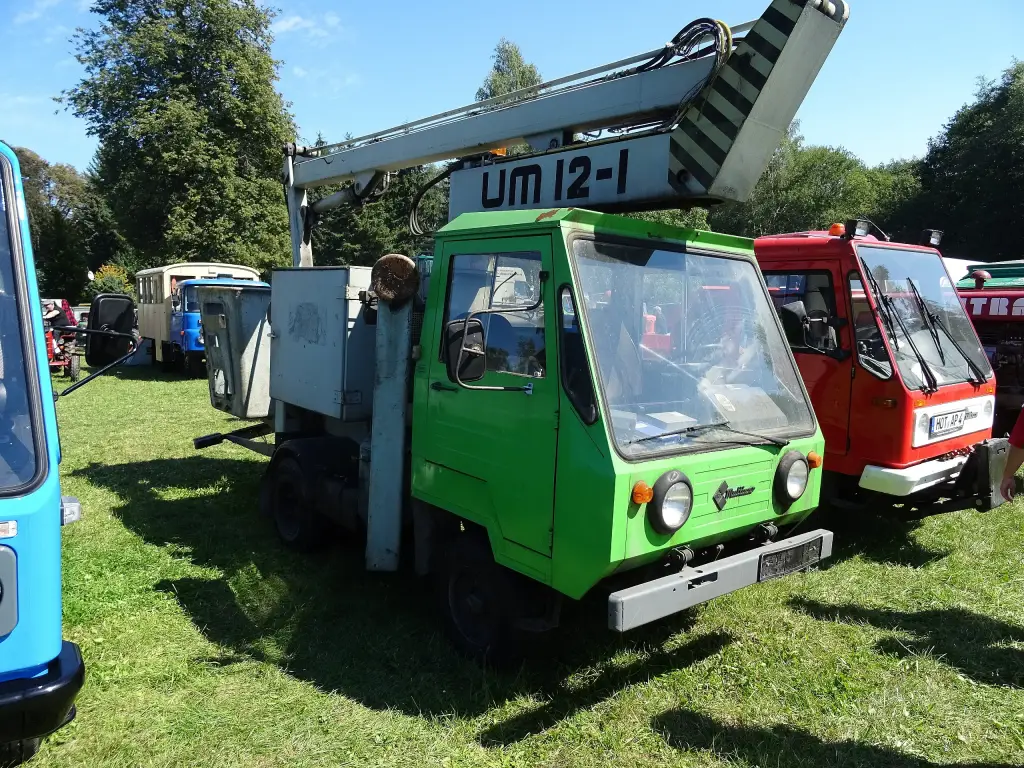
The improvements over the Multicar 24 were aimed mainly at comfort for the driver and passenger. A two-seat version had existed since 1977 as the Multicar 24-0, and the 25 can be told from that outwardly similar predecessor by its deeper windscreen, the triangular side windows in the A-pillar and individually mounted, bottom-hinged wipers. Inside there was a new vibration-damping driver’s seat and a clearer layout of instruments. Newly designed leaf springs cut the vibration when running empty, and a changed heating and ventilation system added to comfort. The cab now tilted forward by 42 degrees and was released by a single central lock between the seats; on the 24 driver and passenger had to unlock their sides separately and the angle was smaller.
The four-cylinder diesel of type 4 VD 8.8/8.5-2 SRF was a further development of the engine used in the 24. It was now carried on four rubber springs and still gave 45 hp (33 kW). The clutch was enlarged, and a new creep gearbox was available on request, allowing working speeds as low as 2 km/h. Ball-and-nut steering replaced the earlier Ross steering and reduced the effort needed at the wheel.
Bodies and drive
To allow bodies to be changed quickly, they were fixed to standardised points on the frame with only four screws, so that any of the available types could be mounted within an hour. All interchangeable bodies were worked by the vehicle’s own hydraulics, supplied in several versions: system 01 was the basic type for tipper bodies only, system 02 had a higher output and could drive extra equipment such as a dozer blade, and system 05 suited all the bodies. Controls were at the driver’s seat or, in exceptional cases, directly at the body. The chassis was newly designed for the construction changes and for the twisting forces met off the road.
Model updates followed through the 1980s. In 1981 the truck received a 500 W three-phase alternator. At the Leipzig autumn fair of 1980 it was shown with all-wheel drive, which went into series production in 1982 and widened its field of use again; bodies with tarpaulin and bows became available in 1983. In 1985 the all-wheel-drive model was fundamentally revised with a completely new drivetrain. Its Cunewalde diesel grew to 2238 cc and 46 hp (34 kW), a new transfer gearbox was fitted, the wheelbase rose from 1970 to 2100 mm and top speed reached 60 km/h; the type was called 25.1 A, and an AL version had a wheelbase of 2675 mm. A roll bar was built into the cab and a 600 W preheater warmed the coolant for winter starting.
The end and the Model 91
After the political change of 1990 the company had to cut jobs and renew its production completely, but thanks to its strong specialisation it was the only vehicle maker of the GDR that could keep selling its products and still exists. Multicar Spezialfahrzeuge GmbH Waltershausen was founded on 1 May 1990, and the Multicar 25 remained in series production until March 1991. From March 1991 the works switched to the Model 91, which met the new legal requirements; its main change was a Volkswagen four-cylinder diesel of type 028.B, 1896 cc and 54.4 hp (40 kW), then regarded as the most modern engine of its kind. Models with and without all-wheel drive were offered, but the production of special bodies stopped. By the end of production in 1992, when the Multicar 26 took over, a total of 100,546 vehicles had been built.
Design and features
- Comfort: a deeper windscreen, new springs, a better seat and improved heating over the Multicar 24.
- Tilting cab: 42 degrees forward, released by one central lock between the seats.
- Quick-change bodies: four screws on standardised points, an hour’s work for any body.
- Hydraulic systems 01, 02 and 05: from tippers only to every interchangeable body.
- All-wheel drive: shown in 1980, in production from 1982, revised in 1985 with a 60 km/h top speed.
- Quality mark Q: awarded in January 1979, one of very few GDR vehicles to receive it.
Multicar 25 versions
- Multicar 25: the standard rear-wheel-drive truck.
- All-wheel drive: from 1982, with the revised 25.1 A of 1985.
- 25.1 A and AL: the 1985 all-wheel-drive types with 2100 mm and 2675 mm wheelbases.
- Creep gearbox: optional, for working speeds down to 2 km/h.
- Tarpaulin and bows: bodies available from 1983.
- Model 91: the 1991 transitional version with a Volkswagen 1.9-litre diesel.
The Multicar 25 followed the Multicar 24, which had replaced the Multicar 22. More of the marque, including the later M26 and FUMO, is in the Multicar collection.
Video: IFA Multicar 25
Video on YouTube.
Sources
- Multicar 25, German Wikipedia: history, cab, engines, bodies, production total
- Multicar, English Wikipedia: exports, Model 91 and company history