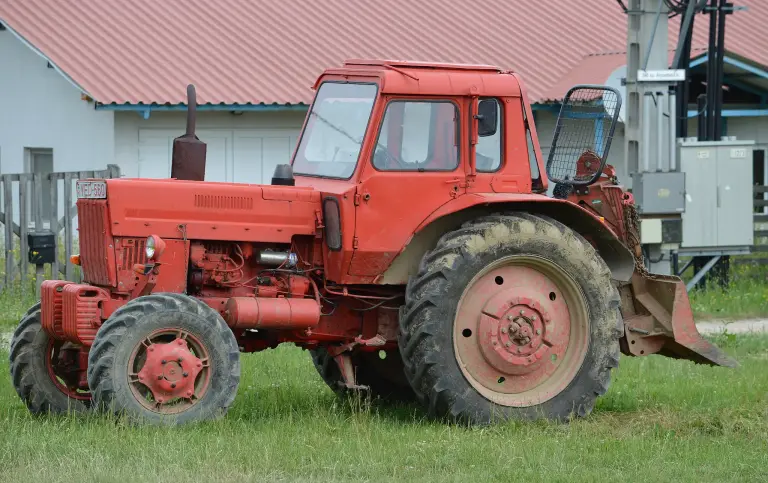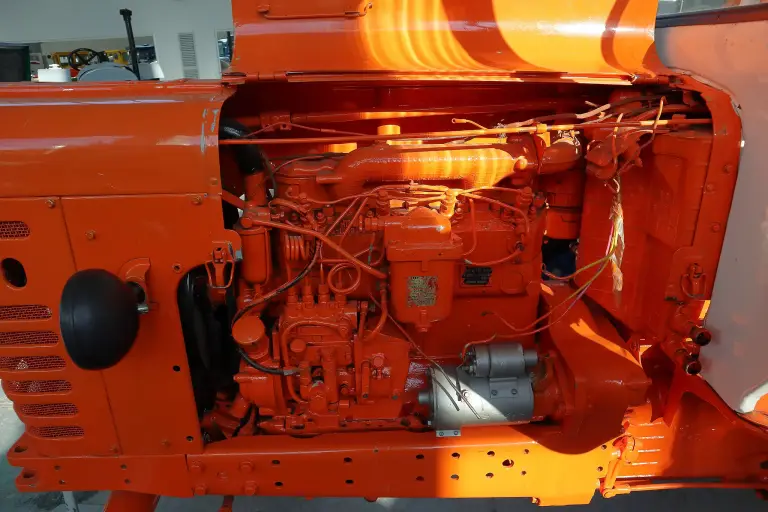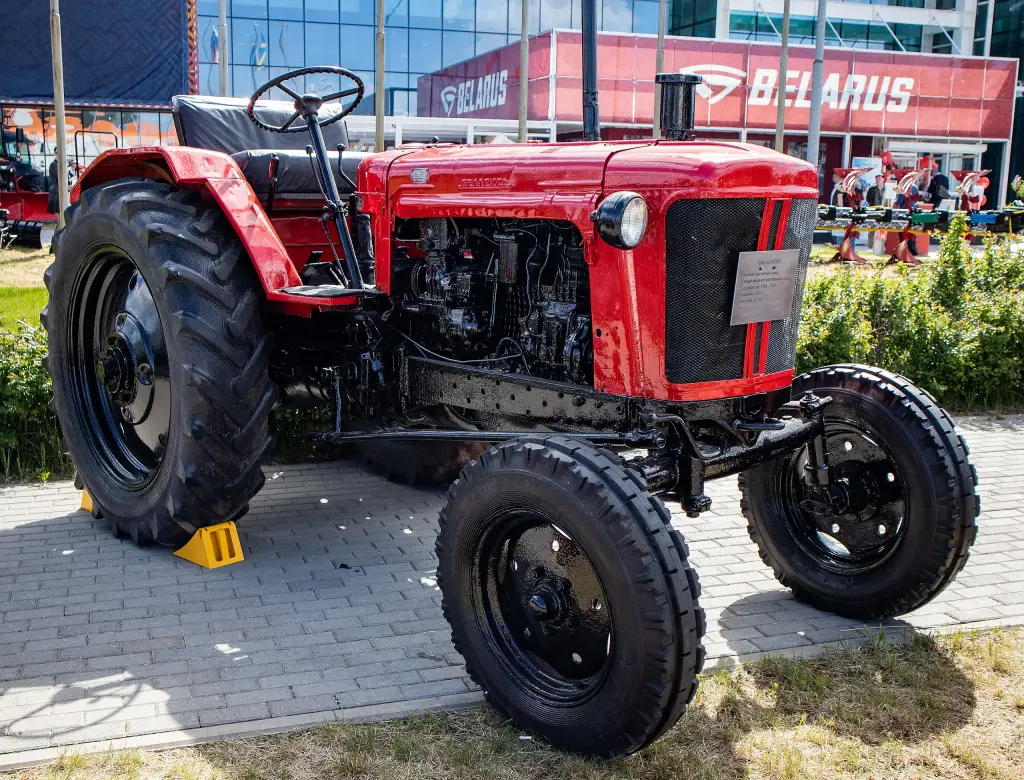
The MTZ-5 was the universal row-crop tractor that Minsk Tractor Works put into production in 1956 in place of the MTZ-2. It was built in Minsk until 1962 and, under the YuMZ brand, in Dnepropetrovsk until 1972, and from 1958 it was joined by a four-wheel-drive version, the MTZ-7.
MTZ-5 and MTZ-7 at a glance
| Maker | Minsk Tractor Works, Minsk; also YuMZ, Dnepropetrovsk |
|---|---|
| Production | 1956–1962 (MTZ); 1958–1972 (YuMZ) |
| Class | 1.4 t universal row-crop wheeled tractor |
| Engine | D-40 family diesel, four-cylinder, 45 hp |
| Base engine | D-40K, 1,500 rpm, 105 mm bore |
| Fuel consumption | 210 g per hp-hour on the base MTZ-5 |
| Gearbox | five speeds; ten speeds from the 1957 MTZ-5M |
| Transport speed | 22.3 km/h (MTZ-5M) |
| Clearance, front axle | 640 mm (MTZ-5M) |
| Tyres | 6.5-20 front and 12-38 rear (MTZ-5M) |
| MTZ-5L built | 41,118 (1958–1960) |
| MTZ-7 built | 2,790 (1959–1961) |
The MTZ-5 and the MTZ-7 are described in a single article of Russian Wikipedia and have no English-language page of their own; this page is based on that article and on the English article about the Minsk Tractor Works.
History of the MTZ-5 and MTZ-7
The MTZ-5 was developed at Minsk Tractor Works on the basis of the MTZ-2, a 36 hp tractor the plant had built since 1953. The first examples were assembled in January 1956 and the machine soon went into series production; it stayed on the Minsk line until 1962. From 1958 the same family was also built at the Southern Machine-Building Plant in Dnepropetrovsk, where it was sold under the YuMZ name until 1972.
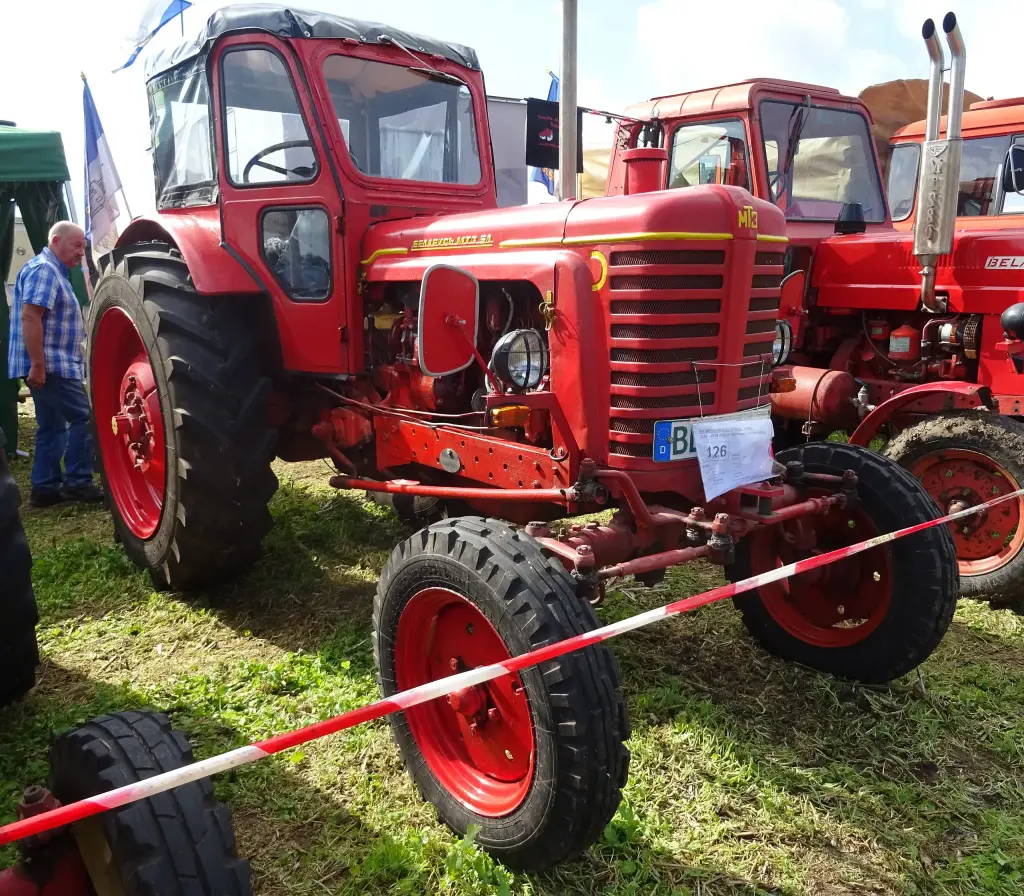
The tractor followed the classic MTZ layout: a semi-frame of two channels joined by a front beam, with the engine ahead of the clutch, gearbox and rear axle, which carried the brakes, the power take-off and the rear linkage. The family used naturally aspirated D-40 diesels of 45 hp, an independent PTO and a separate-aggregate hydraulic system working through an NS-37 unit or three remote cylinders. It was intended for row crops such as maize, sugar beet, potatoes, sunflowers and vegetables, for shallow cultivation of light and medium soils, and for sowing and harvesting some cereals; it also served as the chassis for a line of excavators.
The MTZ-5 was modernised in 1957. The MTZ-5M received a D-40M engine with an ST-50 electric starter instead of the petrol starting engine, a ten-speed gearbox in place of the five-speed, and a transport speed of 22.3 km/h; the rear differential locked automatically from a foot pedal, clearance under the front axle rose to 640 mm, and the tractor moved onto larger 6.5-20 front and 12-38 rear tyres with lower tyre pressures. A cab and a foot-operated engine-speed control made the work easier, and in 1958 the designers were awarded a gold medal at the Brussels World’s Fair.
The MTZ-5L differed from the 5M only in its D-40L engine, which kept a petrol starting engine and did without glow plugs and a decompression mechanism; 41,118 were built between 1958 and 1960. In 1959 the faster MTZ-5LS and MTZ-5MS joined the range, the letter S standing for skorostnoy, high-speed.
MTZ-7: the four-wheel-drive version
The MTZ-7L and MTZ-7M were modifications of the MTZ-5L and MTZ-5M with a driven front axle, larger front wheels, a cardan shaft and a transfer box. The front axle was built like that of an off-road car and passed traction to the steered wheels through a final drive, a differential and constant-velocity joints; the first prototypes used axles taken from the GAZ-67, later replaced by parts made for the GAZ-63 lorry. The MTZ-7 was meant for row-crop work on wet soils, in rows from 445 to 900 mm apart. Series production of the MTZ-7M, 7MS and 7LS began in 1959: 169 tractors were built that year and 1,277 in 1960, making 2,790 in all before production ended in 1961.
Design and features
- D-40 diesel: four-cylinder engine of 45 hp; on the base MTZ-5 fuel consumption fell to 210 g per hp-hour.
- Independent PTO: a redesigned clutch let the power take-off run independently of the transmission.
- Separate hydraulic system: an NS-37 unit or three remote cylinders worked the rear linkage.
- Ten speeds: the 1957 MTZ-5M added a ten-speed gearbox and a 22.3 km/h transport speed.
- Four-wheel drive: the MTZ-7 added a driven front axle for row-crop work on wet soils.
MTZ-5 and MTZ-7 versions
- MTZ-5 (1956): the base model with a D-40K engine and a five-speed gearbox.
- MTZ-5M (1957): D-40M engine, electric starter, ten-speed gearbox, locking differential and a cab.
- MTZ-5L (1958–1960): D-40L engine with a petrol starting engine; 41,118 built.
- MTZ-5LS and MTZ-5MS (1959): high-speed versions of the 5L and 5M.
- MTZ-7, 7M, 7MS and 7LS (1958–1961): four-wheel-drive versions; 2,790 built.
- YuMZ tractors (1958–1972): the same family assembled in Dnepropetrovsk.
Later Belarus tractors are described in the articles on the MTZ-50 and the MTZ-80 and MTZ-82; more of them are in the MTZ collection.
Video: Belarus MTZ 5 LS start
Video by latfoto on YouTube.
Sources
- МТЗ-5, Russian Wikipedia: history, design, versions, production figures
- Minsk Tractor Works, English Wikipedia: plant background