The Motobécane Mobyx was a tiny moped designed to be carried rather than ridden far. Its first version, the X1 of 1971, weighed about 28 kg, had folding handlebars and saddle and could be laid in the boot of a car; the name Mobyx was used officially only from the X7 of 1974.
Motobécane Mobyx at a glance
| Maker | Motobécane, France |
|---|---|
| Model | X1, also documented as Cady X1 |
| Production | 1971–1974 (X1); X7 from 1974 |
| Engine | 49.9 cc Isodyne, 1.1 hp |
| Top speed | 30.5 km/h (X1), 44.4 km/h (X7) |
| Consumption | under 2 litres per 100 km (X1) |
| Brakes | two 70 mm drum brakes (X1), 80 mm (X7) |
| Wheels | 2.5 × 9 inches (X1), 10 inches (X7) |
| Weight | about 28 kg (X1), 37 kg (X7) |
| Dimensions | 1.25 m long, 45 cm wide without pedals (X1); 1.455 m (X7) |
| Fuel tank | 2 litres |
| Suspension | none on the X1; telescopic fork on the X7 |
This page is based mainly on the French Wikipedia article on the Mobyx, with the English article on Motobécane for the company’s background.
History of the Motobécane Mobyx
The X1 of 1971
In 1971 Motobécane showed a new small two-wheeler called the X1. Neither the sales literature nor the technical documents of the period used the name Mobyx: the machine was described as the « Cyclomoteur X1 » or « Cady X1 », and Mobyx was employed officially only for the later X7. The X1 was the first French, and probably the first European, 50 cm³ pocket bike homologated in the moped class. The Solex Micron of 1968, built to the same idea by a rival, had no pedals and was therefore registered as a vélomoteur under the rules of the time.
Design
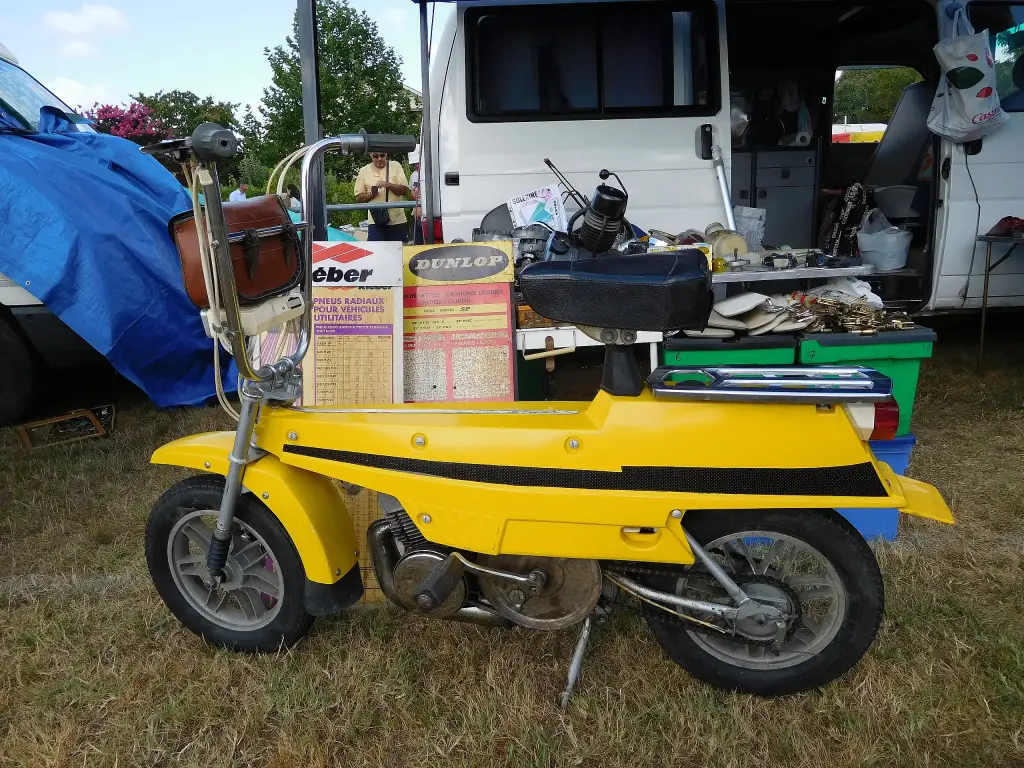
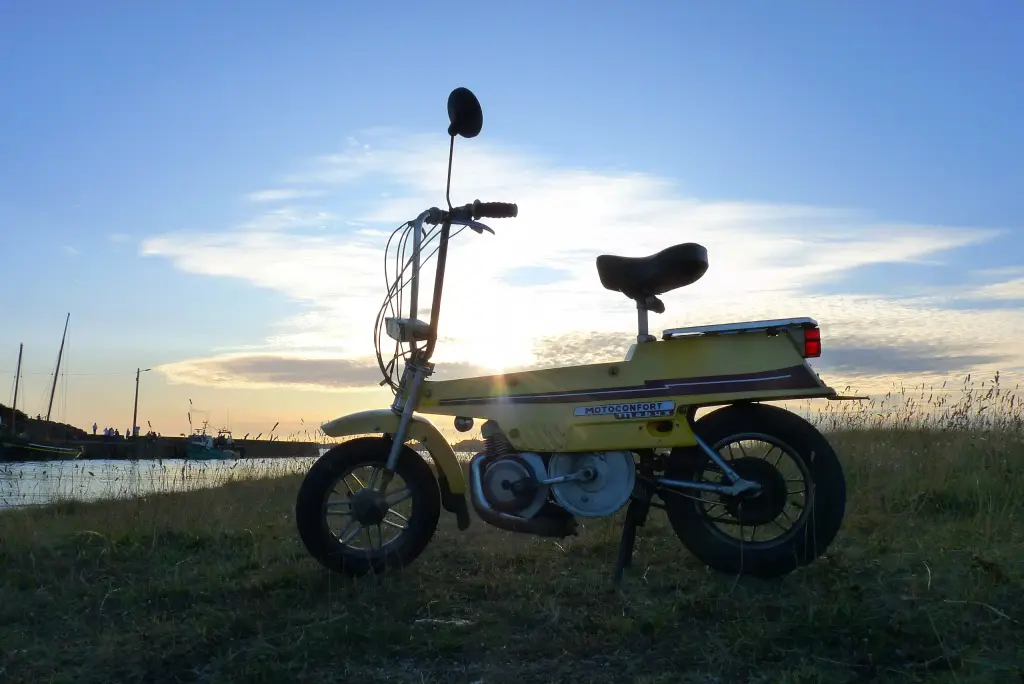
The X1 used the 1.1 hp Isodyne engine from the Cady range. It was not powerful but it was frugal: less than two litres per 100 km in ordinary use, with a top speed of 30.5 km/h at maximum engine speed. Braking was by two 70 mm drum brakes. A tubular frame was completely enclosed by two plastic half-shells, and it held a small two-litre tank; there was no suspension at all. The 2.5 × 9 inch wheels were in light alloy, and a carrying handle on the cross-member let the machine be carried almost like a suitcase. The X1 measured 1.25 m long and 45 cm wide without the pedals, and weighed about 28 kg. Its saddle and handlebars folded, and the tank’s air intake could be closed with a knurled knob so that the moped could be laid down and stored in a car boot or at the back of a camper van. Two versions were offered, the X1 and the X1L, the latter with indicators and a brake light.
Career
The X1 arrived too early and cost about as much as a more practical Mobylette, so it never achieved the success expected of it. Its X1 version was built only from 1971 to 1974. Less stable and less capable than its bigger sister, it was aimed mainly at boat owners and caravanners who wanted a vehicle that would stow away very easily. Light and handy, it was at its best in town, and the twenty or so kilograms it saved over a « bleue » Mobylette let its rider move it almost like a small bicycle.
The Mobyx X7
The Mobyx X7 of 1974 was a different proposition. It was no longer the holiday maker’s suitcase moped but a more complete, more conventional mini-moped that Motobécane presented as specially designed for the city. Its AV 7 engine was much more powerful and thirstier, taking the X7 and its rider to 44.4 km/h at maximum engine speed, and the drum brakes grew to 80 mm. The machine had also put on weight: 37 kg and 1.455 m long. Every version had a telescopic fork and ten-inch wheels. Six versions were catalogued: X7, X7 L, X7 V, X7 VL, X7 AL and X7 AVL, where V meant the Mobymatic variator, A rear suspension and a long two-place saddle, and L a brake light and indicators. Before the A versions existed, the parts manual called the non-L models S, probably for Standard against L for Luxe.
Design and features
- Car-boot size: 1.25 m long and 45 cm wide, with folding handlebars and saddle and a closable tank vent.
- Light weight: about 28 kg, with a carrying handle so that it could be lifted like a suitcase.
- Frugal engine: the 1.1 hp Isodyne unit used under two litres per 100 km and gave 30.5 km/h.
- Enclosed frame: a tubular chassis hidden under two plastic half-shells, with no suspension on the X1.
- X7 upgrade: AV 7 engine, 44.4 km/h, 80 mm brakes, telescopic fork and ten-inch wheels.
Motobécane Mobyx versions
- X1 (1971–1974): the original pocket moped with the Isodyne engine and 9-inch wheels.
- X1L: an X1 with indicators and a brake light.
- X7 (1974): AV 7 engine, telescopic fork, 10-inch wheels, 37 kg.
- X7 V: with the Mobymatic variator.
- X7 A and AL: rear suspension and a long two-place saddle, with or without lights.
- X7 S / VS: earlier parts-manual names for the non-L versions.
The Mobyx used an engine from the Cady range and sat below the full-size Mobylette in the Motobécane catalogue. More mopeds are in the Motobécane collection.
Video: 1976 Motobécane Mobyx X1
Video on YouTube.
Sources
- Motobécane Mobyx, French Wikipedia: X1 design, dimensions, career, X7 versions
- Motobécane, English Wikipedia: company background