The Motobécane Mobylette was the moped that put France on two motorised wheels after the Second World War. Launched in 1949 with a 49.9 cc two-stroke engine, it was built in millions and its name became the everyday French word for any small moped.
Motobécane Mobylette at a glance
| Maker | Motobécane, France (also sold as Motoconfort) |
|---|---|
| Production | 1949–1984 as Motobécane, then as MBK until 2003 |
| First model | Mobylette AV 3, 1949 |
| Engine | 49.9 cc air-cooled two-stroke |
| Engine types | AV 3, AV 31, AV 35, AV 7, AV 10 |
| Frame | two pressed sheet-steel halves, tank inside the frame |
| Transmission | belt and chain; Dimoby clutch, Mobymatic variator |
| Top speed | 25 or 40 km/h depending on type |
| Peak output | 750,000 a year in 1974–1975 |
| Total built | about 14 million in 48 years |
| Plant | Rouvroy from 1960 |
| Licence production | Raleigh RM in Britain, Suvega in India |
The English Wikipedia article covers the Motobécane company; the French and German articles on the Mobylette supply the model history and the list of types.
History of the Motobécane Mobylette
Origins, 1949
The Mobylette was created in 1949 by Éric Jaulmes, Motobécane’s technical director since 1941, with Charles Benoit, the firm’s co-founder and director. Motobécane sold its first machine as the « Mobylette AV 3 », and AV 3 was also the name of its engine. The 49.9 cc two-stroke was derived from the engine of the Poney AG2, a two-speed moped made by reducing the 63 cc Poney AG1 of 1938 to 49.9 cc. The name Mobylette contracts « mobile » and « bicyclette ».
How it was built
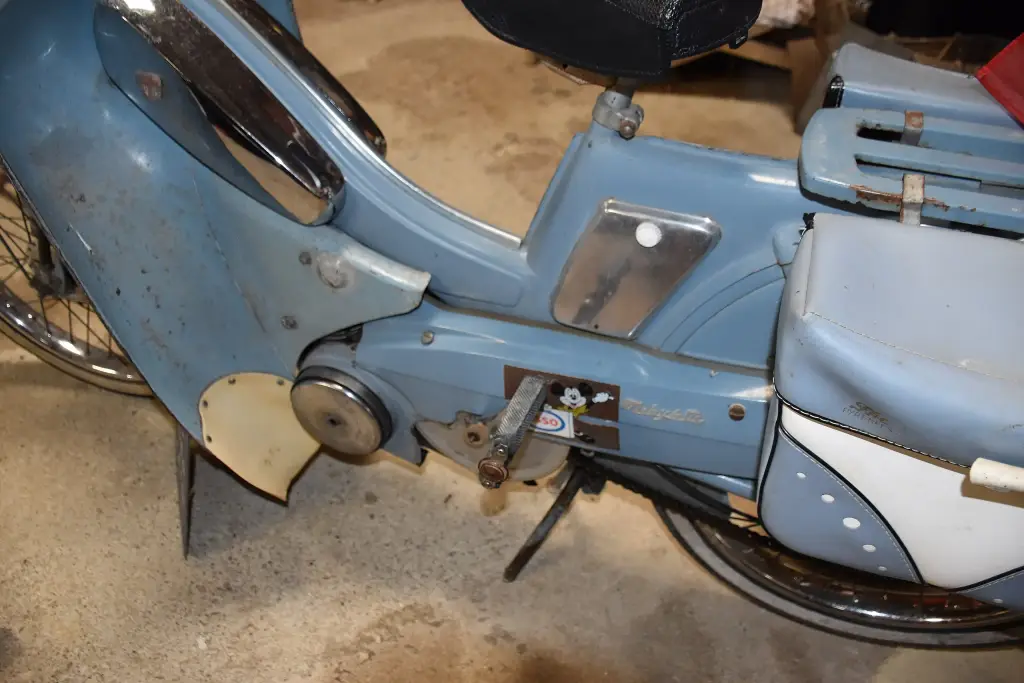
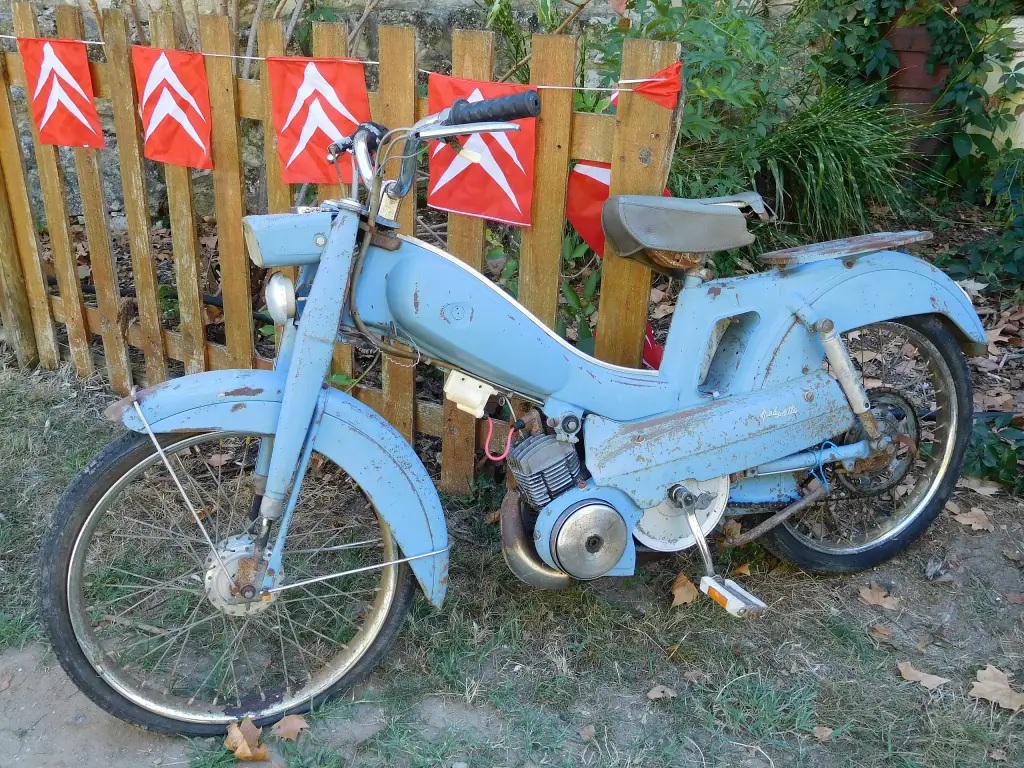
The frame was made of two pressed sheet-steel halves welded together, the hollow between them forming the fuel tank. Power went first by belt to the rear wheel through a large pulley and then by chain from the pedal shaft. In 1951 a centrifugal clutch arrived, which let the engine keep running when the moped stopped and so made lighting possible at night; in the mid-1950s the double-effect « Dimoby » automatic clutch allowed a restart without pedalling after a stop with the engine running. The Mobymatic variator, in which centrifugal balls move a pulley cheek and the engine pivots backwards on its frame mounting, soon became the standard transmission and varied the belt ratio from 1:18.7 to 1:11.8. The engine itself evolved from the AV 3 through the AV 31 and AV 35, whose light-alloy cylinder was hard-chromed, to the AV 7 with Schnürle scavenging instead of a deflector piston, and finally the AV 10 with reed-valve induction and fitted to the 51v at the end of the 1970s. Starting was by pedals or by pushing, because the law required mopeds to work as bicycles until 1982; later models such as the 51 Hard Rock and Magnum Racing had a kickstarter.
The boom years
In 1960 Motobécane opened the Rouvroy works, a 338,000 m² site devoted entirely to the Mobylette range and employing up to 3,500 people. More than 400,000 Mobylettes were built in 1960 alone, output reached up to 4,500 machines a day, and by 1973 more than nine million had been made. In the 1970s the most common model was the AV88, designed in 1957 and known as « la Bleue », which reached fifteen million examples, and for a time Motobécane was the world’s largest maker of motorised two-wheelers. The moped was also built abroad: Raleigh made it in Britain as the RM series from 1960 to 1971, where these machines took 38 per cent of moped sales in the late 1960s, Mopeds India built it as the Suvega, and Montgomery Ward sold it in the United States as the Riverside. In all, some fourteen million Mobylettes were built over 48 years.
Types and the end
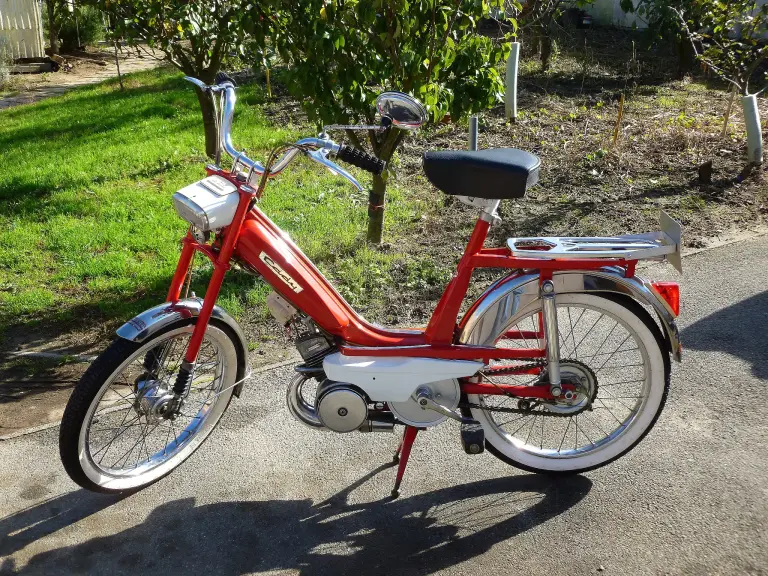
The range split into mopeds limited to 25 km/h, such as the M-7 25, AV 142–146, M1 and N 150 LC, and faster 40 km/h machines such as the AV 42–46, AV 59 with Moby-Matic and the 50 VL. Comfortable versions carried plenty of chrome, indicators, mirrors and sometimes a brake light; bright green, orange, yellow and mid-blue were characteristic colours. In the 1990s the compulsory helmet law and competition from imported Asian scooters cut demand: output was down to 15,000 Mobylettes a year by 2002, made by 25 people, and in 2003 Yamaha, which had taken over the loss-making MBK, stopped production because of the Euro 2 emission rules that came into force in June 2003. In French the word « mobylette », or « mob », has become the generic term for a small moped of any make.
Design and features
- Pressed-steel frame: two stamped halves joined to form the chassis, with the fuel tank inside the structure.
- Belt and chain drive: a large pulley at the rear, a Dimoby automatic clutch and, later, the Mobymatic variator.
- Simple two-stroke engine: 49.9 cc, developed from the AV 3 to the reed-valve AV 10, and cheap to repair.
- Pedals as standard: the law required bicycle operation until 1982, so early Mobylettes started on the pedals.
Motobécane Mobylette versions
- AV 3 (1949): the first Mobylette, which also gave its name to the engine type.
- AV88 « Bleue » (1957): the most common model of the 1970s.
- 51v and MBK 51: late models with the AV 10 reed-valve engine; the 51 Hard Rock had a kickstarter.
- 99Z and 95TT: versions with a counter-piston compressor arrangement giving unusually high torque for the capacity.
- 25 km/h types: M-7 25, AV 142–146, M1, 140 TL and N 140/N 150, from 0.5 to 1.5 hp.
- 40 km/h types: AV 42–46, AV 59 and AV 40 TL, plus the 50 VL and 50 VL C with Moby-Matic.
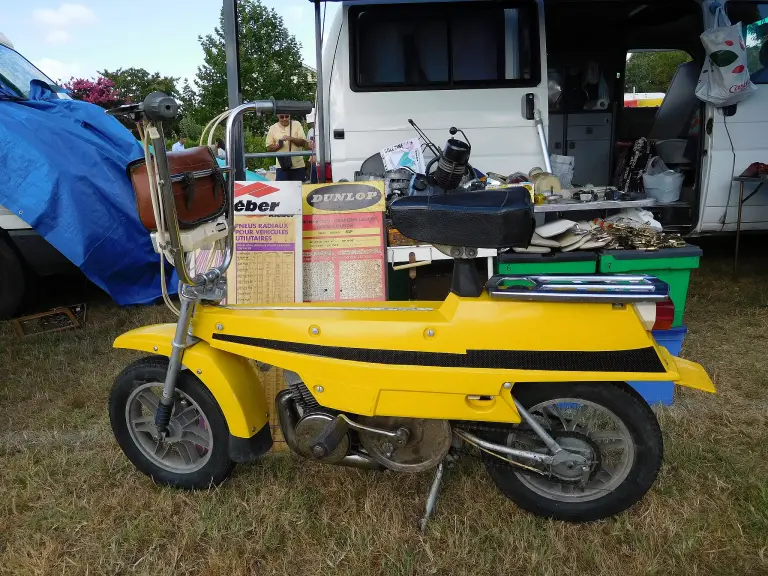
The small-wheeled Mobyx and the Cady used engines from the same Motobécane family, and more French mopeds are in the Motobécane collection.
Video: MOBYLETTE AV88 La bleue
Video on YouTube.
Sources
- Motobécane, English Wikipedia: company history, total production, licence building
- Mobylette, French Wikipedia: design, engines, production figures, end of the line
- Mobylette, German Wikipedia: frame and transmission, model list, colours