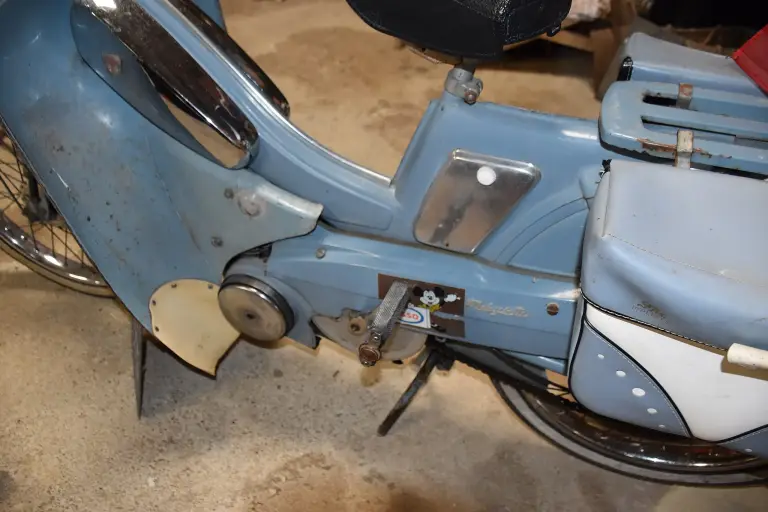
The Motobécane Cady was a small, light moped aimed at teenagers and built in several versions from the mid-1960s. Its pressed-steel frame held a 2.8-litre tank, its 49.9 cc engine gave about 33 km/h, and a folding version was made for people who wanted to carry it with a caravan.
Motobécane Cady at a glance
| Maker | Motobécane, France; Motoconfort versions used C instead of M |
|---|---|
| Common from | 1965 |
| Engine | 49.9 cc Isodyne, Super Isodyne from 1974 |
| Top speed | about 33 km/h |
| Consumption | under 2 litres per 100 km |
| Weight | 27 kg |
| Frame | pressed sheet steel with a 2.8-litre tank |
| Wheels | 19 inches on the M1, 16 inches on later models |
| Tyres | whitewall sidewalls on the original equipment |
| Colours | bordeaux first, then red, blue, white, topaze and yellow |
| Last version | M3PRTSG with Super Isodyne and separate lubrication |
The Cady is described in a single French Wikipedia article, based on Motobécane parts catalogues of 1974 and 1976; the English article on the company supplies only background, so this page is based on one source.
History of the Motobécane Cady
A moped for the young
The Cady was a moped of the French maker Motobécane, intended for a teenage public, and it probably took its name from the supermarket « Caddie ». It was very common from 1965 and was quickly adopted by women riders thanks to its low weight and minimalist character. Its success was such that sales of the rival VéloSoleX were particularly affected.
Design
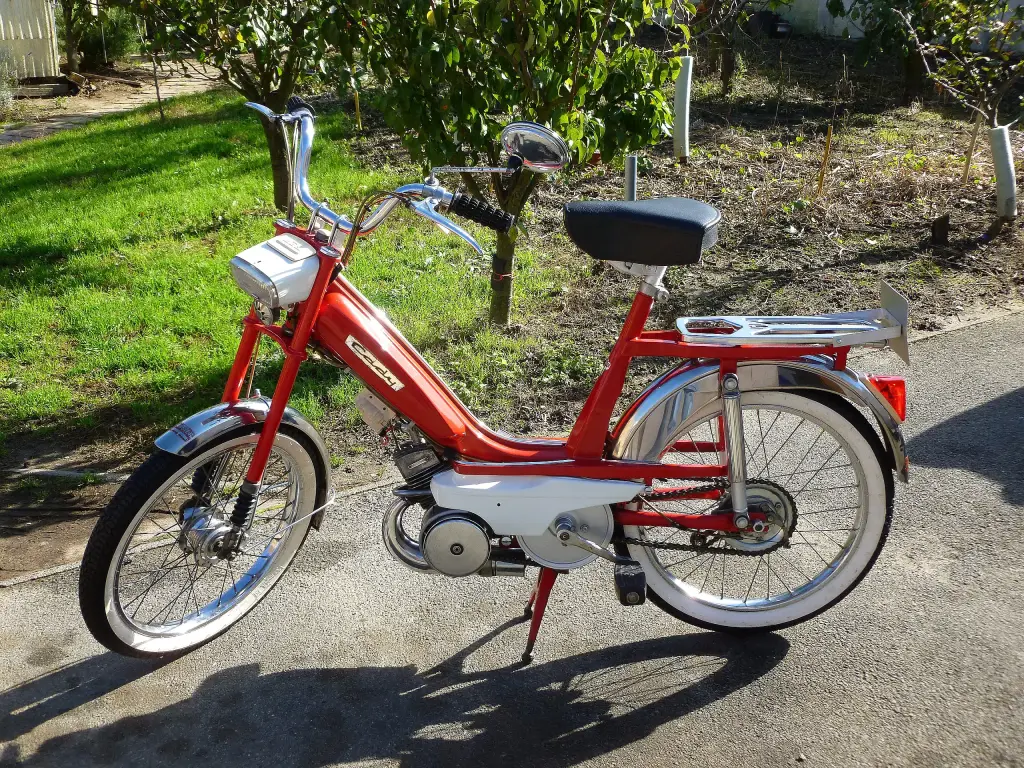
The little moped weighed 27 kg and used the firm’s 49.9 cm³ Isodyne engine, replaced after 1974 by the Super Isodyne. The engine was not powerful but it was frugal, using less than two litres per 100 km in ordinary use, and it gave the Cady a maximum speed of about 33 km/h. The modest output sometimes had to be helped by the pedals on a hill, but once on the flat the Cady was pleasant and quiet to ride. A pressed sheet-steel frame incorporated the small 2.8-litre tank. The original M1 had no suspension and 19-inch wheels, but every later model in the range had suspension and 16-inch wheels, with whitewall tyres as original equipment. The Cady came in several colours: bordeaux only for the first M1 and the folding M1P, then, from the M1PR onwards, red, blue, white and topaze.
Versions
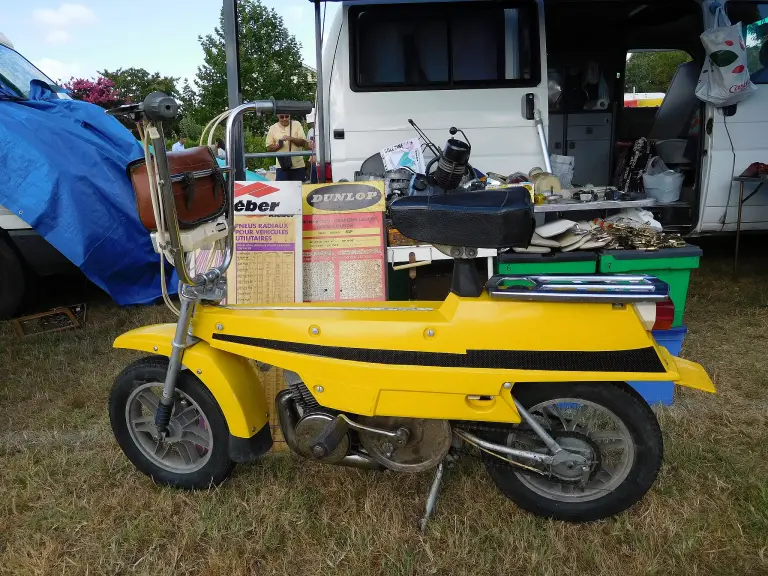
The range grew version by version. The M1 was the sober original: 19-inch wheels, no suspension, the Isodyne engine, pad brakes at the front and a drum at the rear, and bordeaux paint throughout. The M1P of 1967 was a rare folding model whose entire front section could be removed, aimed at motorists towing a caravan, then very fashionable; it had 16-inch small wheels, folding pedals so that it would fit into a small space, bordeaux paint and its headlamp on the front mudguard. The M1PR of 1969 had 16-inch small wheels, no suspension and the Isodyne engine. The M1PRT was the same machine with a telescopic front fork, which also brought a front drum brake, and the M1PRTS added a swinging-arm rear suspension. The M3PRTS of 1974 brought the Super Isodyne engine, and the M3PRTSG was the final evolution, with a Super Isodyne and separate lubrication. Motoconfort-badged versions used the same designations with a C in place of the M, for example C1PRTS, although some Motoconfort models kept the M.
Advertising
The Cady was promoted on television and in the youth press for its design and its practical, economical character. Launched in the middle of the « trente glorieuses », it relied on advertising as strongly as its rival the VéloSoleX had done.
Design and features
- Light and simple: 27 kg with a pressed-steel frame that held the 2.8-litre tank.
- Frugal Isodyne engine: 49.9 cc, under two litres per 100 km and about 33 km/h.
- Suspension from the later models: telescopic fork and swinging-arm rear suspension arrived after the unsprung M1 and M1PR.
- Folding M1P: detachable front section and folding pedals for carrying with a caravan.
- Colour range: bordeaux at first, then red, blue, white, topaze and yellow.
Motobécane Cady versions
- M1: 19-inch wheels, no suspension, Isodyne engine, bordeaux only.
- M1P (1967): folding model with a detachable front end and 16-inch wheels.
- M1PR (1969): 16-inch small wheels, no suspension, several colours.
- M1PRT: telescopic front fork and front drum brake.
- M1PRTS: adds swinging-arm rear suspension.
- M3PRTS and M3PRTSG (1974): Super Isodyne engine, the last with separate lubrication.
The Cady’s Isodyne engine also powered the little Mobyx, and the Cady sat below the full-size Mobylette in the range. More mopeds are in the Motobécane collection.
Video: my 1976 motobecane mobylette cady
Video on YouTube.
Sources
- Motobécane Cady, French Wikipedia: design, versions, colours, market
- Motobécane, English Wikipedia: company background