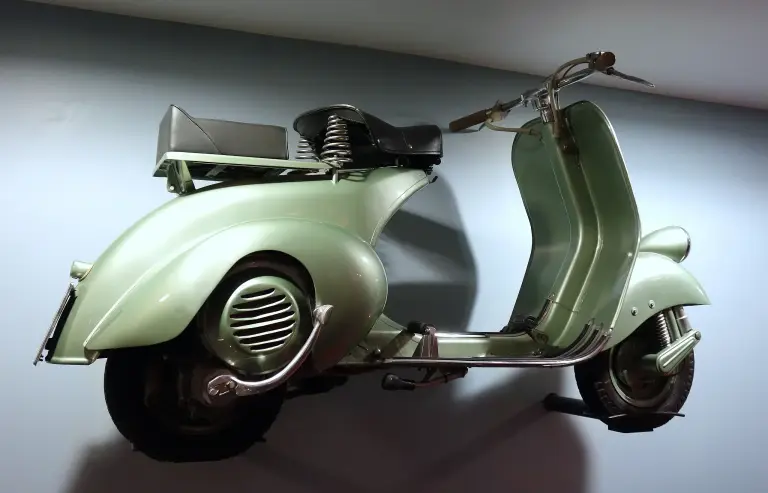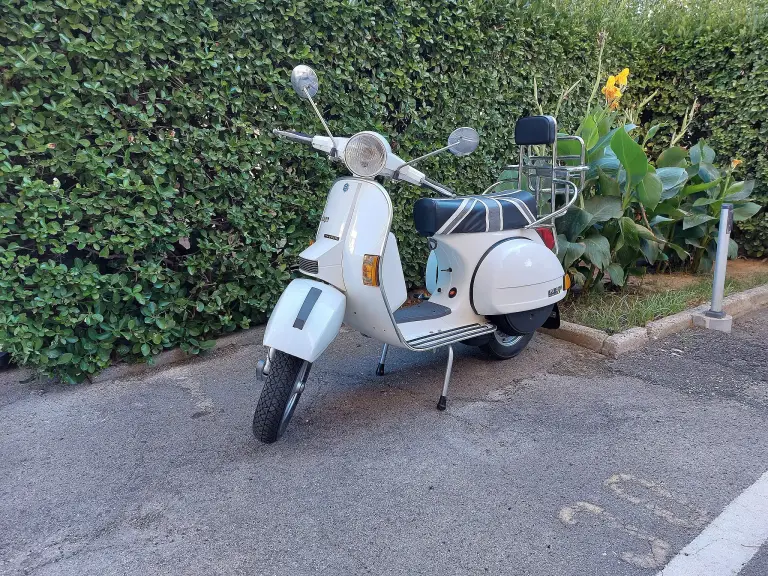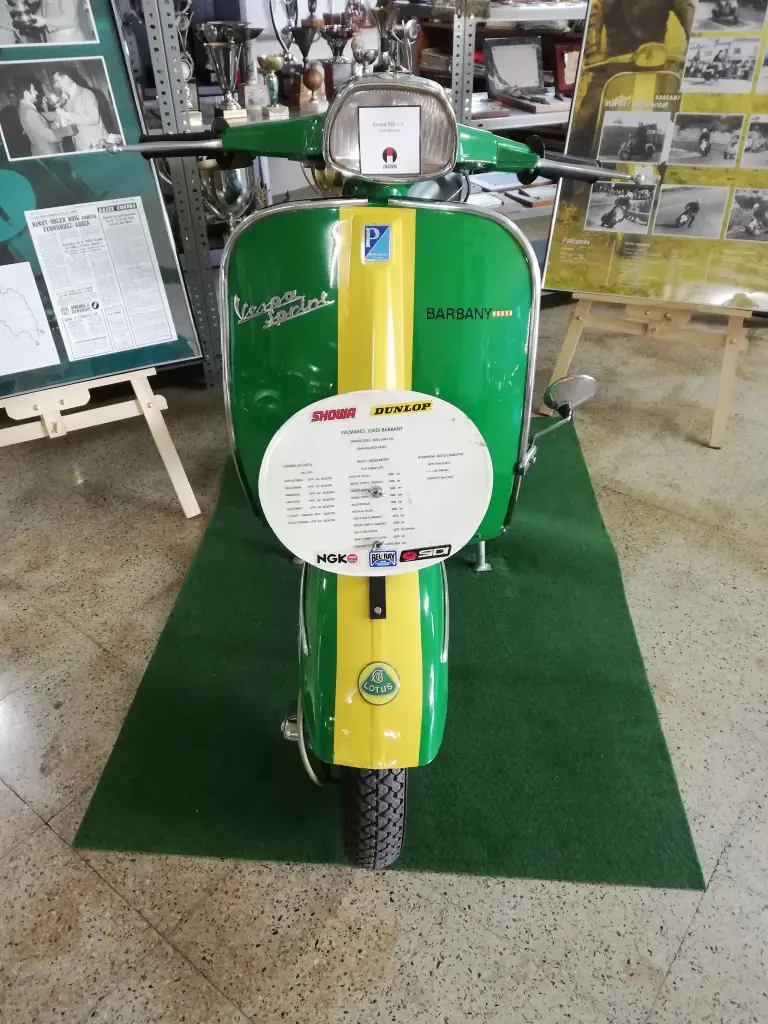
The Vespa 150 was Piaggio’s answer, in 1954, to the more powerful scooter that Hoffmann was building under licence in Germany. It went into series production in 1955 and stayed in the range until 1979; 1,187,000 were built, and it was the first Vespa with rotary-valve timing and the first with a four-speed gearbox.
Vespa 150 at a glance
| Maker | Piaggio |
|---|---|
| Production | 1954–1979, series production from 1955 |
| Built | 1,187,000 |
| Developed against | the more powerful Hoffmann licence model |
| Engine | air-cooled two-stroke single, rotary-valve timing from 1958 |
| Mixture | 1:20, changed to 1:50 in 1959 |
| Gearbox | three speeds, four from the VBB of 1960 |
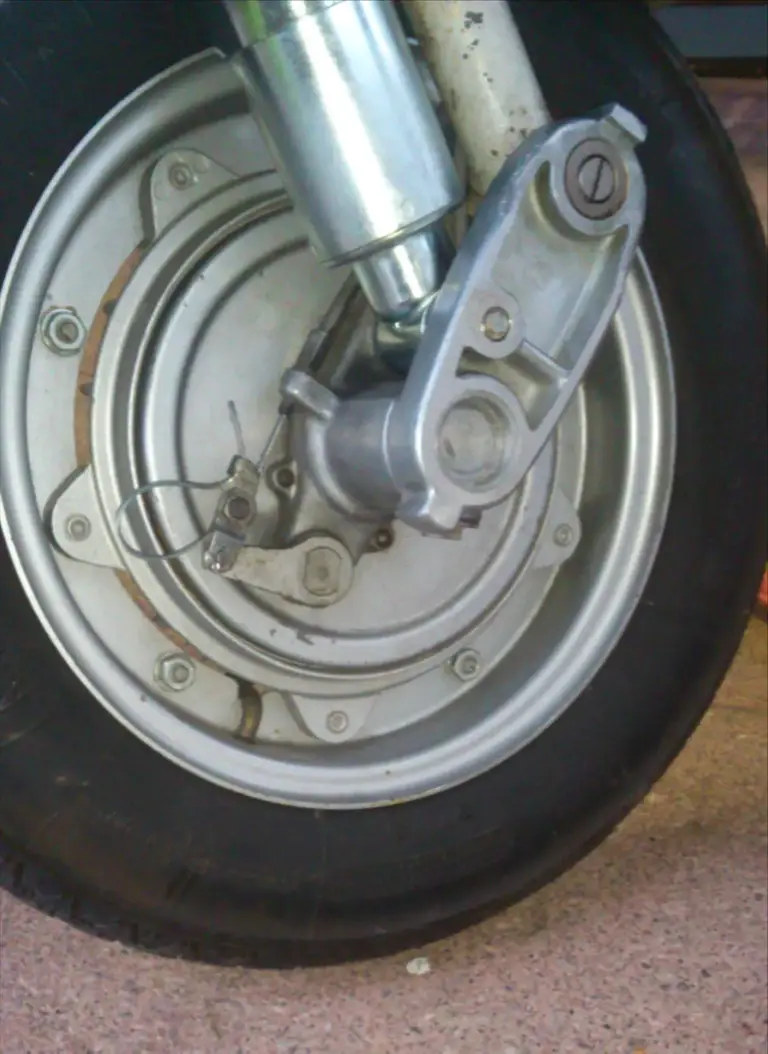
| Last series | Vespa 150 Super, with self-ventilating brake drums |
| Identification | five slots on the engine side of the body |
| Military version | Vespa 150 TAP, anti-tank scooter for French airborne troops |
Based on one source, the German Wikipedia article on the Vespa 150.
History of the Vespa 150
The answer to Hoffmann
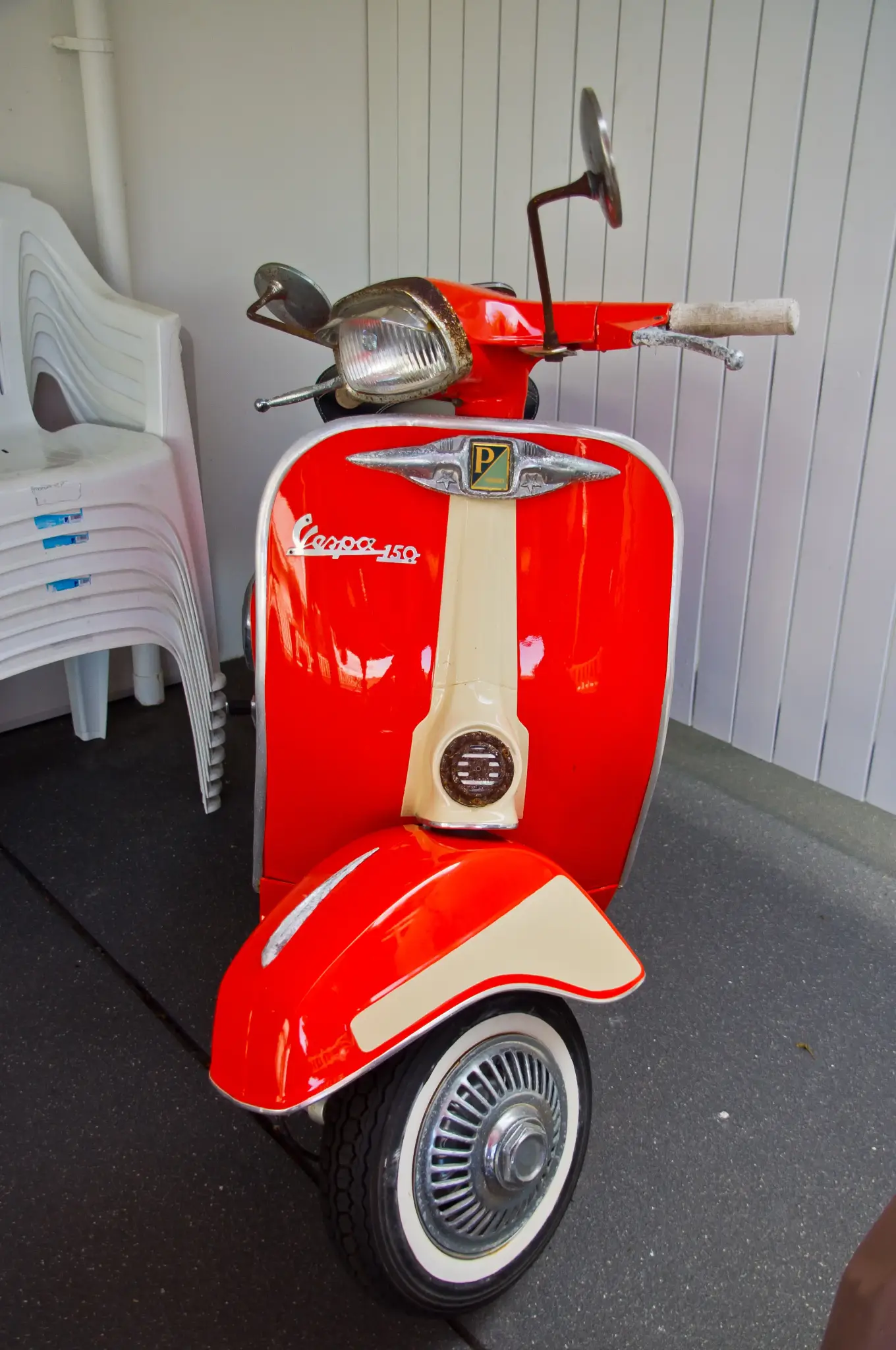
The Vespa 150 was developed in 1954 against the more powerful scooter that Hoffmann was building under Vespa licence in Germany, and series production began in 1955. It kept the recipe that Piaggio had used since the Vespa 98: a pressed-steel frame with the front fairing built in, wheels that could be swapped front to rear, an engine and gearbox unit swinging on the rear wheel, and a front wheel carried on a single-sided trailing arm.
Rotary valve and four speeds
For the 1958 model year the 150 became the first Vespa with rotary-valve timing, in which the crankshaft itself opens and closes the inlet, and in 1959 the oil content of the mixture was reduced from 1:20 to 1:50. The VBB series built from 1960 was the first to use a four-speed gearbox. The last series, sold as the Vespa 150 Super, had self-ventilating brake drums and can be recognised by its slightly more angular body and the five slots on the engine side.
Military and endurance
The Vespa 150 also served as the basis of the Vespa 150 TAP, an anti-tank scooter ordered from Piaggio by the French ministry of defence for its airborne troops. In the summer of 1964 Roberto Patrignani rode a Vespa 150 from Milan to Tokyo, some 13,000 km in about 85 days, through Yugoslavia, Greece, Turkey, Syria, the Lebanon, Jordan, Iraq, Iran, Afghanistan, Pakistan, India, Thailand, Malaysia and Hong Kong.
Design and features
- Rotary-valve engine: from 1958 the first Vespa with rotary-valve timing, which allowed the leaner 1:50 mixture from 1959.
- Four-speed gearbox: introduced on the VBB of 1960 and kept to the end of production.
- Pressed-steel frame: the classic Vespa recipe, with interchangeable wheels and a single-sided front arm.
- Military use: the 150 TAP was an anti-tank scooter built for French airborne troops.
Vespa 150 versions
- Vespa 150 (1954–1959): the original three-speed model, rotary valve from 1958.
- VBB (1960): the first four-speed Vespa 150.
- Vespa 150 Super: the final series, with self-ventilating brake drums and a squarer body.
- Vespa 150 TAP: the military anti-tank version for France.
The 150 followed the Vespa 125 of 1948 by a year, and the line ended with the Vespa PX in 2017. More scooters are in the Vespa collection.
Video: Vespa 150 Sportique Ride
Video on YouTube.
Sources
- Vespa 150, German Wikipedia: production years and total, rotary valve, four-speed gearbox, the TAP, the Milan-Tokyo ride