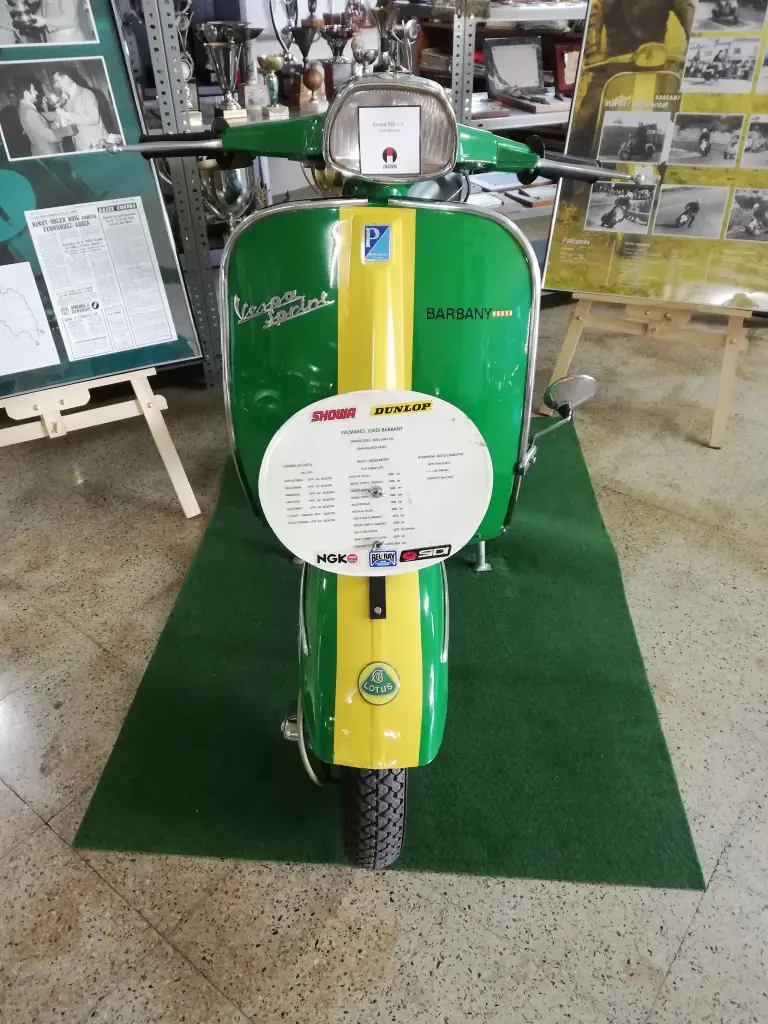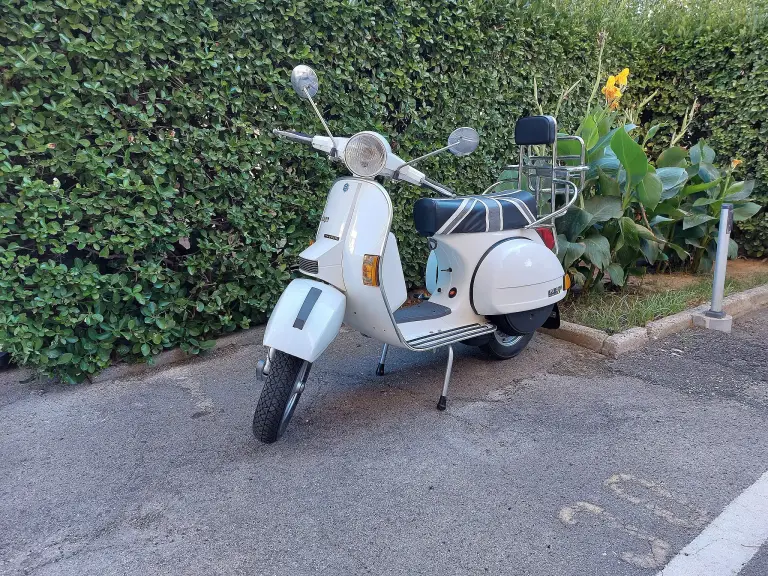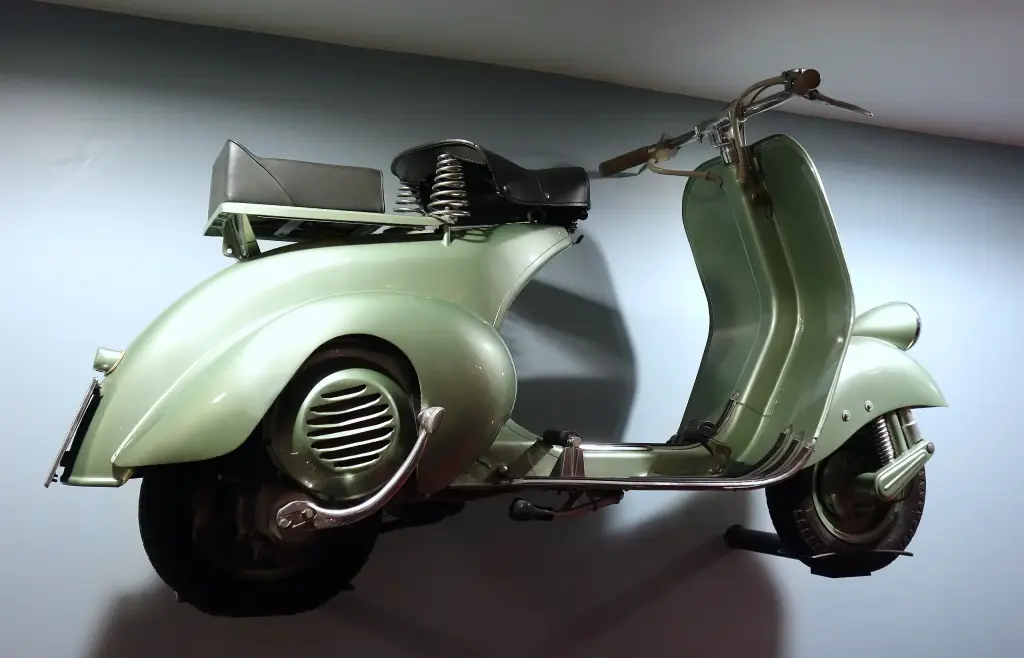
The Vespa 125 was Piaggio’s standard scooter from 1948 to 1969. It began as a Vespa 98 with a larger engine and a revised gearchange, and in 1957 it carried the range onto the new “largeframe” body that stayed in production, in updated form, until 1979.
Vespa 125 at a glance
| Maker | Piaggio |
|---|---|
| Production | 1948–1969 |
| Based on | Vespa 98 |
| Engine | 125 cc single-cylinder, run on a 2% petrol-oil mixture |
| Carburettor | with a choke worked by a lever under the saddle |
| Front suspension | coil spring instead of the 98’s band springs |
| Rear suspension | sprung rear wheel, opening the motor cover at the bottom |
| Early gearbox | three speeds, kick start, on the VNA1T and VNA2T |
| Four speeds | from the VNB5T |
| New body | 1957, two long welded pressings, the “largeframe” |
| Last 8-inch model | Vespa 125 Super (VNC) |
| Successor | Vespa 125 GT |
Based on one source, the German Wikipedia article on the Vespa 125.
History of the Vespa 125
From the Vespa 98
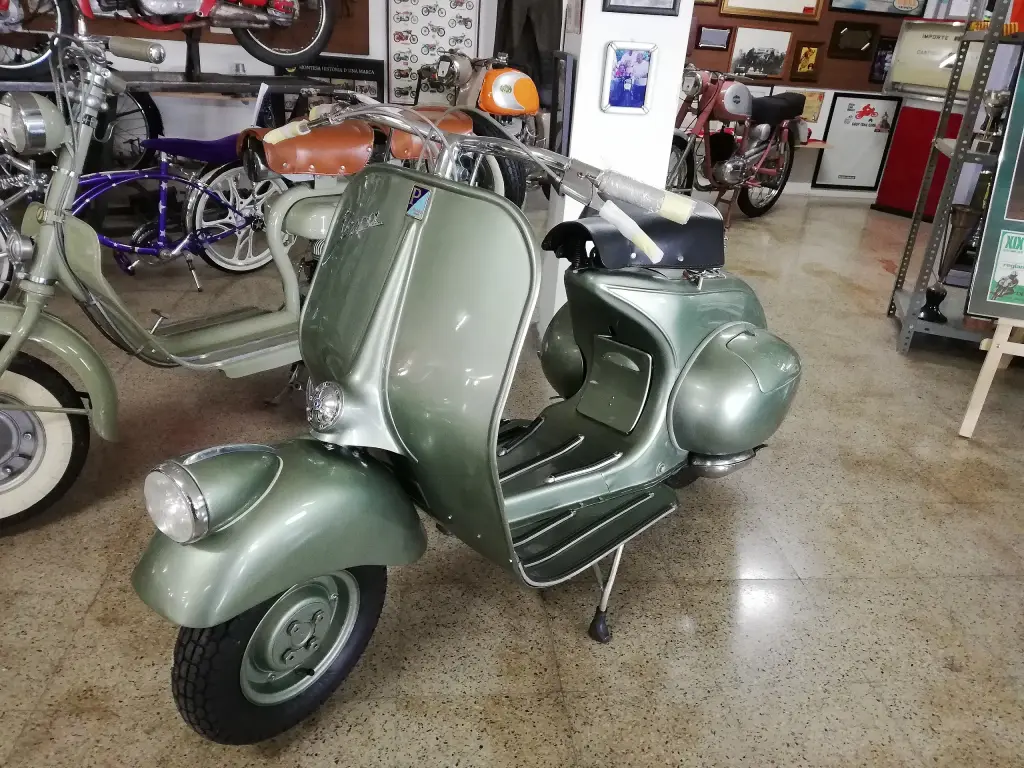
The first Vespa 125 of 1948 was a development of the Vespa 98, separated from it by the 125 cc engine and a redesigned gearchange. The carburettor had a choke worked by a lever under the saddle, the front swing arm now used a coil spring instead of the band springs of the 98, and the rear wheel was sprung too, which meant that the round opening in the engine cover had to be opened downwards so the engine could move. The saddle itself was better sprung than before. The first series, VNA1T and VNA2T, still had three speeds and a kick starter.
The largeframe of 1957
With the model shown in 1957 Piaggio ended the era of scooters whose headlamp sat on the front mudguard and introduced a body made of two pressed halves welded together lengthwise, cheaper to build and known as the largeframe. The engine swing arm became the left-hand half of the engine casing, the cooling air duct was built into the right-hand half, and the handlebar was completely new. The Vespa 150 followed a year later, and both grew into the 125 Super and 150 Super and then into the wider range of the 125 GT and 150 GL and the Rally models up to the Rally 200. The chassis introduced here was updated over the years and remained in production until 1979. The VNB, presented at the end of 1959 with the larger VBA, had a rotary-valve engine, ran on a 2 per cent mixture and carried a battery at first, though it could later be ordered without one.
The last series
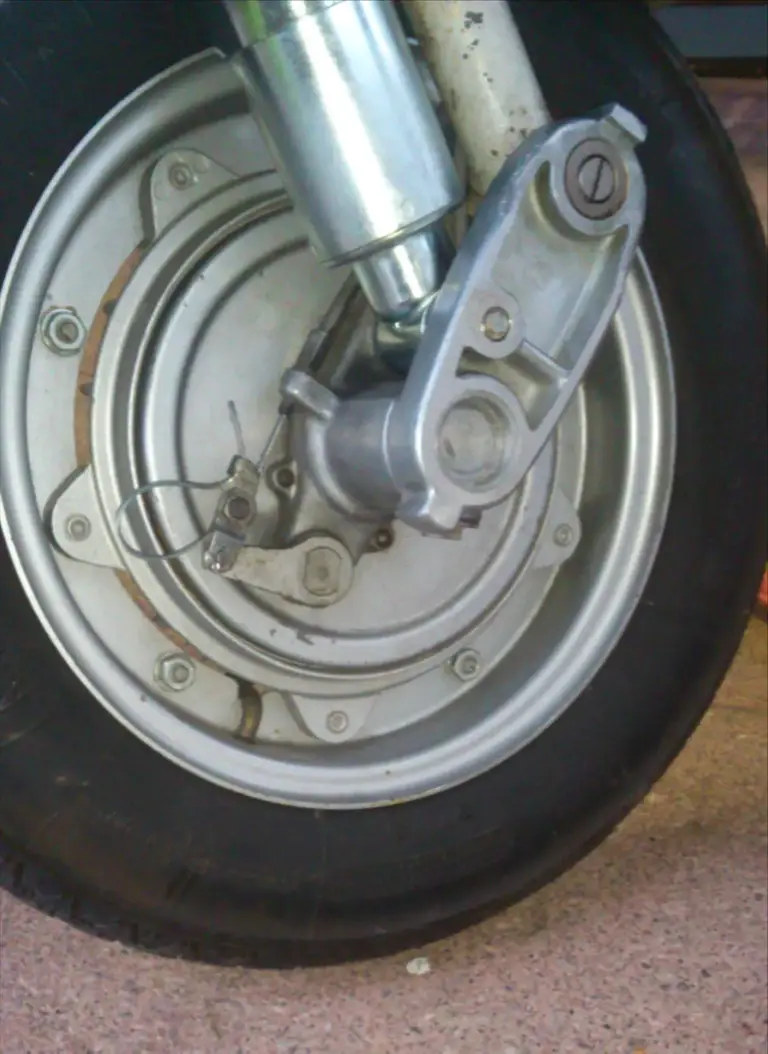
Each series brought small changes to the chassis, the engine and the fittings, so they can be told apart by the badge, the lighting and the speedometer; the VNB5T was the first to have a fourth gear. The Vespa 125 Super, known by its VNC code, was the last Vespa on 8-inch wheels, with self-ventilating brake drums at both ends, a slightly more angular body, aluminium trim strips on the side panels and five slots on the engine side. Its successor, the 125 GT, kept the engine but sat on a heavily modified frame.
Design and features
- Coil-sprung front end: the 125 replaced the Vespa 98’s band springs with a coil spring, and sprung the rear wheel as well.
- Rotary-valve engine: the VNB of 1959 brought a rotary-valve motor that ran on a 2 per cent petrol-oil mixture.
- Four speeds: the VNB5T added a fourth gear to the three-speed box of the early series.
- Long production: the largeframe chassis of 1957 was updated continuously and stayed in the range until 1979.
Vespa 125 versions
- VNA1T and VNA2T: the first series, three speeds and kick start.
- VNB (1959): rotary-valve engine, battery at first, later optional.
- VNB5T: the first four-speed 125.
- Vespa 125 Super (VNC): the last Vespa on 8-inch wheels, with a more angular body.
- Licence-built cars: the Vespa ACMA 125 Type N in France and the Vespa 125 Augsburg Types 232 and 392 in Germany.
The 125 shared its body with the Vespa 150 of 1954, and the two-stroke line ended with the Vespa PX. More scooters are in the Vespa collection.
Sources
- Vespa 125, German Wikipedia: production years, early series, the 1957 largeframe, licence production