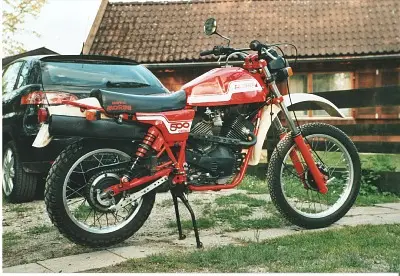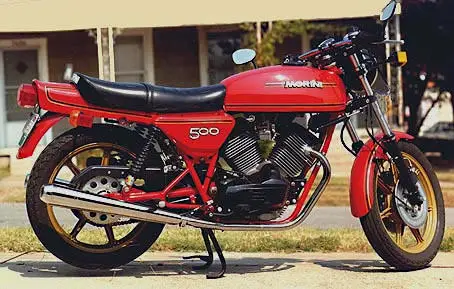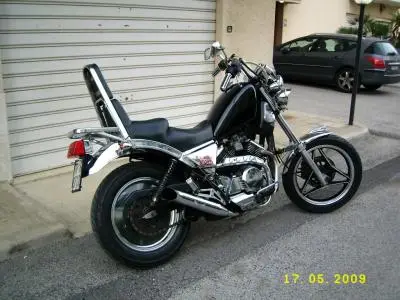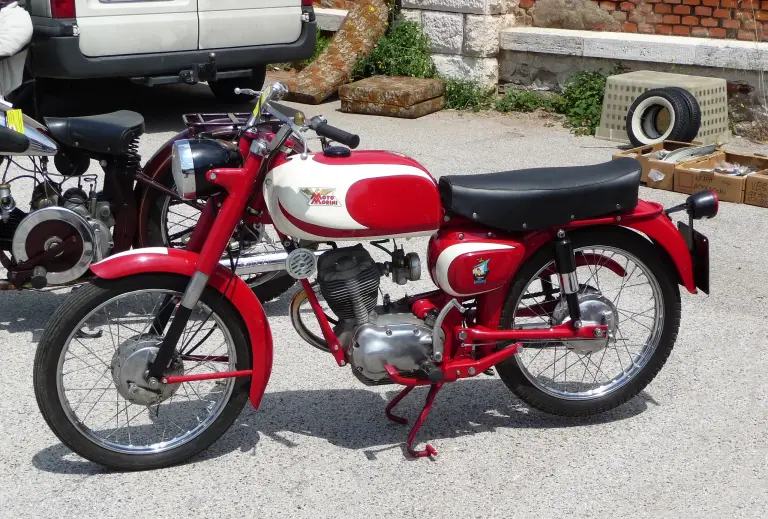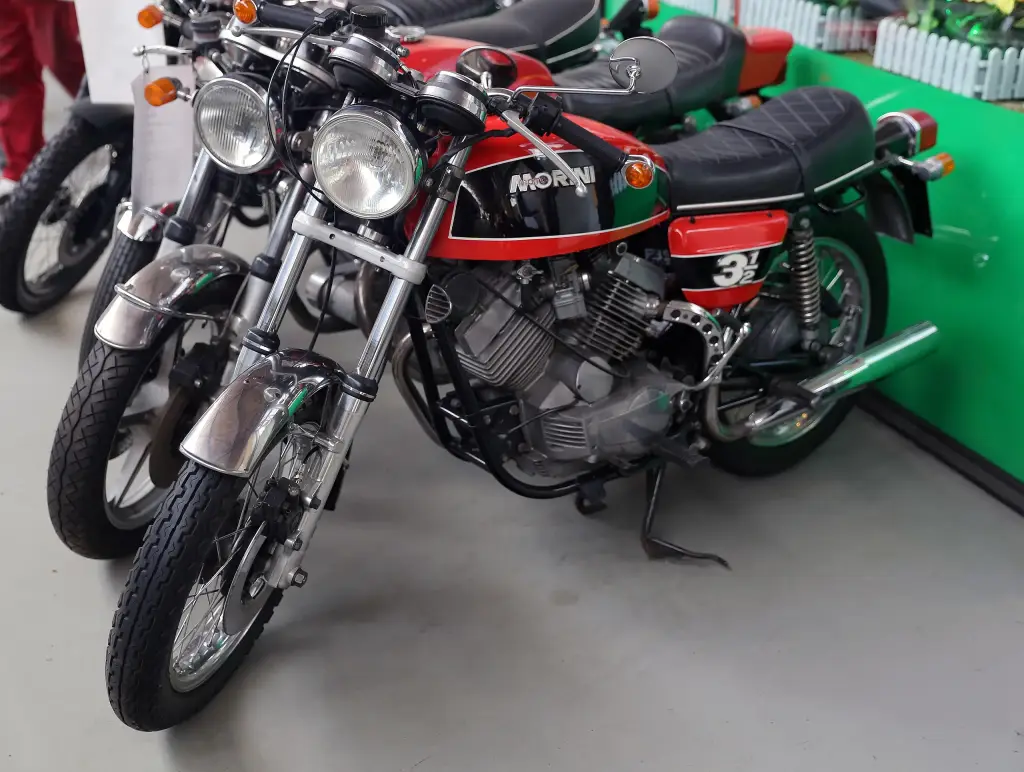
The Moto Morini 3½ is the 350 cc V-twin that Morini put into production in 1973 and built until 1983. It was designed by Franco Lambertini, who had come from Ferrari, and its engine was so modular that Morini derived every one of its later engines from it. The 3½ was sold as a tourer and, from 1974, as a sharper Sport version.
Moto Morini 3½ at a glance
| Made by | Moto Morini, Bologna, Italy |
|---|---|
| Production | 1973–1983 |
| Designer | Franco Lambertini, prototype shown at Milan in 1971 |
| Engine | 344 cc air-cooled 72-degree V-twin, pushrods and rockers |
| Heads | flat Heron heads, combustion chamber in the piston crown |
| Camshaft drive | toothed belt, the first on a production motorcycle |
| Gearbox | six speeds, one of the first six-speed gearboxes on a road bike |
| Standard output | 35 hp at 8,200 rpm, 166 km/h |
| Sport output | 39 hp at 8,500 rpm, just over 170 km/h |
| Chassis | steel double-cradle frame, Marzocchi forks, Ceriani shocks |
| Brakes | drum front, 200 mm on the Standard and 230 mm on the Sport, disc from 1976 |
| Replaced by | the 350 K2 of 1983 |
There is no English Wikipedia article on the 3½; this page is based on the Italian and German articles. The records for the 350 and the 350 Sport have been merged into this one.
History of the Moto Morini 3½
The background (1969–1973)
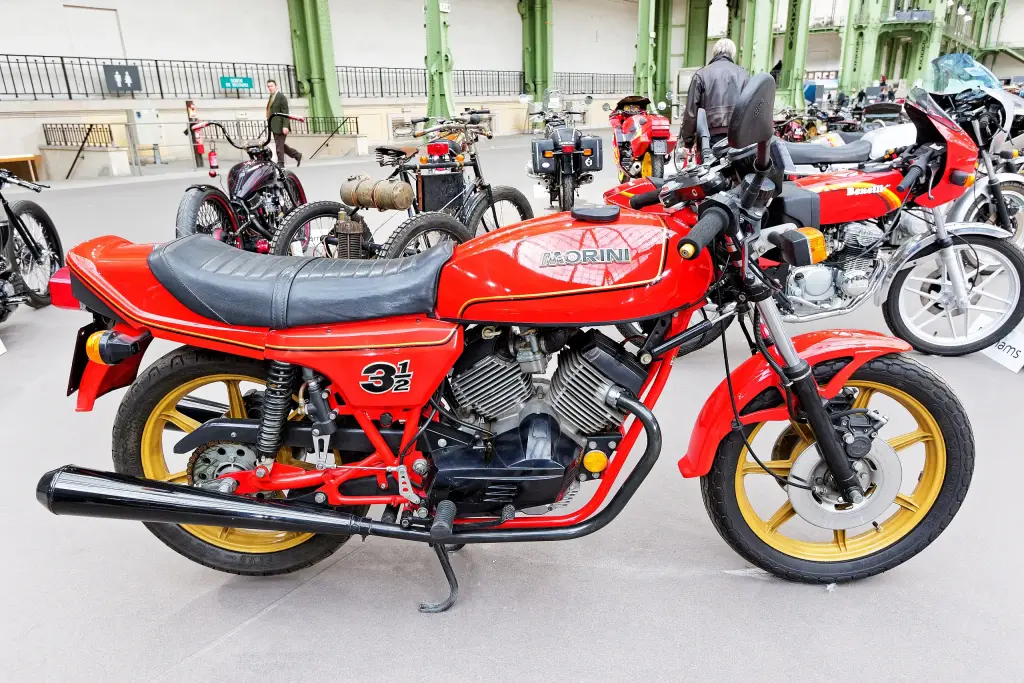
Alfonso Morini, who had founded the firm in Bologna in 1937, died in 1969 and his daughter Gabriella took over the company. Morini had until then built almost nothing but single-cylinder engines with pushrods and a low camshaft, and the new management wanted a modern range that would be simple to produce. Franco Lambertini, who had left Ferrari works and joined Morini in 1970, was given the job; he had already revised the engine of the Corsaro Regolarità. The first prototype of the new machine was shown at the Milan show in 1971 and series production began in 1973.
The engine
The 3½ took its name from its displacement, roughly 350 cc, and its engine was a 72-degree V-twin. Lambertini chose that angle as the best compromise between vibration, bulk, weight and compactness, and laid the crankshaft across the frame to keep the engine short. To save height there was no overhead camshaft: the parallel valves were worked by pushrods, and the combustion chambers sat in the piston crowns rather than in the cylinder heads, the Heron layout already used on the Corsaro Regolarità. The curved inlet ports gave the mixture a swirl that helped combustion, and the camshaft was driven by a small toothed belt, the first time that had been done on a motorcycle. Ignition was contactless, from a capacitor-discharge system designed by Ducati Elettronica, the clutch was a ten-plate dry unit and the gearbox had six speeds, unusual on a road bike of the time. The rear cylinder was set back 50 mm from the front one to help cooling, and the foot shift was on the right, unlike the Japanese competition. Suspension was a Marzocchi telescopic fork and two Ceriani shock absorbers, the frame a conventional steel double cradle and the instruments came from Veglia.
The versions (1973–1983)
At its launch the 3½ was offered only as the Standard, a touring machine also known as the GT or, for export, the Strada, with a flat dual seat and a chromed luggage rack that doubled as a grab handle. In 1974 Morini added the Sport: 39 hp at 8,500 rpm instead of 35 at 8,200, clip-on handlebars, a humped seat, a larger 230 mm front drum instead of the 200 mm item and a black and red paint scheme. The Standard was good for 166 km/h and the Sport for a little over 170, both on very little fuel. In Germany the Sport did not meet the noise limits, so it was officially sold with a baffle insert in the exhaust that cut output to 28 hp. The front brake became a disc in 1976, cast alloy wheels and, on the Sport, a small fairing with a hint of a screen followed later. The 3½ went out of production in 1983, when the 350 K2 arrived as its revised successor, and at the 2024 EICMA show Morini presented a new 3½ that reworked the lines of the original.
Design and features
- Toothed-belt camshaft drive: the first motorcycle engine to use a belt instead of gears or a chain for the camshaft.
- Heron heads: flat cylinder heads with the combustion chamber in the piston crown, which gave good combustion and low fuel consumption.
- Modular design: the same architecture was stretched from 125 to 500 cc, and every Morini engine up to the firm’s closure in 1992 came from it.
- Economy: rarely more than 5 litres per 100 km, and a 1976 test returned 65 miles per gallon with a rider and pillion aboard.
Moto Morini 3½ versions
- 3½ Turismo: the original touring version of 1973, with a flat dual seat and a chromed luggage rack.
- 3½ Strada / GT: the naked version without the rack, sold as the Strada from 1973 and as the GT from 1980.
- 3½ Sport: from 1974, with clip-ons, a humped seat, a bigger front drum and 39 hp.
- 350 K2: the 1983 reworking that ended the 3½’s career.
- 3½ of 2024: a modern reinterpretation shown at EICMA, not a production version of the original.
The 3½ engine also went into the Dart and, in larger form, into the Camel enduro. The small-block Morini of the 1960s was the Corsaro; more models are in the Moto Morini collection.
Video: 1975 Moto Morini 350 3 1/2 Sport Ride
Video on YouTube.
Sources
- Moto Morini 3½, Italian Wikipedia: history, engine design, versions, performance
- Moto Morini 3½, German Wikipedia: technical detail, variants, German-market restrictions