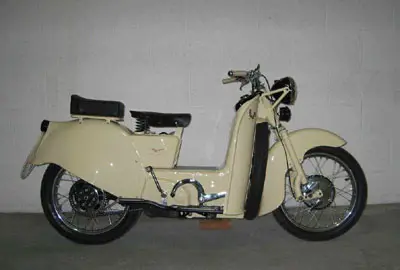
The Galletto is a scooter that Moto Guzzi built between 1950 and 1966. It came from a project by the company founder Carlo Guzzi, who set out to combine the advantages of a motorcycle with high wheels and those of a scooter.
Moto Guzzi Galletto at a glance
| Maker | Moto Guzzi, Mandello del Lario |
|---|---|
| Production | 1950–1966 |
| Designed by | Carlo Guzzi |
| Shown | Geneva motorcycle show, 1950 |
| Engine | 159.5 cc at first, 160, 175 and 192 cc later |
| Layout | horizontal single, pushrod and rockers, short stroke |
| Gearbox | three speeds at first, four from 1952 |
| Wheels | 17-inch, 2.75-17 front and 3.00-17 rear |
| Fuel tank | 7 litres |
| Top speed | 80 km/h in the first version |
| Later versions | 175 cc with 7 hp and 85 km/h, 192 cc with 7.5 hp, electric start in 1961 |
The English Wikipedia has no article on the Galletto; this page is based on the Italian article and is therefore based on one source.
History of the Moto Guzzi Galletto
The Galletto was born from a project by the founder of the company, Carlo Guzzi, who decided to combine the advantages of a motorcycle with high wheels with those of a scooter, removing the drawbacks of both: the machine offered the rider protection, ease of use and a spare wheel, mounted between the front wheel and the front part of the frame though listed as an extra, together with the performance, comfort and road holding of a motorcycle. Work had begun around 1947 with experiments on a 125 cc vehicle of the same type.
The prototype was shown at the Geneva show in 1950 and was an immediate success for its comfort and strength. It was presented with a 150 cc engine but went on sale some time later with the engine taken to 160 cc. At the Milan show in 1952 a revised version appeared with the engine enlarged to 175 cc, 7 hp and 85 km/h, and a four-speed gearbox with an electrical system able to work as an emergency if the battery failed. At the beginning of 1954 the engine grew again to 192 cc with 7.5 hp and a 6-volt dynamo.
High wheels and a short stroke
The scooter had high wheels, 2.75-17 at the front and 3.00-17 at the rear, which made it the ancestor of modern high-wheel scooters. The rear wheel was cantilevered and fixed, like the front one, by four aluminium nuts. It was therefore suitable for long journeys and could carry fairly heavy loads without losing performance; the tank held 7 litres and the top speed of the first version, with the 159.5 cc horizontal pushrod single and three-speed gearbox, was 80 km/h.
The general layout was influenced by the official definition of motoscooter in the 1949 sporting regulations of the Italian motorcycle federation, which specified an open frame and wheels of no more than 17 inches, and this explains the choice of wheel size and the need to keep the engine within limits that did not affect the wheelbase or the width of the vehicle. The engine itself was unusual: it had no traditional crankshaft, the connecting rod working on an overhung flywheel with a very short stroke, an idea taken from racing experiments in the Moto Guzzi research department. The bore and stroke were 60 by 53 mm for 150 cc and 6.4 hp at 5,200 rpm, a ratio of 0.885, chosen to keep the wheelbase short.
The end
In 1956 the engine of the Galletto was developed into the Ercolino light truck. The last Galletto version dates from 1961 and is recognisable by various styling and mechanical changes, the most important being electric starting. When the ownership of Moto Guzzi passed from the Parodi family to SEIMM, it was decided to drop all models considered obsolete or unprofitable, and the Galletto went out of production in 1966.
Design and features
- High-wheel scooter: 17-inch wheels, the idea behind today’s big-wheel scooters.
- Spare wheel in front of the leg shield: a third tyre for punctures that also protected the rider’s legs.
- Short-stroke engine: no traditional crankshaft, the rod working on an overhung flywheel.
- Growing engine: 160, 175 and 192 cc through the years, with electric start from 1961.
- Ercolino link: the engine was developed into the Ercolino light truck in 1956.
Moto Guzzi Galletto versions
- Galletto 160 (1950): the first production version, 80 km/h and three speeds.
- Galletto 175 (1952): 7 hp, 85 km/h and a four-speed gearbox.
- Galletto 192 (1954): 7.5 hp with a 6-volt dynamo.
- Galletto 1961: revised styling with electric starting, the last version.
The Galletto engine later powered the Ercolino truck, part of the Moto Guzzi triporteurs, and it was a contemporary of the Airone. More machines are in the Moto Guzzi collection.
Video: Moto Guzzi Galletto 192
Video by verdi292 on YouTube.
Sources
- Moto Guzzi Galletto, Italian Wikipedia: history, engine sizes, wheels, technical details, end of production