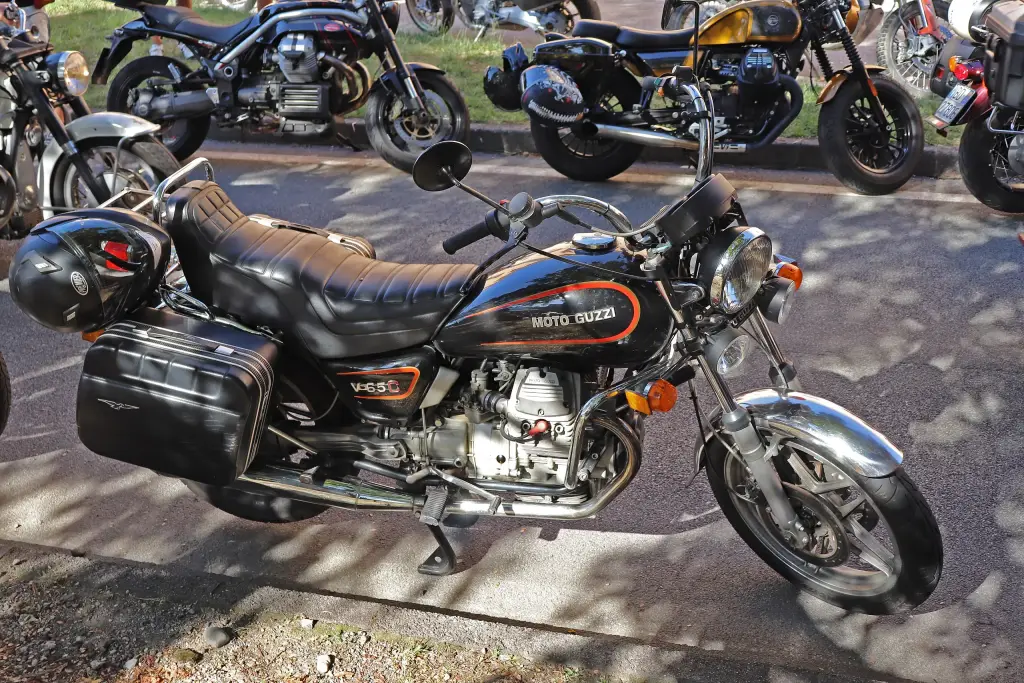
The V65 is a motorcycle model produced by Moto Guzzi from 1982 to 1994 in various versions. It was the 650 cc member of the small-block family, presented at the Milan show in 1981 and on sale from the summer of the following year.
Moto Guzzi V65 at a glance
| Maker | Moto Guzzi, Mandello del Lario |
|---|---|
| Production | 1982–1994 |
| Presented | Milan motorcycle show, 1981 |
| Engine | 650 cc 90° V-twin, with heads developed from the V35 and V50 project |
| Power | 52 hp, 60 hp on the four-valve Lario |
| Gearbox | five speeds, shaft final drive |
| Main versions | V65, SP, Custom, Lario, TT, NTX 650, Florida, GT, P.A. |
| Custom series | C, also available as 350 and 500 |
| Public service | V65 P.A. with three-piece fairing and a siren in place of the pillion seat |
The English Wikipedia has no article on the V65; this page is based on the Italian article and is therefore based on one source.
History of the Moto Guzzi V65
After presenting the Moto Guzzi V35 and V50 at the end of the 1970s, machines that used the classic V2 layout of the historic V7 designed by engineer Carcano, the Mandello company decided to renew the project according to new knowledge and new trends in ergonomics and economy, for the factory and the rider alike, and for mechanical practicality, trying to cut consumption without losing performance. The modernisation was carried out by engineer Tonti.
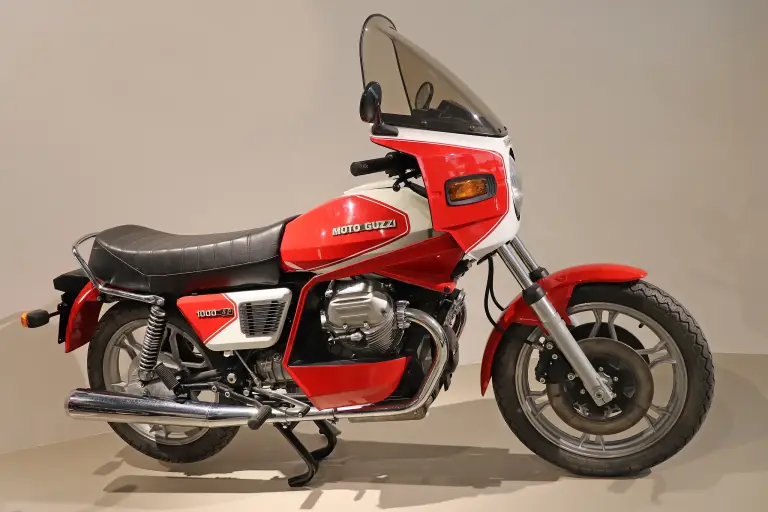
The project was initially a frame, the usual one of the V35 and V50, which the Guzzisti call the small series because of their low capacities, that had to carry the bodywork of three models: the Normale, a road bike; the SP, for Super Protezione, a machine derived entirely from the Normale but with aerodynamic protection studied in the company wind tunnel, hence a road and touring bike; and the Lario, a sports machine derived from the bodywork of the Guzzi V35 Imola II with the 650 cc engine and, as the novelty that caused more problems than satisfaction, the Guzzi four-valve head. The four-valve head raised power to 60 hp against 52 hp for the others and had a good response at high revs, but the valves, rockers and their mechanisms often needed adjustment because of the frequent stress.
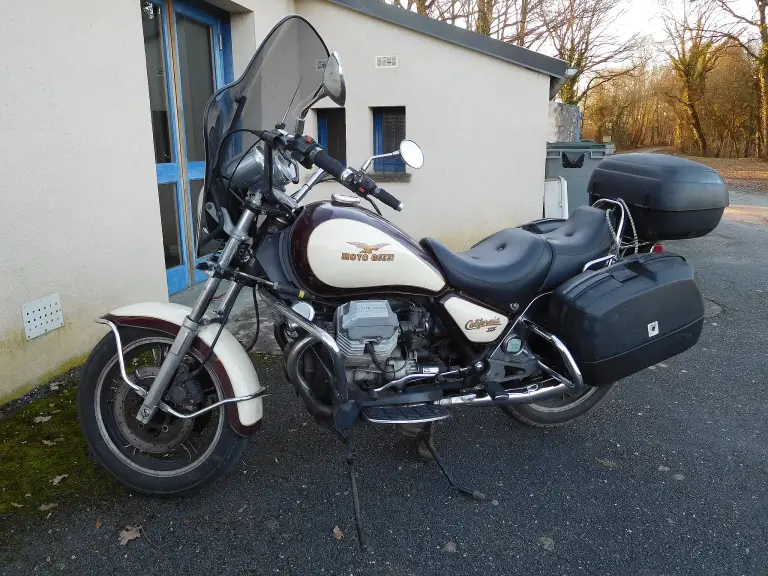
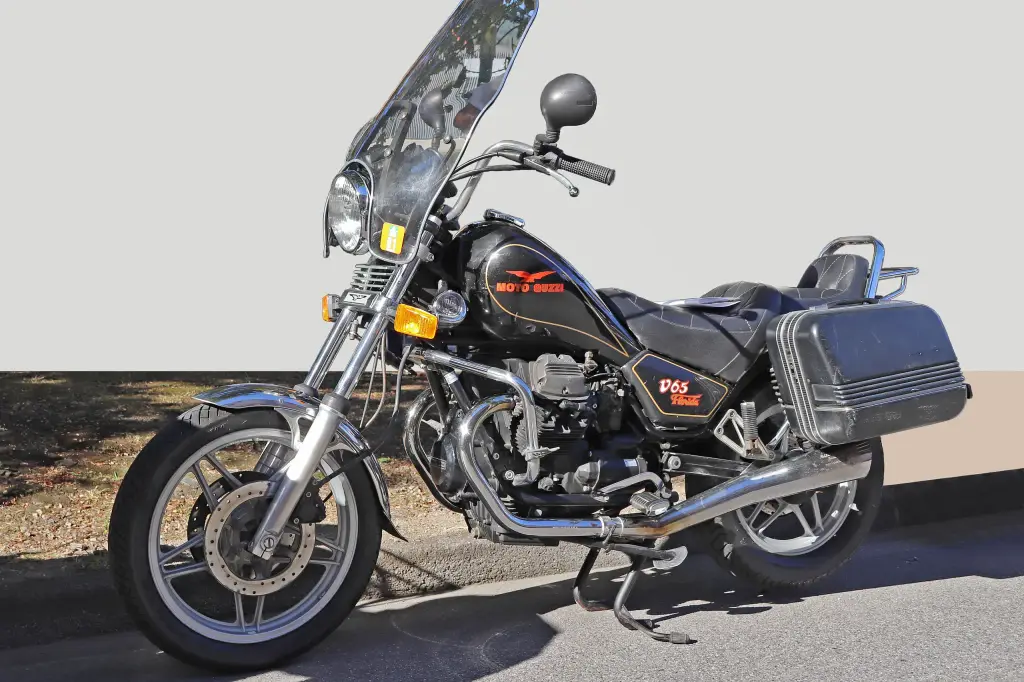
The range, presented at the Milan show in 1981 and on sale from the summer of 1982, remained unchanged until 1984 despite modest sales and the already mentioned Lario problems, partly solved but by then of bad reputation. Then the C series was introduced, a Custom segment available with 350, 500 and 650 cc engines, with a more European than American line that the customers of the time much appreciated; it was the best-selling city custom for a long time. As standard the largest of the three had Guzzi panniers marked with the eagle and a screen, matching the bigger customs and even inspiring the line of the Moto Guzzi California III.
Police and later versions
Alongside the new V65, Guzzi, which had long supplied patrol motorcycles to the traffic police, also supplied the new small-series machines, including the P.A. model with specific equipment required by the ministry for approval as a police vehicle. Unlike the Normale it had a single seat, the second place being reserved for the siren and equipment, and a three-piece fairing, different from the SP, which later became an integral touring fairing in the following NT version. For economy the factory prepared the P.A. versions from the 650 cc engine, since the 500 was standard and 650 engines were optional, simply mounting the engine in the frame. Since these machines carried the frame numbers of the road Normale, it is impossible to compile a complete production figure for the V65.
In the second half of the 1980s the range looked old, and with the introduction of the V75, closer to the Lario than to the normal V65, it was decided to drop the Normale and the SP, continue production of the Lario and the C with light restyling and introduce a new model, the Florida, a close relative of the Custom family designed to Italian canons, with an elongated tank, a forward and low seat, and a rack with a backrest. From the V65 Florida the Moto Guzzi Nevada was later developed. The V65 engine did not stop being produced: it was used for a new roadster, the GT, which followed the lines of 1970s bikes and was derived from the V35 III, with no fairing, chrome engine guards and round mirrors. That was the last novelty among the V65 road models, and after the end of Florida production the model practically ceased to exist apart from the P.A. versions and the 650 cc off-road engines.
Design and features
- One frame, three bikes: the Normale, SP and Lario shared the small-block chassis.
- Four-valve Lario: 60 hp instead of 52, with delicate valve gear needing frequent adjustment.
- Wind-tunnel SP: the Super Protezione fairing was developed in the company wind tunnel.
- City custom: the C series was for years the best-selling custom of its kind in Italy.
- Police version: the P.A. with a three-piece fairing and the siren where the pillion seat would be.
Moto Guzzi V65 versions
- V65 (1982–1987): the standard roadster.
- V65 SP (1983–1986): Super Protezione with a wind-tunnel fairing.
- V65 Custom (1984–1987): the C series in 650 form.
- V65 Lario (1984–1987): the sports version with the four-valve head.
- V65 TT (1984–1989) and NTX 650 (1987–1994): the off-road models.
- V65 Florida (1986–1994): the custom that led to the Nevada.
- V65 GT (1987–1993): the later retro-styled roadster.
- V65 P.A.: the public-service version.
The V65 was the bigger brother of the V35, and its Florida version led to the Nevada; the four-valve Lario followed the Le Mans idea. More machines are in the Moto Guzzi collection.
Sources
- Moto Guzzi V65, Italian Wikipedia: project, versions, Lario, custom series, police version, later models