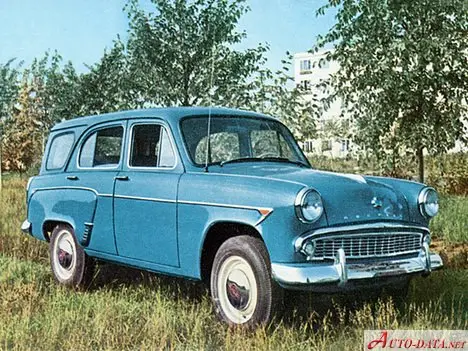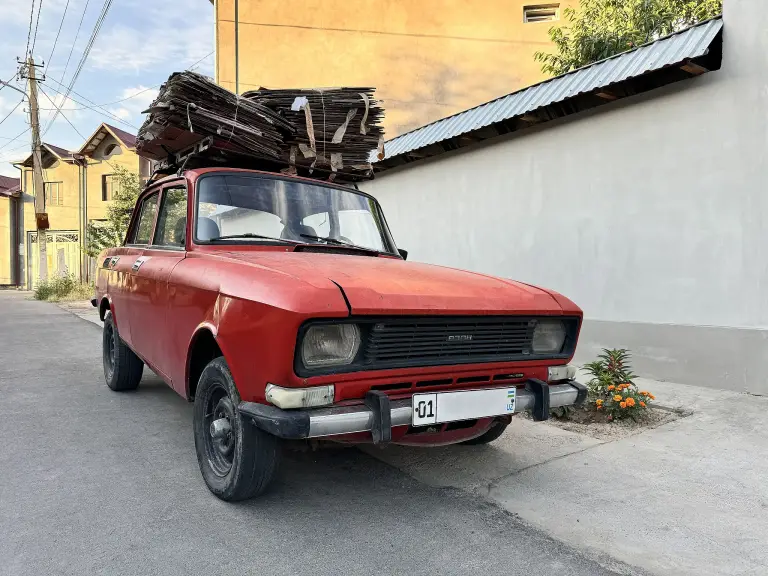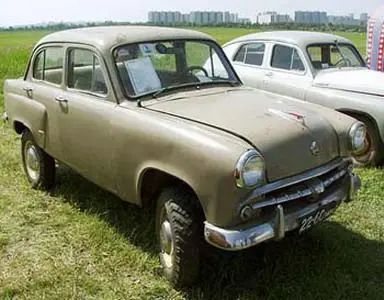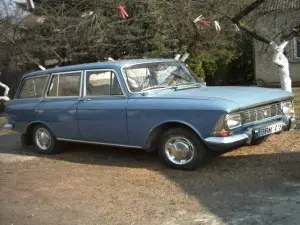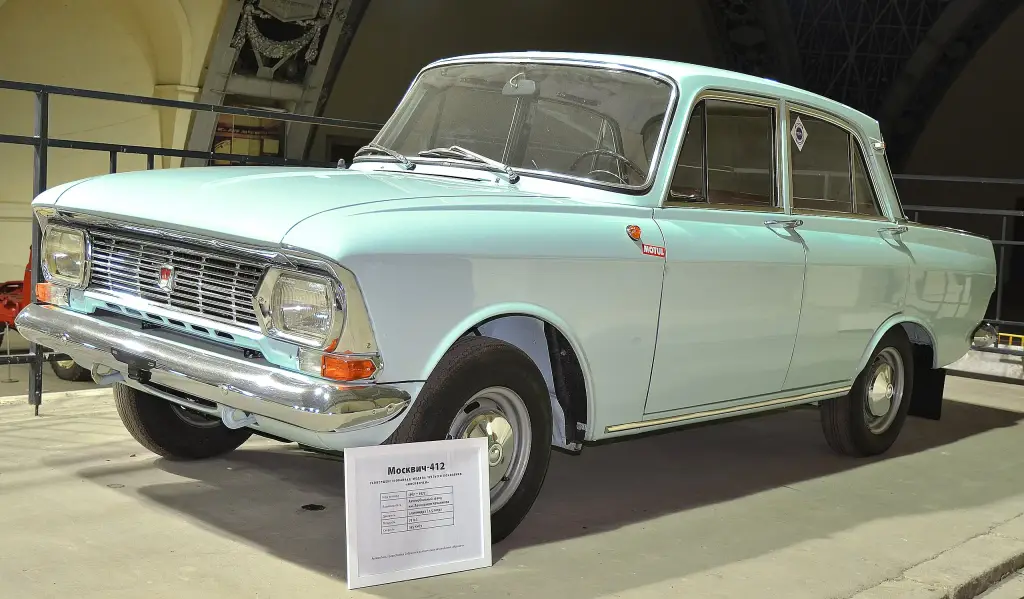
The Moskvich 412 was the powerful version of the Moskvich 408. Introduced in October 1967 with a new 1.5-litre overhead-cam engine of 75 hp, it gave the small Moskvich performance previously reserved for larger cars. AZLK built it in Moscow until 1975, while the IZh factory in Izhevsk kept it in production until 1997.
Moskvich 412 at a glance
| Makers | MZMA / AZLK, Moscow; IZh, Izhevsk |
|---|---|
| Production | Moscow October 1967 – 1975; Izhevsk 1967–1997 |
| Body | four-door saloon; estate M-427, van M-434 |
| Engine | 1,478 cc overhead-cam four, aluminium block, 75 hp |
| Engine layout | tilted 20 degrees to fit under the bonnet |
| Sports version | 412-2V, 100 hp |
| Power to weight | 13.9 kg per hp, against 19 for the GAZ-21 Volga |
| Gear lever | column until early 1969, floor afterwards |
| Front brakes | discs from 1970 on part of production |
| Safety code | M-412IE after the 1969 redesign |
| Racing | SATRA Motors entries, 1972–1973 |
History of the Moskvich 412
The 412 was planned from the start of the 408 project as a version with a more powerful and faster-revving engine. To win state funding for the new motor, a sports variant was proposed; the open “Tourist” never reached production, but the engine work continued and by the mid-1960s produced the 1.5-litre overhead-cam M-412. That engine went into a modified 408 body, and the car’s acceleration improved so much that it reached the practical limit of the chassis.
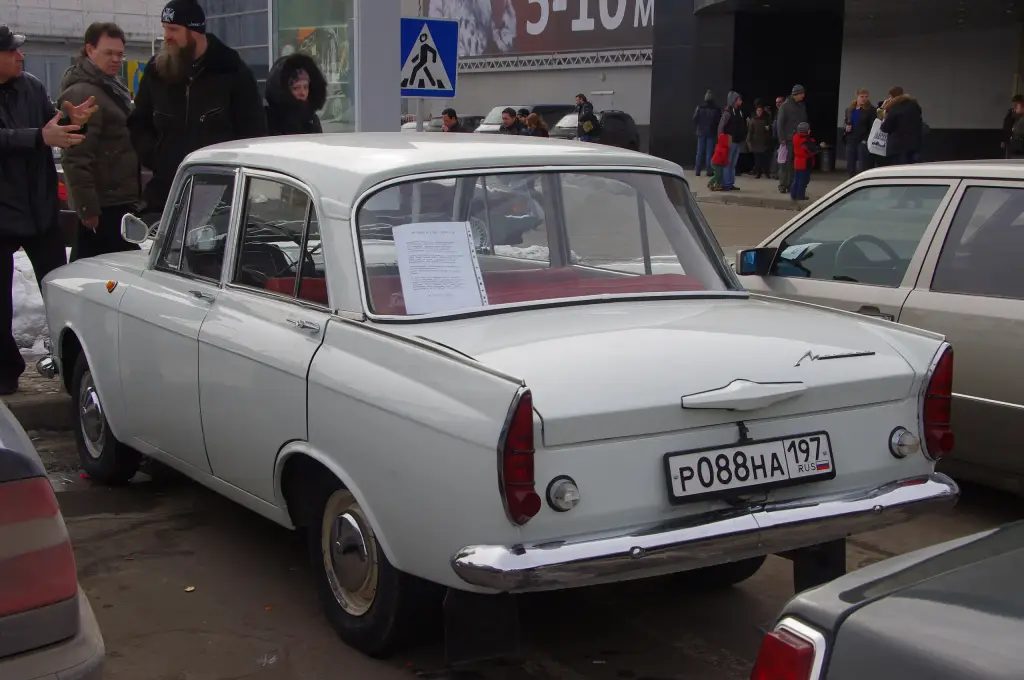
The engine was the work of designer Igor Okunev. Its block, head and inlet manifold were cast in aluminium alloy to save weight, it had a hemispherical combustion chamber and replaceable steel liners, and because the overhead camshaft made it taller than the old overhead-valve unit it was mounted at a tilt of 20 degrees. With 1,478 cc and 75 hp it gave the Moskvich a power-to-weight ratio of 13.9 kg per hp, better than the GAZ-21 Volga at 19 and even the future GAZ-24 at 15.5. A 100 hp version, the 412-2V, was used in sports cars.
Production began in October 1967. Until early 1969 the 412 had the gear lever on the steering column and a front bench seat, so that only the badge on the boot distinguished it from a 408; separate front seats came in January 1968 and the floor-mounted lever in November 1968, together with a collapsible steering column. In November and December 1969 both the 408 and the 412 received a redesigned body, the first Moskvich with rectangular headlights—East German VER units shared with the Wartburg 353—and horizontal rear lights with triangular indicators on the small fins. The modified cars carried the suffix IE, standing for the new safety standards and export potential.
Safety was the theme of the later cars. The body was crash-tested, met the UNECE standards and received an international safety certificate after almost five months of testing in France. From 1970 there were dual-circuit power-assisted brakes, front disc brakes on part of the output, a reinforced structure, a soft-rimmed wheel, padded interior parts, seat belts and a padded dashboard. The 412 was the first Moskvich to pass safety tests in France, Bulgaria, Czechoslovakia and Sweden in 1970–71 and in West Germany in 1972. It also went racing: SATRA Motors campaigned 412s in the Group One Production Saloon championship in 1972 and 1973, beating Hillman Imps and Austin Minis, took a 1-2-3 in the 1973 Avon Round Britain Rally and a class win on the South Africa Safari Rally.
Design and features
- Overhead-cam engine: 1,478 cc, aluminium block and hemispherical chambers, 75 hp.
- Performance: the best power-to-weight ratio of any small Soviet car of its time.
- Safety equipment: dual-circuit servo brakes, front discs, seat belts and a padded dashboard.
- International approval: safety tests passed in France, Sweden, Czechoslovakia, Bulgaria and West Germany.
- Long life: built in Moscow to 1975 and in Izhevsk until 1997.
Moskvich 412 versions
- Moskvich 412 (1967–1969): first series with round headlights and a column gear lever.
- Moskvich 412IE (1969–1975): redesigned body with rectangular headlights and floor lever.
- Moskvich 412-2V: 100 hp version for sports cars.
- Moskvich 427 (1969–1976): five-door estate on the 412 base.
- Moskvich 434 (1968–1976): three-door panel van derived from the 427.
- IZh-412 (1967–1997): Izhevsk-built version developed on its own programme.
The 412 was developed from the Moskvich 408, and its estate version is described under Moskvich 427. Its successor was the Moskvich 2140, and more models are in the Moskvich collection.
Sources
- Moskvitch 412, English Wikipedia: engine, safety work, racing, versions
- Москвич-412, Russian Wikipedia: development, power-to-weight, production dates