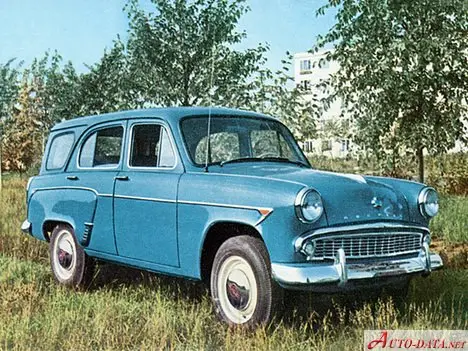
The Moskvich 423 was the first estate car built in series in the Soviet Union. Introduced in early 1957 on the chassis and mechanics of the Moskvich 402, it was a five-door load carrier that could be used as a family car during the week and as a van at weekends. Production lasted until 1963.
Moskvich 423 at a glance
| Maker | MZMA, Moscow |
|---|---|
| Production | 1957–1963 |
| Based on | Moskvich 402 |
| Body | five-door estate |
| Engine | 1,222 cc four, 35 hp |
| Payload | 250 kg with two people, including the driver |
| Alternative load | four or five people and 100 kg of luggage |
| Cargo floor | 1,473 mm long and 1,220 mm wide with the rear seat folded |
| Tailgate | hinged on the left, sill 760 mm above the ground |
| Rear springs | 5 mm wider than on the 402 saloon |
| Spare wheel | in a horizontal well under the floor |
A separate article on the 423 exists only in Russian Wikipedia; the English article describes the estate as the 402-423. No free photographs of the 423 estate were found, so the article uses the existing cover image.
History of the Moskvich 423
In early 1957 the Moscow small-car factory began producing a cargo and passenger car of the estate type, the Moskvich 423. It was the first Soviet car of this kind to be built in series, and it used the same side panels with curved drip rails and the same rear panel with its high boot sill as the saloon it was derived from, the Moskvich 402. The layout was simple and practical: the rear seat folded to make a load bay 1,473 mm long and 1,220 mm wide, and with the seat down the car could carry 250 kg and two people, including the driver, or four or five people with 100 kg of luggage.
The engineers made a few changes to suit the extra load. The rear springs were 5 mm wider than those of the basic Moskvich 402, and a horizontal well under the floor held the spare wheel, keeping it out of the load area. The fifth door was hinged on the left and its sill sat 760 mm above the ground, a compromise between loading height and rear overhang. Mechanically the car followed the 402, with its 1,222 cc engine of 35 hp.
From 1961 a simplified body was introduced, with squared-off frames around the rear side windows and a single continuous drip rail running along the whole roof instead of the curved sections of the original. The estate remained in production until 1963, when the newer generation took over: the Moskvich 426 appeared in 1967 as the estate version of the Moskvich 408, with the 423 and the 424 listed by the factory as the models it replaced. Estates were never built in the same numbers as saloons, and surviving 423s are rare today, which makes the model an early landmark in Soviet family-car design.
Design and features
- First Soviet series estate: a five-door body built in volume from 1957.
- Flexible load bay: 1,473 mm long with the rear seat folded.
- 250 kg payload: enough for two people and their goods.
- Practical details: left-hinged tailgate and a spare wheel well under the floor.
- Strengthened rear end: wider leaf springs than the 402 saloon.
Moskvich 423 versions
- Moskvich 423 (1957–1963): the standard estate with curved drip rails.
- 1961 body: squared rear door frames and a single roof-long drip rail.
- Moskvich 424: the estate of the later 403 generation, with squared rear door frames.
The 423 was the estate version of the Moskvich 402 and 407, and it was replaced by the Moskvich 426. More models are in the Moskvich collection.
Sources
- Москвич-423, Russian Wikipedia: body, payload, dimensions, 1961 change
- Moskvitch 402, English Wikipedia: estate introduction, engine, payload