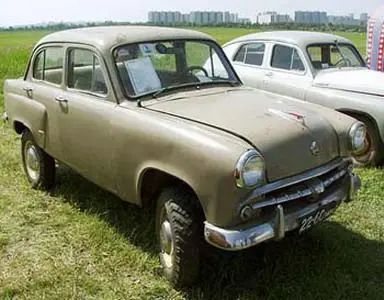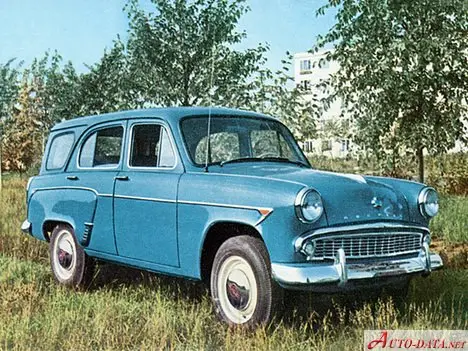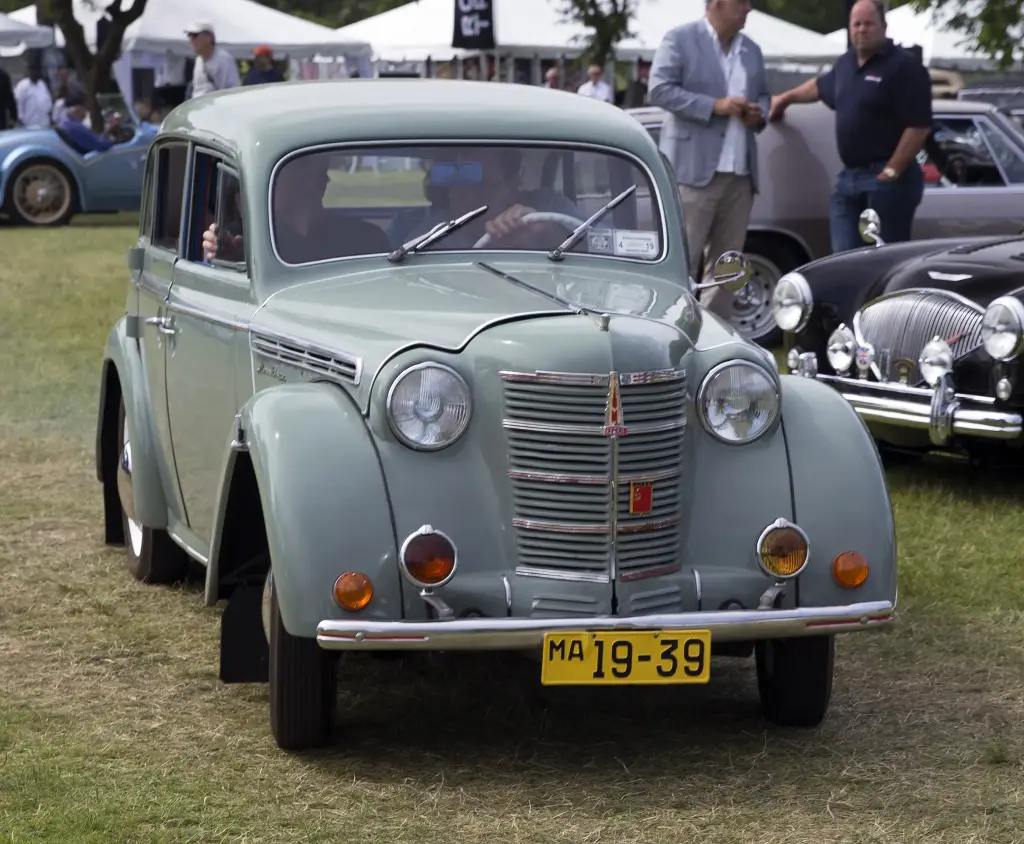
The Moskvich 400 was the first Soviet car built in large numbers for private owners. Developed from the Opel Kadett K38 and put into production in December 1946, it was a small four-door saloon of 1,074 cc. In 1954 it was replaced by the improved Moskvich 401, and by the end of production in 1956 the two had reached 247,439 cars.
Moskvich 400 at a glance
| Maker | MZMA, Moscow |
|---|---|
| Production | December 1946 – April 1956 |
| Design basis | Opel Kadett K38 (1937–1940) |
| Body | four-door saloon, unitary construction |
| Engine | 1,074 cc sidevalve four, 23 hp (26 hp in the 401) |
| Transmission | three-speed manual; column gear lever from 1951 |
| Brakes | hydraulic |
| Dimensions | 3,855 × 1,400 × 1,550 mm, wheelbase 2,340 mm |
| Economy | 9 L/100 km, the best of any Soviet car at the time |
| Production total | 247,439 (400 and 401 together) |
| Price in the USSR | 8,000 roubles (400), 9,000 roubles (401) |
History of the Moskvich 400
The Moskvich 400 grew out of a pre-war plan for a small car for buyers outside the big cities. The KIM factory had built the KIM-10 before the war, but the project died with the German invasion. After 1945 the Soviet Union took the plans and tooling of the 1939 Opel Kadett K38 as part of reparations, and in June 1945 Joseph Stalin personally chose the four-door Kadett as the pattern for the country’s first mass-produced popular car. KIM was renamed MZMA in August 1945, and the first car was built on 9 December 1946: in the type number, 400 stood for the engine and 420 for the saloon body.
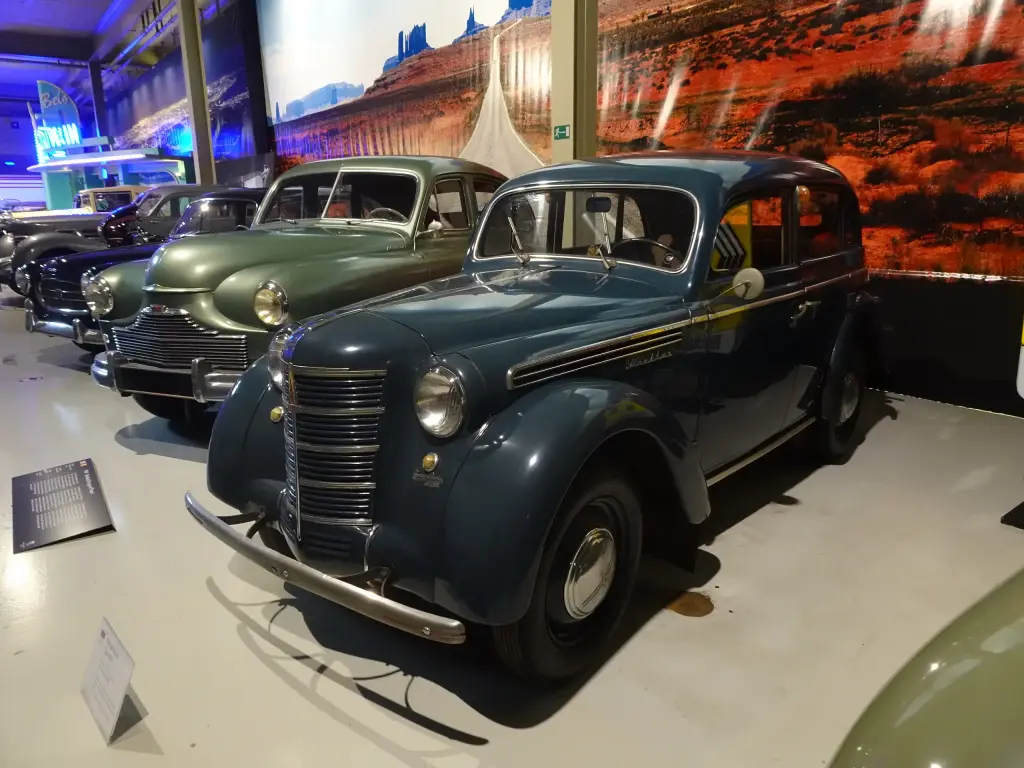
The car had unitary construction, independent front suspension, a three-speed manual gearbox and hydraulic brakes. Its 1,074 cc engine produced 23 hp, giving acceleration to 80 km/h in 55 seconds and a fuel consumption of 9 L/100 km, then the best of any Soviet car. Mass production was approved on 28 April 1947; 1,501 cars were built in the first year, 4,808 in 1948 and 19,906 in 1949, the year a mesh oil filter was added. Synchromesh on the top two gears and a column-mounted gear lever arrived in 1951, and the 100,000th Moskvich was built in October 1952.
Other bodies followed the saloon. A wood-framed van, the 400-422, with an 800 kg payload, went into production in 1948, while the 400-421 estate and a pick-up stayed prototypes. A cabriolet, the 400-420A, appeared in 1949. In October 1950 the 400 went on sale in Belgium at £349, below the Ford Prefect and Anglia and well below the Morris Minor; the magazine Motor praised the quietness of its engine, the quality of its finish and its ride.
The Moskvich 401 of 1954 was an improved 400 rather than a new car. A higher compression ratio of 6.2:1 and better intake and exhaust manifolds raised output from 23 to 26 hp, and there were new starter motor, dynamo, wheel bearings and handbrake; externally the two cars were identical. The 401 weighed 885 kg and reached 90 km/h. The van was renumbered 401-422 and a pick-up, the 401-420B, was also listed. The saloon went out of production on 20 April 1956, replaced by the Moskvich 402.
Design and features
- Unitary body: modern construction for 1946, with independent front suspension.
- Frugal engine: 9 L/100 km made it the most economical Soviet car of its day.
- Private buyers: the first Soviet car produced in volume for individual ownership.
- Export success: on sale in Belgium from 1950 at £349, undercutting British small cars.
- 401 improvements: higher compression, better manifolding and a stronger electrical system.
Moskvich 400 versions
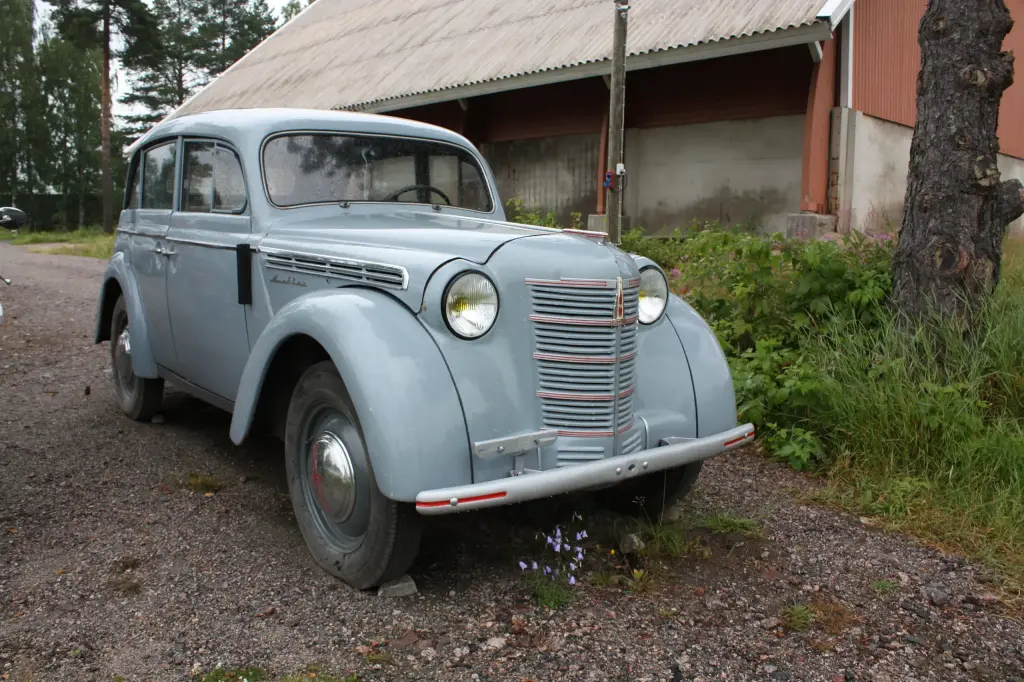
- Moskvich 400-420 (1946–1954): the standard saloon.
- Moskvich 400-422 (1948–1956): wood-framed van with an 800 kg payload, later 401-422.
- Moskvich 400-420A (1949): cabriolet.
- Moskvich 401-420 (1954–1956): improved saloon with 26 hp.
- Moskvich 401-420B: pick-up version.
The 400 was replaced in 1956 by the Moskvich 402, and its four-wheel-drive relative is described under Moskvich 410. More models are in the Moskvich collection.
Sources
- Moskvitch 400-420, English Wikipedia: development, engines, bodies, exports, totals
- Москвич-400, Russian Wikipedia: prices, production split, Kadett origin