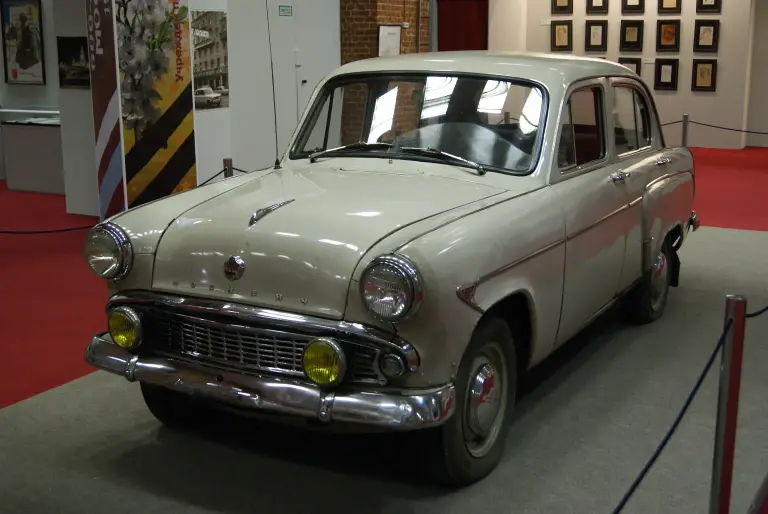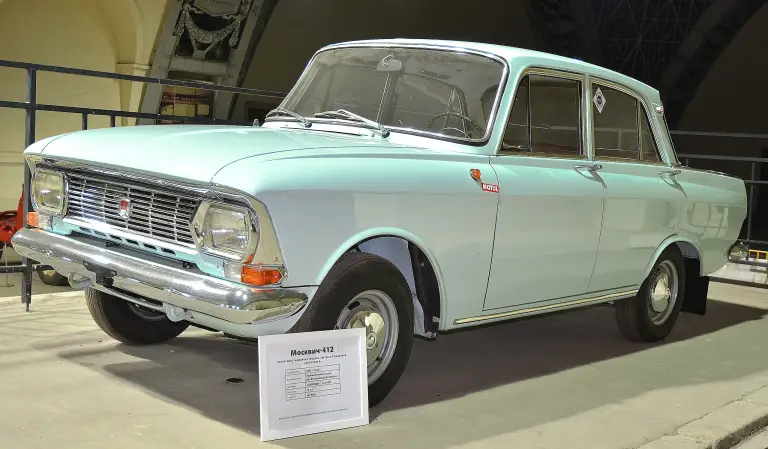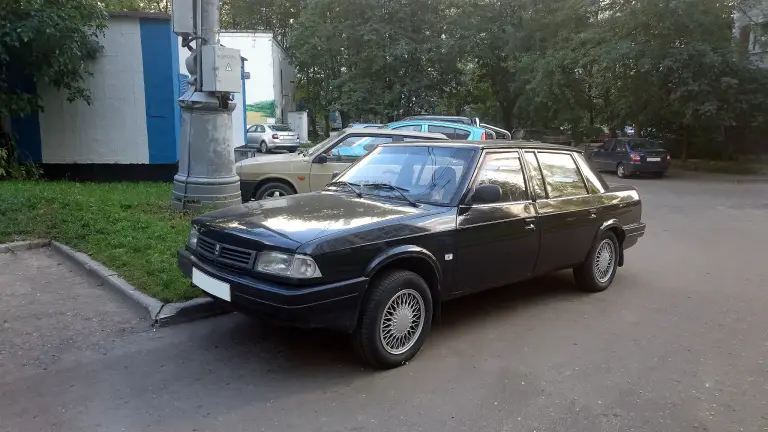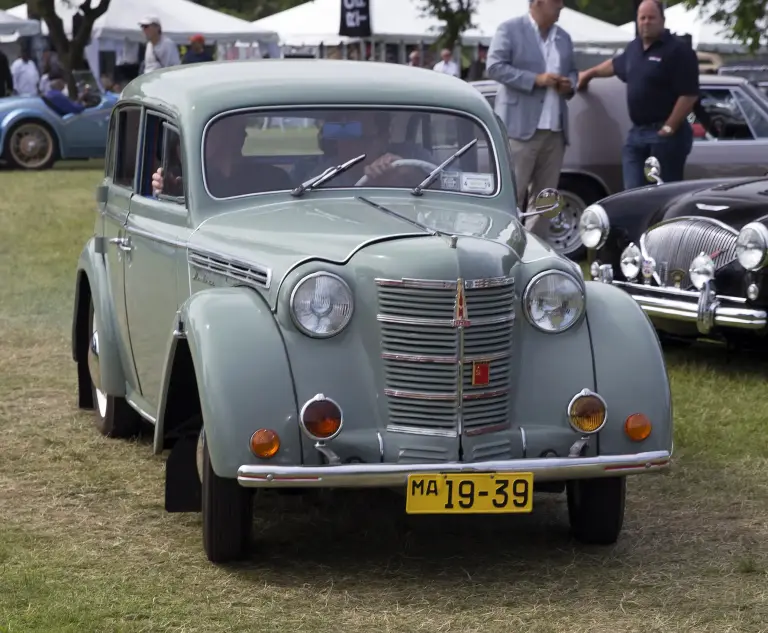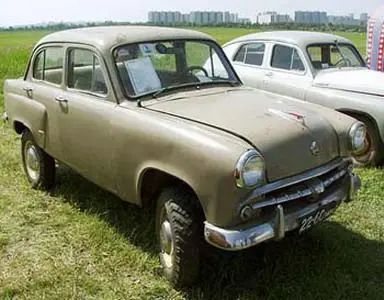
The Moskvich 410 was a limited-production four-wheel-drive car built by MZMA from 1957 to 1961, meant for repair teams working in the fields. It used the body of the Moskvich 402 with a reinforced structure, GAZ-69 axles and a two-speed transfer case, and it was followed in 1958 by the 410N with a more powerful engine and by the 411 estate.
Moskvich 410 at a glance
| Maker | MZMA, Moscow |
|---|---|
| Production | 1957–1961 |
| Based on | Moskvich 402 and 407 saloons |
| Engine 410 | 1,222 cc flathead four, 35 hp |
| Engine 410N | 1,358 cc overhead-valve four, 45 hp |
| Ground clearance | 220 mm under the axles, 430 mm under the floor |
| Wading depth | 0.3 m |
| Climb | 33 degrees in first gear |
| Top speed | 85 km/h |
| Transmission | three-speed plus two-speed transfer case; four-speed from 1960 |
| Built | 7,580 of the 410, 1,515 of the 411 |
| Estate version | Moskvich 411, from 1958 |
The two sources give different production totals: 7,580 cars in English Wikipedia against about 10,500 for the 410 and 410N together in Russian; both figures are quoted. No free photographs of the 410 were found, so the article uses the existing cover image.
History of the Moskvich 410
The idea came from the Virgin Lands campaign: mechanics repairing machinery in the fields needed cheap personal transport, and the GAZ-69 used too much fuel for the job. GAZ built the first M-72 prototypes in 1955, and the party leadership liked the idea of off-road cars based on passenger models. GAZ developed the M-73 in 1956 with the engine and some parts of the Moskvich 402, but had no spare capacity, so the work was handed to MZMA and the car went into production there in the first quarter of 1957.
The 410 was a 402 with a reinforced unitary body, the steering gear of the Pobeda, an oil radiator for the engine and Bendix-Weiss constant-velocity joints in the front axle. A two-speed transfer case was designed specially for it, telescopic dampers gave way to lever-type ones better suited to rough ground, and the car rode on larger 6.40-15 tyres with a knobbly tread. Ground clearance rose to 220 mm, wading depth was 0.3 m and the car could climb a 33-degree slope in first gear, but top speed fell to 85 km/h against 105–115 km/h for the 402.
The original 410 used the 35 hp flathead engine and a three-speed gearbox with a two-speed transfer case. In 1958 it was upgraded to the 410N with the 45 hp overhead-valve engine and four-speed gearbox of the Moskvich 407, and the final drive ratio was lowered, adding about 10 km/h to the top speed. A station wagon on the same wheelbase, the Moskvich 411, appeared in 1958 and was joined by the three-door 431 prototype. In total 7,580 of the 410 and 1,515 of the 411 were made; Russian sources put the combined 410 and 410N figure at about 10,500.
The car had real weaknesses. Its high centre of gravity made it prone to tipping in fast corners, and the body was not rigid enough: under heavy loads on bad roads the structure tired quickly and could crack. MZMA did not call it a true off-roader and the owner’s manual warned against using it on very difficult ground. Despite that, many survivors are still in working order, and the 410 has been reproduced as a die-cast model in the Avtolegendy SSSR series.
Design and features
- Four-wheel drive: GAZ-69 axles and a two-speed transfer case designed for the car.
- Ground clearance: 220 mm under the axles and 430 mm under the floor.
- Reinforced body: a strengthened shell for rough-road work.
- Rough-road details: lever shock absorbers, larger knobbly tyres and an engine oil radiator.
- 410N upgrade: the 45 hp overhead-valve engine and four-speed gearbox of the 407.
Moskvich 410 versions
- Moskvich 410 (1957–1958): saloon with the flathead engine of the 402.
- Moskvich 410N (1958–1961): saloon with the 45 hp engine of the 407.
- Moskvich 411 (1958–1961): four-wheel-drive estate on the same wheelbase.
- Moskvich 431 (1960): three-door estate, a single prototype.
The 410 was the four-wheel-drive offshoot of the Moskvich 402 and 407, and its ancestor is the Moskvich 400 and 401. More models are in the Moskvich collection.
Sources
- Moskvitch 410, English Wikipedia: versions, numbers built, off-road figures
- Москвич-410, Russian Wikipedia: origins, construction, defects, modifications