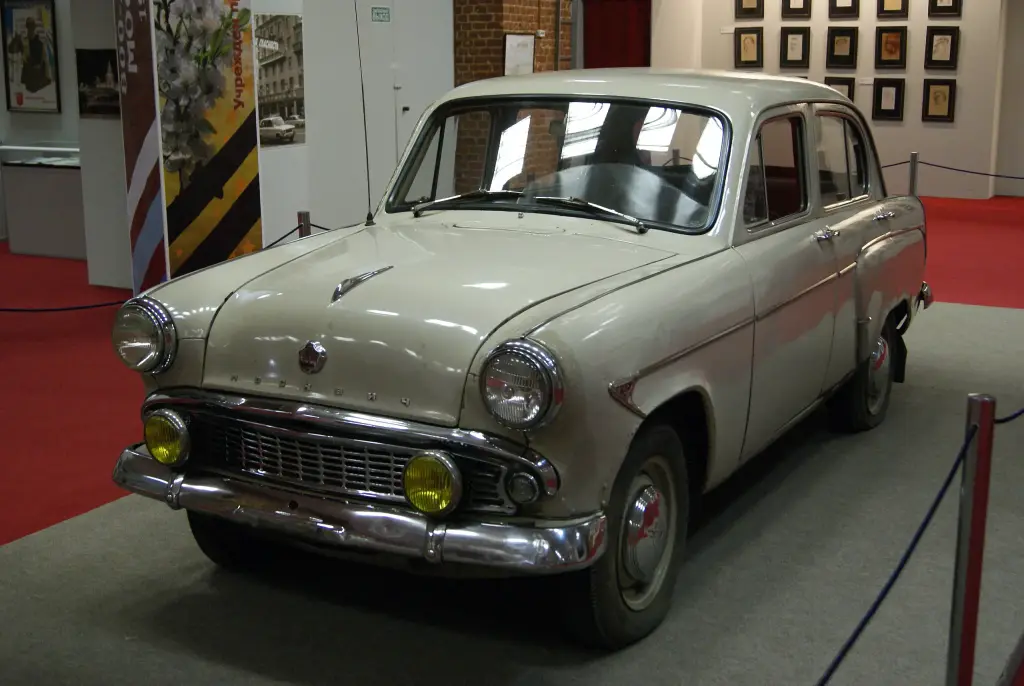
The Moskvich 403 was a deliberately temporary car. From December 1962 to July 1965 MZMA built it with the body of the outgoing Moskvich 407 and the new front subframe, suspension and steering of the Moskvich 408, whose body pressings were not yet ready. It kept the plant running and taught its suppliers the new components.
Moskvich 403 at a glance
| Maker | MZMA, Moscow |
|---|---|
| Production | December 1962 – July 1965 |
| Body | four-door saloon, carried over from the late 407 |
| Chassis | new front subframe with 408 suspension and steering |
| Engine | M-407D, then M-407D1 from May 1964 |
| Front suspension | two ball joints per side |
| Gearbox | four-speed, linkage concentric with the steering column |
| Wheels | 15-inch rims with 5.60-15 tyres |
| Price | 3,400 roubles, against 2,500 for the 407 |
| Built | 105,726 |
| Production 1964 | 66,471, the peak year |
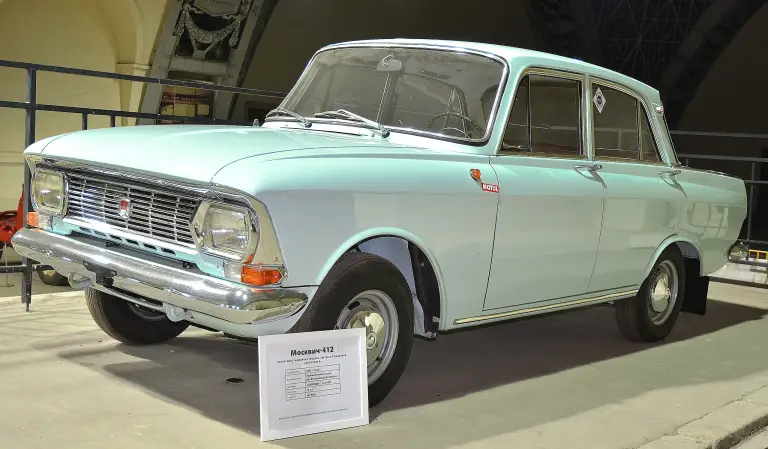
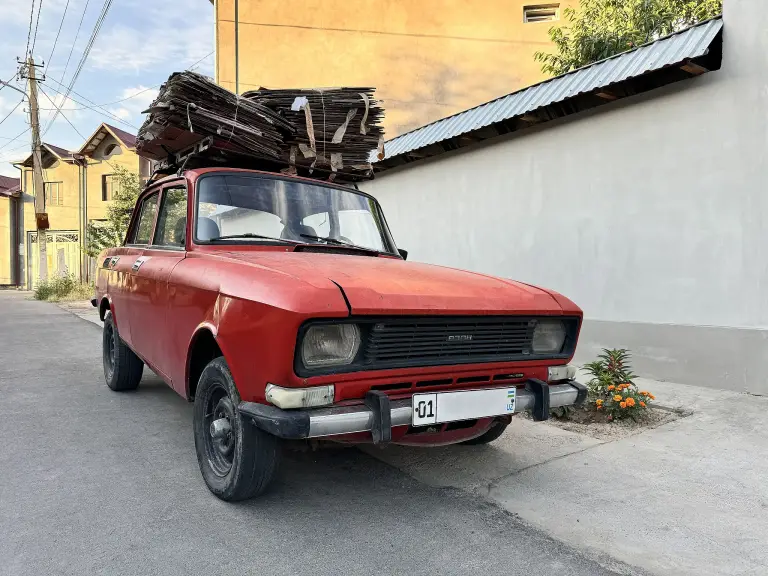
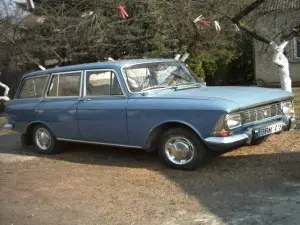
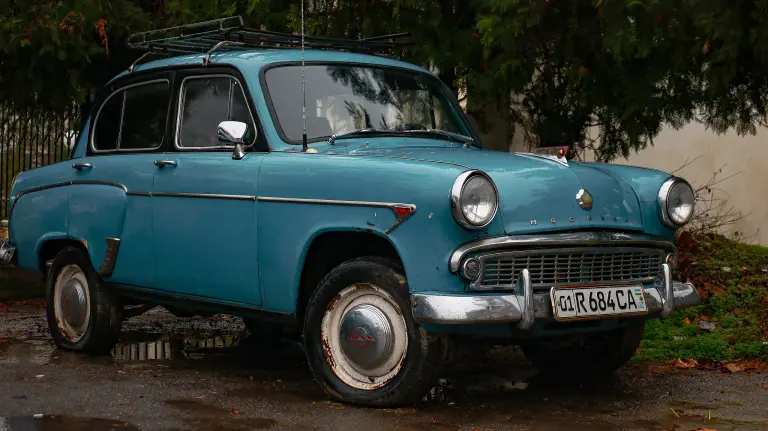
The detailed article on the 403 exists only in Russian Wikipedia; the English article covers it as a section of the 402/407 page and gives a different production total (133,523). This page follows the Russian figures. No free photographs of the 403 were found, so the article uses the existing cover image.
History of the Moskvich 403
From the late 1950s MZMA was preparing a completely new car, the future Moskvich 408. Most of its mechanical parts were ready, but the presses and welding lines for the new body were late, being the most expensive part of the job. The factory therefore built a transitional model: the old 425-type body, which by then looked much like the late 407, sitting on a completely new subframe that carried the engine, front suspension and steering of the coming 408.
The body was almost identical to the late 407 except for the front bulkhead and the subframe. On most cars the visible differences were three-part rear lights instead of two-part ones and, inside, a new steering column with the indicator switch on the left rather than on top, a gear linkage running concentrically around the steering shaft instead of beside it, a new wheel with a V-shaped hub, and a windscreen washer, although the wipers were still driven mechanically from the camshaft.
The engine was the M-407D, identical to the 407 apart from a vertically mounted coarse oil filter, and from May 1964 the M-407D1, a step towards the 408 unit with a larger big-end journal diameter, thrust washers and a proper rear crankshaft seal. The front suspension gained a second ball joint on each side, the steering got a three-link layout, and pendant pedals replaced the floor-hinged ones, moving the brake and clutch master cylinders up to the bulkhead.
Buyers noticed the price. The 403 was listed at 3,400 roubles against 2,500 for the 407, and many people who had waited years for an allocation refused the new car, which moved the queue along quickly. Production ran alongside both the 407, until 1963, and the 408, until the summer of 1965: 280 cars in 1962, 23,866 in 1963, 66,471 in 1964 and 17,330 in 1965, 105,726 in all. Overseas critics disliked the heavy chrome of the export version, the 403E, at a time when simple shapes like those of the 408 were becoming fashionable.
Design and features
- Mixed specification: the old 407 shell on the new 408 front end.
- Better front suspension: two ball joints per side instead of one joint and one pin.
- Improved controls: concentric gear linkage, new steering wheel and pendant pedals.
- Export version: the 403E with a wide grille, extra mouldings, mirrors and body-coloured lights.
Moskvich 403 versions
- Moskvich 403 (1963–1965): the standard saloon.
- Moskvich 403T: taxi version with meter, green lamp and checkerboard door signs.
- Moskvich 403E: export version with revised grille and trim.
- Moskvich 403Yu: version for hot climates.
- Moskvich 424: estate derived from the 423N with squared rear door frames.
The 403 bridged the gap between the Moskvich 402 and 407 and the Moskvich 408. More models are in the Moskvich collection.
Sources
- Москвич-403, Russian Wikipedia: design, changes, price, production figures
- Moskvitch 402, English Wikipedia: place of the 403 in the range, engine background