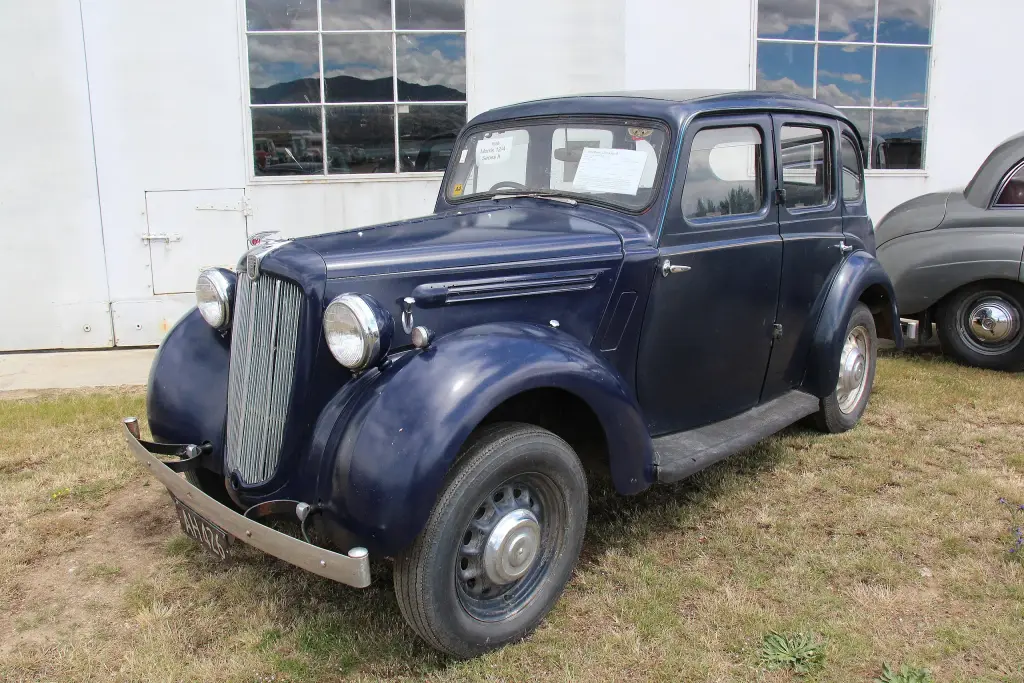
The Morris Twelve was introduced quietly in the autumn of 1934 as little more than a larger-engined Morris Ten Four, for which Morris asked just another £5. It used the chassis and body of the slow-selling longer-wheelbase Ten Six and a long-stroke 1548 cc engine rated at 11.98 hp. It remained in production until the war, in three series.
Morris Twelve at a glance
| Introduced | autumn 1934 |
|---|---|
| Production | 1934–1939 |
| Engine | 1548 cc side-valve four, long stroke |
| Tax rating | 11.98 hp |
| Chassis | from the Ten Six, about six inches longer than the Ten Four |
| Brakes | Lockheed hydraulic on all four wheels |
| Suspension | long semi-elliptic springs, Armstrong hydraulic dampers |
| Steering | Bishop Cam |
| Series II | announced 17 May 1935 |
| Series III | announced 20 August 1937 |
| Replaced by | Morris Oxford MO after the war |
History of the Morris Twelve
The Twelve arrived in the autumn of 1934, probably overshadowed by the promotion of the new Morris Eight, and was in effect a larger-engined Morris Ten Four costing £5 more. It took the chassis and body of the slow-selling longer-wheelbase Ten Six, and its 1548 cc engine, rated at 11.98 hp for tax, was much bigger than the 1292 cc of the Ten Four and the 1378 cc of the Ten Six, because the Treasury formula took no account of stroke length. Very long-stroke engines like this one gave good low-speed torque but were less reliable at high rpm and could not take full advantage of better fuels and improved breathing, and Morris briefly advertised the series II car as performing like a 14 hp model, until the six-cylinder Morris Fourteen arrived in the summer of 1936 and made that claim awkward.
The car had also been sold for three years as a Morris Cowley, in which form it could be ordered with the Oxford’s 1802 cc engine as well as the 1548 cc one. The Twelve shared much with the Ten Four, using the Ten Four gearbox and ratios but with wider wheels and larger-section tyres and, with modifications, the Ten Six wheelbase of six inches more than the Ten Four; it was almost an inch longer still than the Ten Six and its fuel tank held a gallon more than either smaller car. Lockheed hydraulic brakes worked on all four wheels with a mechanical handbrake on the rear, suspension was by long semi-elliptic springs front and rear with Armstrong hydraulic shock absorbers, and the steering was Bishop Cam rather than rack and pinion.
Series II, 1935
Series II was announced on Friday 17 May 1935 alongside a new Ten Four, advertised with the line ‘You can have a twelve horsepower model for £5 extra’. It had a new, longer and lower body with all passengers seated within the wheelbase, narrow windscreen pillars and a wide windscreen, and its body and frame were bolted together to make a strong double box section. There was now built-in luggage space at the rear, reached by lifting the hinged backrest of the rear seat, while an external folding luggage grid dealt with anything extra and the Special coupé kept its own built-in luggage container. Instrumentation gained an enlarged speedometer, the direction indicators were concealed in the body and worked from the steering wheel with a warning light in the centre, and the pedals were mounted directly on the frame. A new three-speed synchromesh gearbox came with standard Jackall hydraulic jacks and Magna wire wheels, with six-stud pressed steel Easiclene wheels available as an option on smaller-section 5.75–16 tyres. The spare wheel sat in a sunken panel at the back with a steel cover on the dearer sliding-head model, and the electrical equipment included a foot-operated headlamp dip switch and a single electric windscreen wiper.
After the 1936 Motor Show, where no new variations were offered, Morris advertised a choice for buyers of every car above the Eight: three speeds with Jackall jacks, four speeds without them, or four speeds with jacks for £5 extra, with Easiclene wheels optional at no cost. Within three months 92 per cent of buyers chose the four-speed gearbox, and it became standard. The Times tested the car and found the four-door six-light body offered ample space for four large people with unusually good headroom and a high view for touring, although the entrance to the rear seats was restricted unless they were slid forward, and complained of a light hum from the back axle. Series III was announced on 20 August 1937 with a new booted shape.
Design and features
- Long-stroke engine: 1548 cc rated at 11.98 hp, strong at low speed but coarse when revved.
- Hydraulic brakes: Lockheed brakes on all four wheels as standard.
- Built-in luggage: Series II added a boot reached by folding the rear seat backrest.
- Synchromesh gearbox: three speeds at first, with 92 per cent of buyers paying for four.
- Jackall jacks: built-in hydraulic jacks, standard with the three-speed gearbox.
Morris Twelve versions
- Twelve (1934–1935): the original car on the Ten Six chassis.
- Series II (1935–1937): new longer, lower body, synchromesh, built-in luggage.
- Series III (1937–1939): new booted body shape.
- Special coupé: two-door with its own built-in luggage container.
The Twelve shared its body with the Morris Ten Series II, and the larger Morris Fourteen was its six-cylinder neighbour in the range. More cars are in the Morris collection.
Sources
- Morris Twelve, English Wikipedia: engines, chassis, Series II, road test