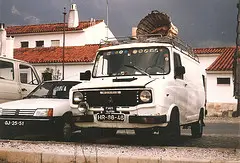
The Sherpa was the light van British Leyland launched in 1974 to replace the Morris J4. It was sold under a succession of marques, including Morris from 1978, and its narrow body made it a long-standing favourite of the Royal Mail and British Telecom. In various forms it survived as the LDV Pilot until 2005.
Morris Sherpa at a glance
| Launched | 1974, as the Leyland Van |
|---|---|
| Also known as | Sherpa, Leyland Sherpa, Austin-Morris Sherpa, Freight Rover Sherpa |
| Morris-badged | from 1978 |
| Derived from | Morris J4 and JU250 |
| Layout | front engine ahead of the cab, rear-wheel drive |
| Engines at launch | 1,622 cc and 1,798 cc B-Series petrol, 1,798 cc diesel |
| Engines from 1978 | 1.7 and 2.0-litre O-Series petrol |
| Launch models | 185, 215 and 240 vans; 215 and 240 pickups |
| Loadspace | 190 cubic feet |
| K2 facelift | June 1982 |
| Later names | Freight Rover 200, Leyland DAF 200, LDV Pilot |
The English Wikipedia article covers the whole line from the 1974 Sherpa to the 2005 LDV Pilot; this page uses the sections on the Sherpa itself.
History of the Morris Sherpa
The Sherpa was derived from the Morris and BMC J4 and JU250 vans of the 1960s. Its main change was to abandon the J4’s forward-control layout and move the engine ahead of the cab, where it could be reached through a bonnet, bringing Leyland’s light van into line with the Ford Transit and Bedford CF. That allowed a longer wheelbase, which brought better stability, payload and side loading, and produced the Sherpa’s distinctive profile, although the last J4s and the first Sherpas are almost identical from the rear. Because it was designed to be built on car production lines the van had a narrow track, a feature later publicity turned into a virtue: its ability in narrow city streets and lanes was why the Royal Mail and British Telecom preferred it to the Transit for many years.
The van was launched in 1974 as the Leyland Van and then renamed Sherpa. It was sold as a Leyland, a Morris, an Austin-Morris and finally a Freight Rover as British Leyland’s ownership changed through the 1970s. The first range had 185, 215 and 240 vans, where the number showed gross vehicle weight in tons, 215 and 240 pickups, a 240 crewbus and minibus, and 220 and 250 chassis cabs, with payloads from 13 cwt in the 185 to 23 cwt in the 240 and 250. Loadspace was 190 cubic feet, far more than the J4 and only just short of the Morris 250 JU.
O-Series engines and the Morris badge
In 1978 the 1.7 and 2.0-litre O-Series engines replaced the original 1,622 cc and 1,798 cc B-Series petrol units, while the 1,798 cc B-Series diesel stayed. The range was redesignated vans 200, 230 and 250, pickups 230 and 250, minibus and crewbus 250 and chassis cab 255. The 2.0-litre petrol cost only £50 more than the 1.7 with the same fuel consumption and much better drivability, and the 1.7 gave 62 bhp. A few months after the engine change the Sherpa was rebadged as a Morris, and in 1981 British Leyland created the Freight Rover division within the Land Rover group, so the badges changed again.
K2 and after
With exports falling and the Sherpa losing ground to the Transit, British Leyland considered dropping the van altogether before launching a limited update, the short-lived Sherpa K2, in June 1982. It had a neater black vertically slatted grille that gave it a family look with the Range Rover, much improved side access to the load bay, and new doors and B-pillar, because the original pillar leaned slightly forward, left over from the J4 body, and obscured the driver’s view. The range became 200, 230, 250 and 280, and a Hi Capacity walk-through body of 330 cubic feet or an optional Luton body of 460 cubic feet could be had on the 255 or 280 chassis cab. The Sherpa became the Freight Rover 200 Series in 1984, then the Leyland DAF 200, and finally the Pilot after LDV was formed in 1993, staying in production until 2005.
Design and features
- Engine ahead of the cab: easier access than the J4’s cab-over-engine layout, and a longer wheelbase.
- Narrow track: designed for car production lines, later valued for narrow streets and lanes.
- Royal Mail favourite: the Post Office and BT bought Sherpas in large fleets for years.
- O-Series engines: 1.7 and 2.0-litre petrol units from 1978, with the B-Series diesel retained.
- Long life: the same basic van became the Freight Rover, Leyland DAF 200 and LDV Pilot until 2005.
Morris Sherpa versions
- Sherpa (1974–1978): 185, 215 and 240 vans with B-Series engines.
- Sherpa (1978–1982): O-Series petrol engines, 200, 230 and 250 designations, Morris badges.
- Sherpa K2 (1982–1984): new grille, doors and B-pillar; 200, 230, 250 and 280.
- Freight Rover 200 Series (1984–1989): square headlamps and new bumpers.
- Leyland DAF 200 and LDV Pilot: later names for the same van, built until 2005.
The Sherpa replaced the Morris J4 and was one of the last vehicles to carry the Morris badge, alongside the Morris Ital. The company behind it is on the Morris Commercial page, and more vehicles are in the Morris collection.
Sources
- LDV Pilot, English Wikipedia: origins, Sherpa range, engines, K2, later names