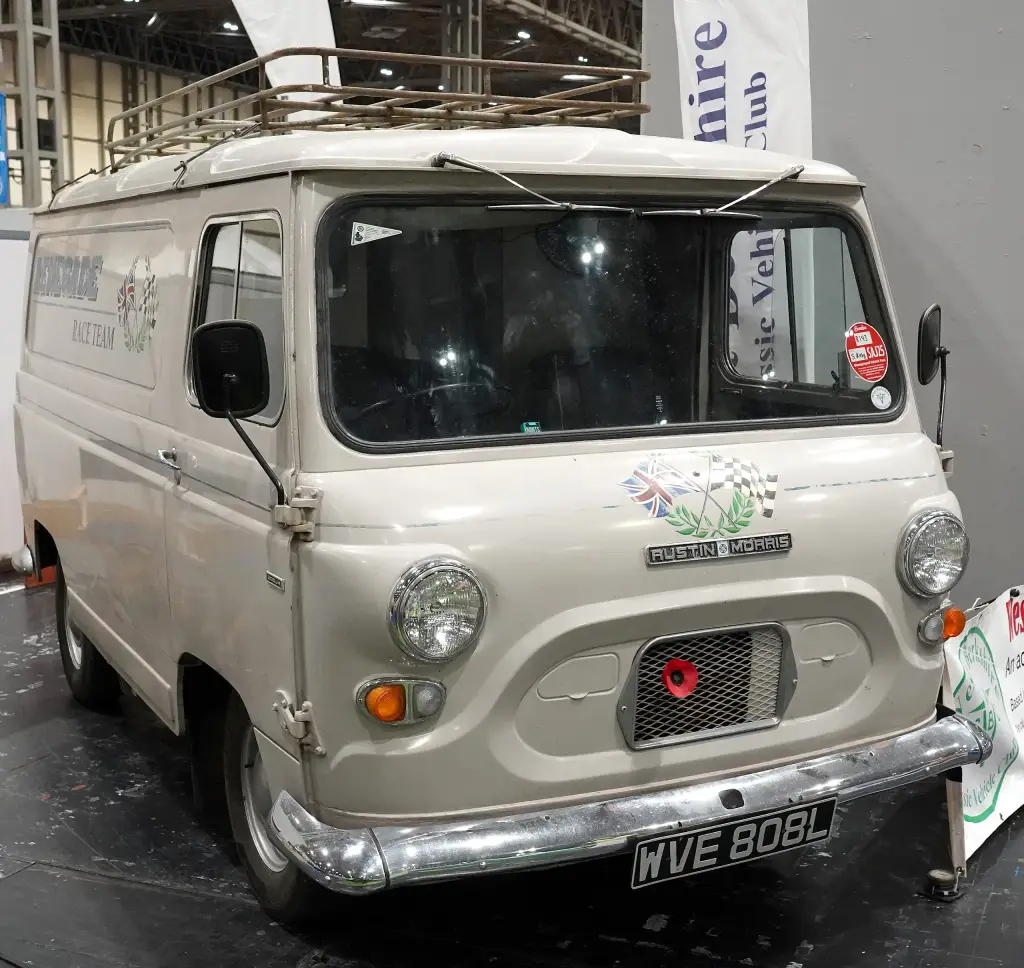
The Morris Commercial J4 was a 10 cwt forward-control van made from 1960 to 1974 in two facelifted forms. Simple, cheap and noisy, it sold mainly to big fleets, and in Royal Mail red it became one of the familiar sights of British streets. It was also built in Spain, where it survived as the Pegaso J4 until 1989.
Morris J4 at a glance
| Production | 1960–1974 |
|---|---|
| Capacity | 10 cwt (often called the Morris 10/12 cwt) |
| Engines | 1,622 cc B-Series petrol; 1,500 cc diesel at extra cost |
| Brakes | drums all round, no servo |
| Front suspension | independent, coil springs, lever-arm dampers |
| Rear suspension | semi-elliptic leaf springs |
| Also sold as | Austin J4, BMC J4 from 1968 |
| Tested (1967 motor caravan) | 63 mph, 22.7 mpg |
| Spanish version | SAVA J4, later Pegaso J4, 1965–1989 |
| Replaced by | Sherpa van, 1974 |
History of the Morris J4
The J4 arrived in 1960 as a 10 cwt forward-control van and was sold first as the Morris J4 and the Austin J4. In the 1960s light vans were often named by load capacity, and this one was commonly called simply the Morris 10/12 cwt. After British Leyland was formed in 1968 it was branded as the BMC J4. The engine was the familiar B-Series petrol unit of 1,622 cc or, at extra cost, a 1500 cc diesel, and the van had drum brakes all round without a servo. The front suspension was independent with coil springs and hydraulic lever-arm shock absorbers, while the rear used semi-elliptic leaf springs.
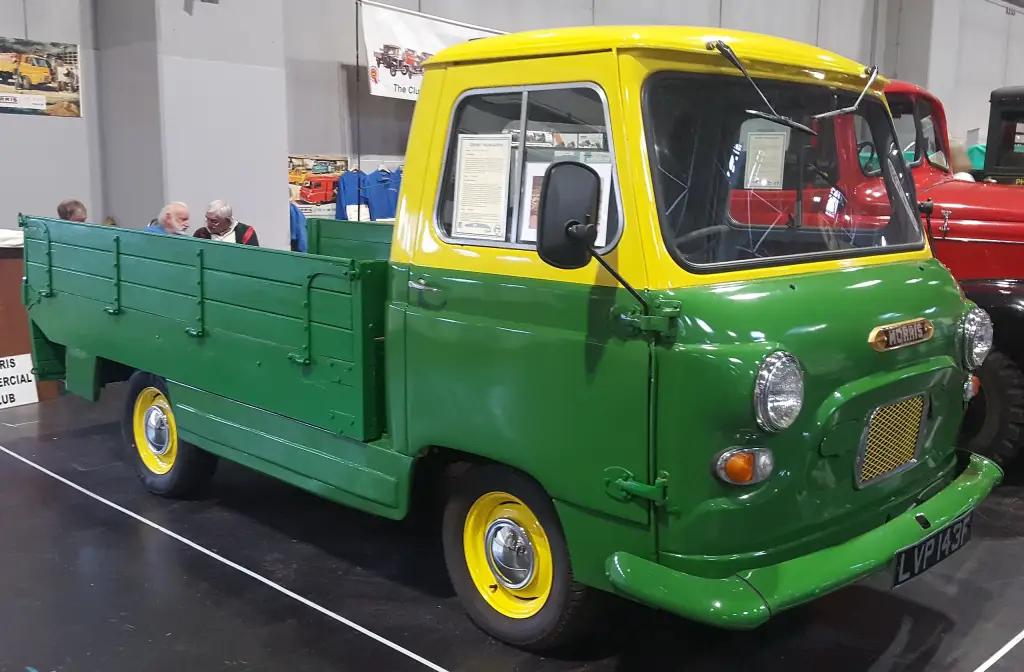
The engine sat in the driver’s cabin between the two seats, which made the J4 unusually noisy even by the standards of the time. Even in 1967 the vans came with synchromesh on the top three gears only. Autocar tested a J4-based petrol motor caravan in 1967 and recorded 63 mph, 0–50 mph in 20.2 seconds and 22.7 mpg, with the vehicle weighing 1,320 kg. The J4 was a success as a light commercial, sold mainly on keen pricing to large fleets, but after 1965 it lived in the shadow of the front-engined Ford Transit, as did other British light commercials of the period. Sliding front doors gave way to conventional front-hinged doors in its last model year, 1973–74.
Spain and the Sherpa
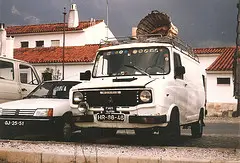
In Valladolid, Spain, SAVA built a diesel version under licence from 1965 to 1989. It was sold first as the SAVA Austin J-4, then as the SAVA J4 and, after SAVA was bought by ENASA, as the Pegaso SAVA J4 and finally the Pegaso J4. The Spanish van came with a glazed nine-seat body or a mixed five-seat layout, and as a van, pickup or chassis-cab. The 1974 redesign, sold as the SAVA J4 5730, brought a black grille with rectangular headlights and a Pegasus badge, later followed by the 1,800-powered J4 1000 and the 1,500 cc J4 700, the numbers referring to payload in kilograms. In Britain the J4 was replaced in 1974 by the front-engined Sherpa, which used the J4’s rear panel work almost unchanged and lived on as the Freight Rover, LDV 200 and LDV Pilot until 2006.
Design and features
- Forward control: the driver’s controls sit ahead of the front wheels, with the engine between the seats.
- Two fuels: B-Series petrol as standard, a 1,500 cc diesel as an option.
- Simple chassis: independent coil-sprung front suspension and leaf springs at the rear.
- Royal Mail livery: a common sight collecting and delivering post in Britain.
- Long afterlife: the body led to the Sherpa and, through it, to the LDV Pilot.
Morris J4 versions
- Morris J4 (1960–1968): the original Morris-badged van.
- Austin J4: the same van with Austin badges.
- BMC J4 (1968–1974): name used after the British Leyland merger.
- 1973–74 cars: conventional front-hinged doors instead of sliding ones.
- SAVA J4 / Pegaso J4 (1965–1989): Spanish diesel versions from Valladolid.
- Bodystyles: van, chassis-cab, pickup, tipper, Luton, minibus and camper.
The J4 succeeded the J-type and was sold alongside the larger J2; the company that built them is on the Morris Commercial page. More vehicles are in the Morris collection.
Sources
- Morris Commercial J4, English Wikipedia: specification, road test, Spain, replacement