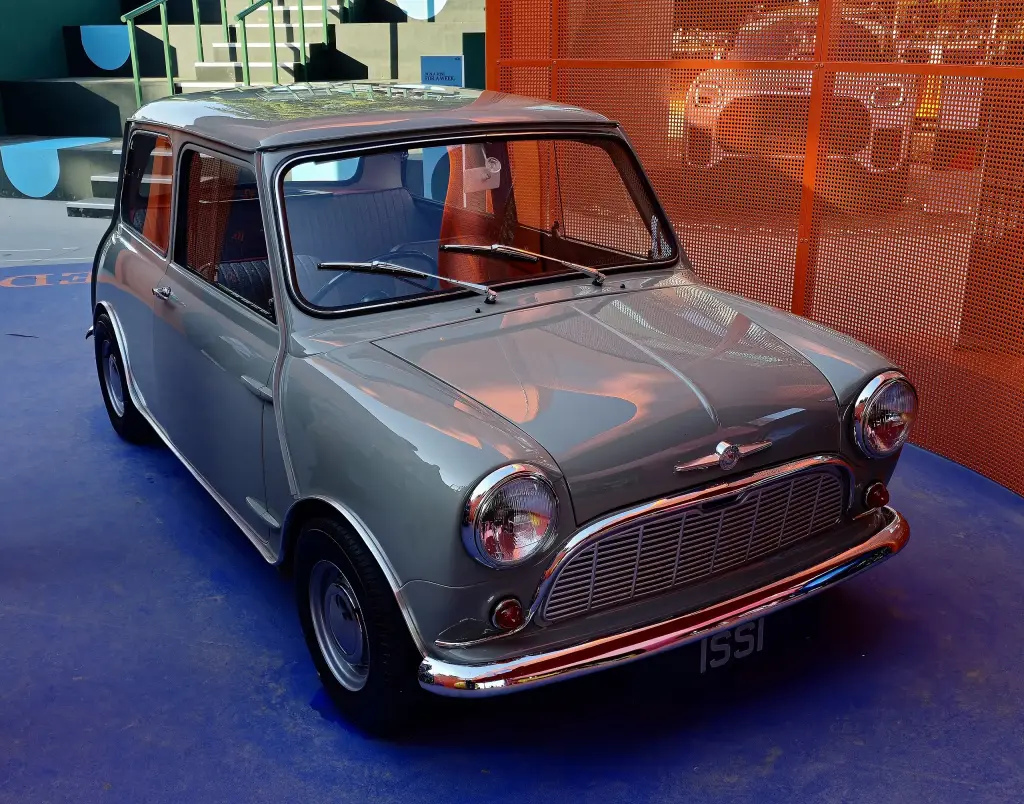
The Morris Mini-Minor was the Morris half of the car the world knows simply as the Mini. Launched in 1959 alongside the Austin Seven, it was designed by Alec Issigonis to fit inside a box ten feet long, four feet wide and four feet high, with most of the length given to the passengers. It became one of the most influential cars ever made.
Morris Mini at a glance
| Also known as | Austin Seven, Austin Mini, Mini |
|---|---|
| Production | 1959–2000 |
| Designer | Sir Alec Issigonis |
| Layout | transverse engine, front-wheel drive |
| Engine | BMC A-Series four-cylinder |
| Gearbox | four-speed, in the engine sump |
| Floorpan use | 80 per cent for passengers and luggage |
| Body styles | saloon, estate, van, pickup, Moke |
| Built at | Longbridge and Cowley, plus many overseas plants |
| Built | about 5.38 million |
| Rally wins | Monte Carlo 1964, 1965 and 1967 (Cooper S) |
History of the Morris Mini
The Mini came about because of the fuel shortage caused by the Suez Crisis of 1956. Petrol was rationed again in Britain, sales of large cars slumped, and German bubble cars boomed. Leonard Lord, the head of BMC, is said to have detested them so much that he demanded a proper miniature car, laid down within a box of 10 by 4 by 4 feet with six of the ten feet given to the passengers and the engine taken from the existing range. Alec Issigonis, who had designed the Morris Minor before the war and had returned to BMC in 1955, was given the job; his smallest project, XC9003, became the priority, and by July 1957 his team had built the first prototype, nicknamed the Orange Box, which Lord approved for production on 19 July as project ADO15.
The Mini kept the conventional BMC A-Series engine but mounted it transversely, with the four-speed gearbox in the sump and drive to the front wheels. Drive went down through a clutch to primary gears on the end of the crankshaft, which gave the car its characteristic transmission whine. The radiator was put at the left side of the car so that the engine-mounted fan could be kept, blowing air into the low-pressure area under the front wing, a layout that saved length but fed the radiator with air already warmed by the engine. The arrangement allowed 80 per cent of the floorpan to be used for passengers and luggage, and almost every small front-wheel-drive car since has used a similar layout.
Morris and Austin
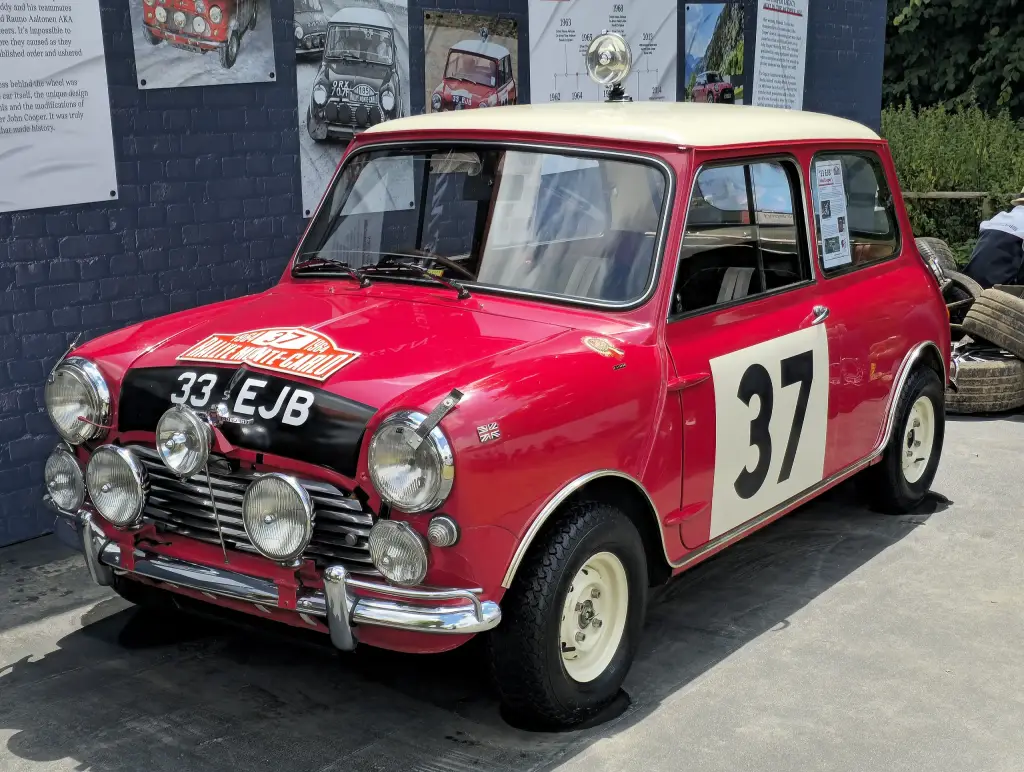
At first the Mini was sold under the Austin and Morris names as the Austin Seven and the Morris Mini-Minor. The Austin Seven was renamed Austin Mini in 1962 and Mini became a marque in its own right in 1969, after which the Morris name disappeared from the car. The Mark I had three major updates, the Mark II, the Clubman and the Mark III, and within them came estates, vans, pickups and the jeep-like Moke. The performance versions, the Cooper and Cooper S, won the Monte Carlo Rally in 1964, 1965 and 1967.
Forty years
Minis were built at Longbridge and at the former Morris plant at Cowley, and also in Australia, Spain, Belgium, Italy, Chile, Malta, Portugal, South Africa, Uruguay, Venezuela and Yugoslavia. British Leyland launched the Austin Metro as its follow-up in 1980, but the Mini outlasted it and stayed in production at Longbridge until October 2000. In 1999 it was voted the second most influential car of the twentieth century, behind the Ford Model T, and it remains an icon of 1960s British popular culture.
Design and features
- Space-saving layout: transverse engine, gearbox in the sump and front-wheel drive free up 80 per cent of the floor.
- Ten-foot package: Lord’s brief fixed the size of the car and the space given to passengers.
- Existing engine: Lord insisted on an engine already in production, to keep the cost down.
- Characteristic whine: the primary gear train gives the Mini its distinctive transmission noise.
- Cooper versions: the performance models that won the Monte Carlo Rally three times.
Morris Mini versions
- Morris Mini-Minor (1959 onwards): the original Morris-badged car.
- Austin Seven / Austin Mini: the same car under the Austin name.
- Mark II, Clubman and Mark III: the three major updates of the Mark I.
- Estate, van, pickup and Moke: the other body styles built on the same layout.
- Cooper and Cooper S: the performance versions, rally winners in 1964, 1965 and 1967.
The Mini was the smaller brother of the Morris 1100 and arrived while the Morris Minor was still in production. More cars are in the Morris collection.
Sources
- Mini, English Wikipedia: origins, design, names, production, rallying