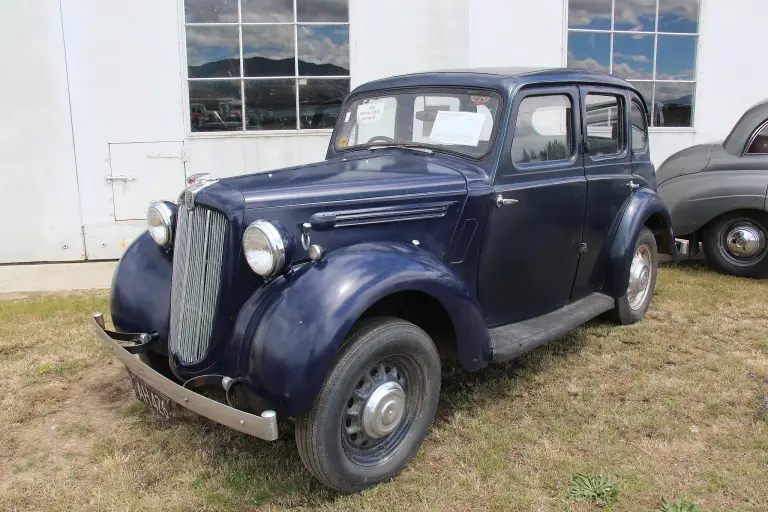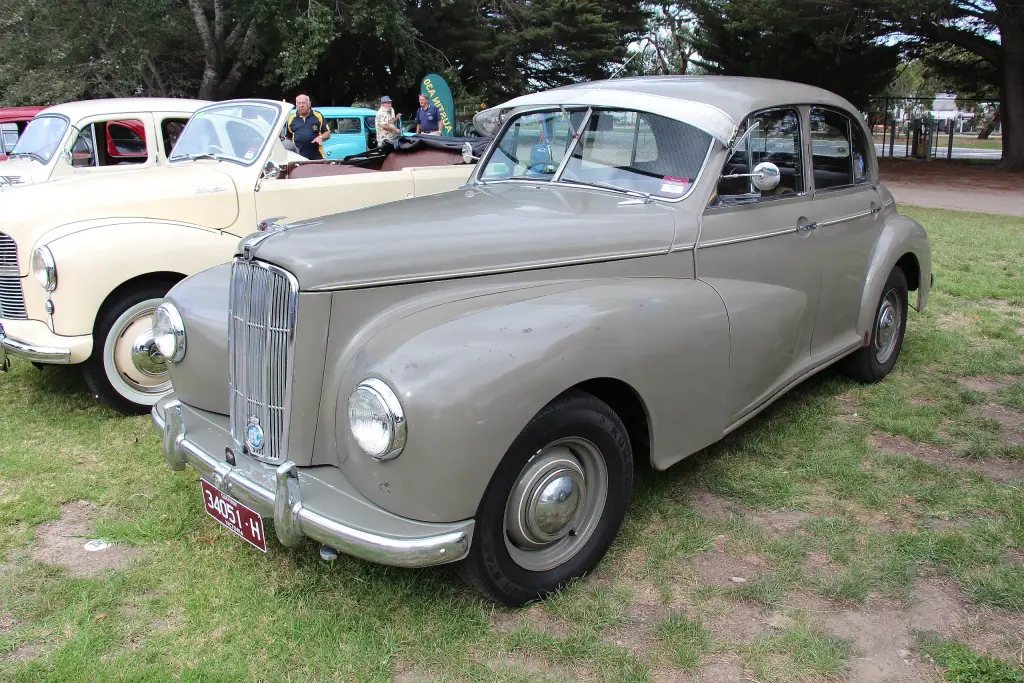
The Morris Six Series MS was announced in October 1948 with the new Minor and Oxford, and it was Morris’s first post-war six-cylinder car. Its 2,215 cc overhead-camshaft engine gave it a top speed of about 82 mph, and under the skin it shared a great deal with the Issigonis-designed Morris Oxford MO.
Morris Six MS at a glance
| Production | 1948–1953 |
|---|---|
| Announced | 26 October 1948 |
| Engine | 2,215 cc overhead-camshaft six, 70 bhp at 4,800 rpm |
| Construction | integral body and chassis |
| Front suspension | independent torsion bars |
| Rear suspension | live axle, semi-elliptic springs |
| Steering | Bishop Cam |
| Brakes | Lockheed hydraulic, 10-inch drums |
| Wheelbase | 110 inches |
| Price at launch | £607, rising to £671 in March 1949 |
| Top speed | 82.5 mph (The Motor, 1950) |
History of the Morris Six MS
The Six MS was announced on 26 October 1948 together with the Minor, Oxford and Wolseley ranges. Like them it was of integral construction, with the body and chassis built as one unit, and it rode on independent front suspension with torsion bars. Under the old horsepower system, dropped that year, its engine rated at just over 20 hp. The car was priced at £607 including tax when new and rose to £671 on 1 March 1949.
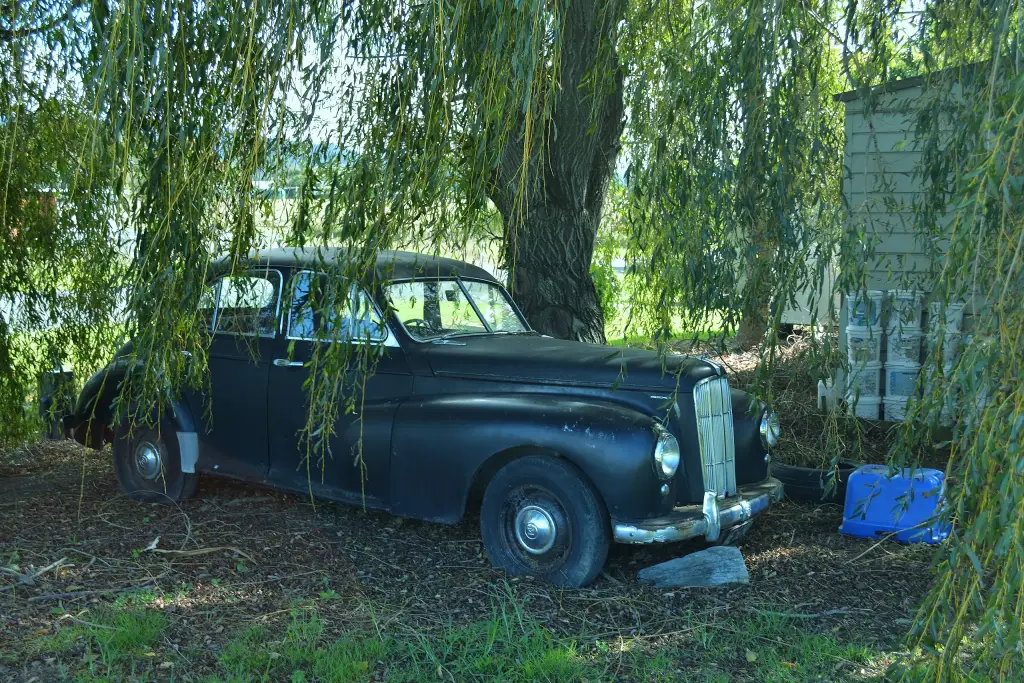
The Six looked like its pre-war 25 hp predecessor and was very similar to the Issigonis-designed Morris Oxford MO, sharing the Oxford’s body shell from the scuttle backwards, and to the Minor MM. Its bonnet was longer than the Oxford’s to take the overhead-camshaft 2,215 cc six-cylinder engine, which produced 70 bhp at 4,800 rpm, and the whole car was longer, with a 110-inch wheelbase against the Oxford’s 97 inches. The front used independent torsion bars, the rear a conventional live axle on semi-elliptic springs, and instead of the Oxford’s rack and pinion steering the Six had a lower-geared Bishop Cam system. The 10-inch drum brakes were Lockheed hydraulic.
Wolseley twin and later changes
Apart from the grille and identification marks, the whole car was shared with Morris’s Nuffield stablemate Wolseley, which sold it as the more luxuriously finished 6/80. Production was delayed until March 1949 because of metal fatigue problems in the link between the bulkhead scuttle and the front suspension. A car tested by The Motor in 1950 reached 82.5 mph and accelerated from 0 to 60 mph in 22.4 seconds, returning 20 miles per gallon; the test car cost £671 including taxes. In 1950 the rear axle ratio was lowered to improve acceleration and twin dampers were fitted to the front suspension, and at the 1953 London Motor Show a de-luxe version was announced with leather upholstery, a heater and over-riders on the front bumpers.
Design and features
- Overhead-camshaft six: 2,215 cc, 70 bhp, the first post-war Morris six.
- Unitary construction: body and chassis built as a single unit, like the Minor and Oxford of the same year.
- Torsion bar front suspension: independent at the front, live axle at the rear.
- Longer than the Oxford: a 110-inch wheelbase against the Oxford’s 97 inches.
- Wolseley 6/80 connection: the same body and engine with more luxurious finish.
Morris Six MS versions
- Morris Six MS (1948–1953): the standard car.
- De-luxe (1953): leather, heater and bumper over-riders announced at the London Motor Show.
- Wolseley 6/80: the Nuffield stablemate with the same shell and engine.
The Six MS was replaced by the Morris Isis and shared its body with the Morris Oxford; its smaller stablemate was the Morris Minor. More cars are in the Morris collection.
Sources
- Morris Six MS, English Wikipedia: engine, chassis, prices, road test, changes