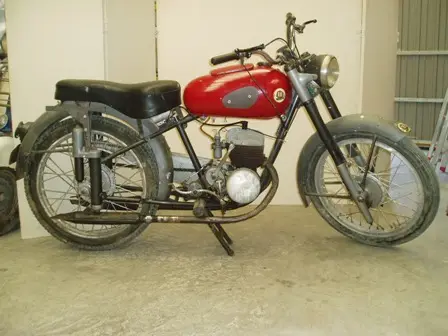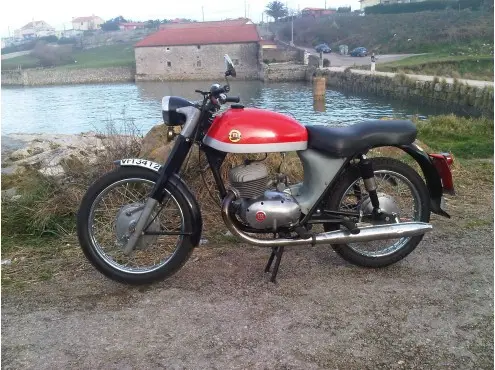
The Montesa Impala was a touring motorcycle built by Montesa in two periods, from 1962 to 1971 and again as the Impala 2 from 1982 to 1989. Designed by Leopoldo Milà, it was one of the firm’s biggest commercial successes and remains one of the most sought-after Catalan classics.
Montesa Impala at a glance
| Maker | Montesa, Barcelona |
|---|---|
| Production | 1962–1971; Impala 2 1982–1989 |
| Designer | Leopoldo Milà |
| Capacities | 175 and 250 cc; 125 cc for the Impala 2 |
| Engine | two-stroke single, air-cooled |
| Frame | single cradle |
| Front suspension | conventional fork |
| Brakes | drum |
| Launched | 30 May 1962 |
| First-year sales | more than 11,000 |
| Award | Delta d’Or, 1962 |
The Impala is described only in the Catalan Wikipedia; this page is based on that single source.
History of the Montesa Impala
Origins
The Impala was the work of Leopoldo Milà, who had been made technical director in 1958 after Francesc Xavier Bultó and most of the technical management left Montesa over disagreements with Pere Permanyer. Milà took up a project he had been considering for some time: an innovative two-stroke 175 that would be comfortable, strong and reliable. It was one of Montesa’s most ambitious projects and coincided with the move of the factory from Poblenou to Esplugues de Llobregat, completed around 1962.
As chief designer, Milà set aside the mono-block engine he had been working on and started again from his own ideas. The aim was a cheap machine that used little fuel but could exceed 100 km/h. Three principles shaped it: no clutch rod, a primary drive by gears rather than chain, and a gearbox in the same block as the engine, sharing one crankcase. The cylinder was cast in injected aluminium, the first made that way in Catalonia, and the gearbox was designed from scratch with rounded parts and no right angles. The exhaust, responsible for the Impala’s distinctive sound, was designed by a German named Göerg who built speedboats and was then working with the company. The shape of the tank, another signature of the model, was chosen because it made manufacture cheaper.
Operation Impala
At the end of 1961, while the bike was still being designed, Oriol Regàs came up with the idea of an African crossing as publicity to prove its quality. Called Operation Impala, it was sponsored by Montesa and the lubricant maker Wynn’s. Five Catalans took part: Regàs, three experienced rally and motorcycle racers (Juan Tei Elizalde, Rafa Marsans and Enric Vernis) and the writer Manuel Maristany, who went as photographer and chronicler. On three pre-series Impalas, with a Land Rover as support vehicle, they covered 20,000 km between Cape Town and Tunis in a hundred days, from 15 January to 16 April 1962.
Launch and success
The Impala was presented at 18:30 on 30 May 1962 and went on sale in June. The first road test appeared that month in issue 20 of the magazine Grand Prix, edited by Piti Millet and Oriol Regàs. It was an immediate success: more than 11,000 were sold in the first year alone. In 1962 it won the Delta d’Or for industrial design, the jury citing its aesthetic beauty, the rational use of materials and its successful practical solution, which made it in their words the best-designed and best-conceived vehicle.
A cult classic
The Impala also had a strong sporting record, with many road rallies and, in its motocross versions, many off-road wins. Far from fading, it has become a cult object and one of the most valued Catalan classics, with good examples changing hands for up to 9,000 euros. About 2,500 are still in use, most of them in the Catalan countries — above all Barcelona, but also Girona, Lleida, Mallorca and Valencia, with a few in Galicia and Madrid. A network of specialist workshops, restorers and owners’ clubs has grown around the model; the Moto Club Impala had more than three hundred members in 2013. Demand has also pushed up thefts: 56 were stolen in Barcelona in the summer of 2009 alone.
Design and features
- Leopoldo Milà’s design: a glassfibre look and a tank shaped for cheap manufacture, praised as one of the best industrial designs of its day.
- Purpose-built engine: unit construction, gear primary drive and the first injected-aluminium cylinder made in Catalonia.
- Proven in Africa: three pre-series bikes covered 20,000 km from Cape Town to Tunis before launch.
- Instant success: over 11,000 sold in the first year and the Delta d’Or in 1962.
Montesa Impala versions
- Impala 175 and 250 (1962–1971): the main road models, in two capacities.
- Impala Sport 175: the version used as the basis of the first Enduro for the American market in 1965.
- Off-road Impalas: motocross, enduro and trial versions derived from the road bike.
- Impala 2 (1982–1989): a second series, also built with a 125 cc engine.
The Impala was replaced by models such as the Brío in the range and gave its frame to the Cappra. More machines are in the Montesa collection.
Video: Montesa Impala On Board Gopro
Video on YouTube.
Sources
- Montesa Impala, Catalan Wikipedia: history, design, Operation Impala, sales