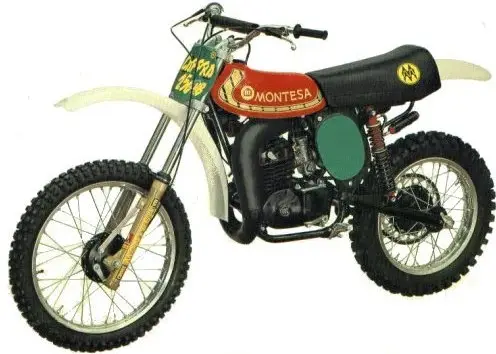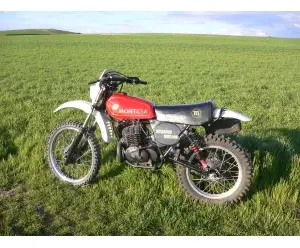
The Montesa Enduro was an off-road motorcycle built by Montesa from 1974 to 1987. It was designed for enduro, a discipline still called Todo Terreno in Spain, and was in effect a Cappra motocross bike adapted to the homologation rules so that it could be used on the road. For years it was one of the Barcelona firm’s three commercial pillars, with the Cota trial bike and the Cappra.
Montesa Enduro at a glance
| Maker | Montesa, Barcelona |
|---|---|
| Production | 1974–1987 |
| Type | enduro / Todo Terreno |
| Capacities | 75 to 360 cc |
| Engine | two-stroke single, air-cooled |
| Frame | single cradle to 1976, double cradle from 1977 |
| Front suspension | conventional fork |
| Rear suspension | telescopic shock absorbers |
| Brakes | drum |
| Based on | Cappra |
| Last versions | H7 80 (1982) and H7 360 (1983) |
The Enduro is described only in the Catalan Wikipedia; this page is based on that single source.
History of the Montesa Enduro
Before the Enduro
The Enduro name had been used before it became a model of its own. In 1965, at the request of its American importer Kim Kimball, Montesa built a special batch of the Impala Sport 175 with a high handlebar, off-road tyres and little else, and sold it in the United States as the Enduro, or Enduro Texas. That first Enduro led to the Texas 250 of 1966, another Impala adapted for off-road use and built until 1971, when it was replaced by the King Scorpion, which had appeared a year earlier. All these machines were designed for road use and at most for forest tracks.
The Enduro of 1974
The Enduro of 1974, the first model designed from the start for off-road competition, changed that. Based on the Cappra VRS, it gave Montesa a competitive machine in a sector where Spanish buyers had until then been limited to the Bultaco Matador and the OSSA Enduro. From then on, under Pere Pi, the company’s development department evolved the Enduro year by year until it was one of the best bikes in its class, taking the innovations tried on the works riders’ prototypes into production.
The small Enduros
The Enduro L of 75 and 125 cc, launched in 1976, was a great sales success. It offered riders of sixteen to eighteen an alternative to the mopeds of the day, such as the Puch Cobra and the Derbi Diablo, and to the Bultaco Lobito and Frontera 74, the latter its main rival. Soon both the small Frontera and the Enduro became all-purpose machines, used by young riders mainly for everyday journeys to school or into town.
H6 and H7
The revised Enduro H6 of 1978 was a turning point. The traditional 250 was cheaper and more versatile, suited to daily use as well as sport, while the new 360 covered riders who wanted a fully competitive machine. The range was improved again with the H7: the 80 in 1982 and the 360 in 1983, the last Enduros and the high point of the model technically. The Enduro 360 H6 and H7 sold well and helped popularise off-road riding at a time when trial was the dominant off-road discipline. The model was so successful that it stayed in production for some years after Honda took full control of Montesa in 1986.
Racing
No one won either of the two main enduro competitions of the period, the European championship or the International Six Days Trial, on an Enduro, but the model took several gold medals at the ISDT. Josep Maria Bubú Casanovas, Joan Bellsolà and Josep Maria Sucarrats were among its first well-known riders, but the model’s real breakthrough came with Carles Mas in Montesa’s works team: on an Enduro he dominated the Spanish championship for years, taking seven titles in a row, and was part of the national team that finished second in the ISDE at the Cerdanya in 1985.
Design and features
- Road-legal racer: the Enduro was a Cappra adapted to homologation rules so it could be registered and used on the road.
- Wide range: from the 75 cc L for young riders to the 360 cc competition models.
- Stiffer frame: a single cradle until the 250 H of 1976, double cradle from the 125 H of 1977.
- Works technology: each year’s Enduro took over parts tried on the factory riders’ prototypes.
Montesa Enduro versions
- Enduro 250 (1974): the first purpose-built model, based on the Cappra VRS.
- Enduro L 75 and 125 (1976): small machines for young riders.
- Enduro H6 (1978): a revised range with 250 and 360 cc versions.
- Enduro H7 80 (1982) and H7 360 (1983): the last and most advanced Enduros.
The Enduro was derived from the Montesa Cappra and shared the Impala basis with the Impala. More machines are in the Montesa collection.
Video: Montesa Enduro 75 L Démarrage
Video on YouTube.
Sources
- Montesa Enduro, Catalan Wikipedia: history, versions, racing, frame