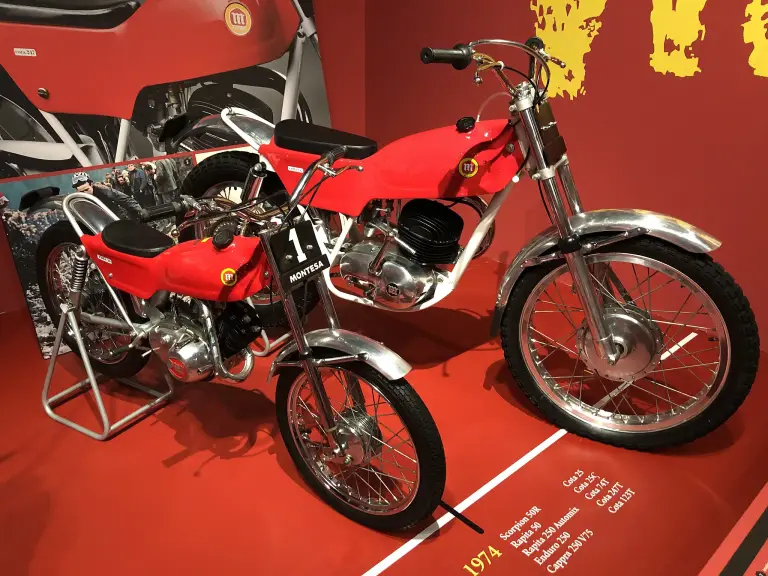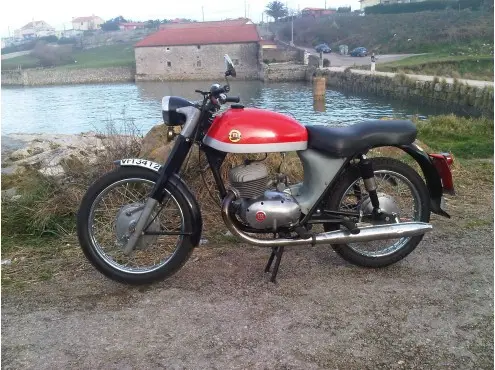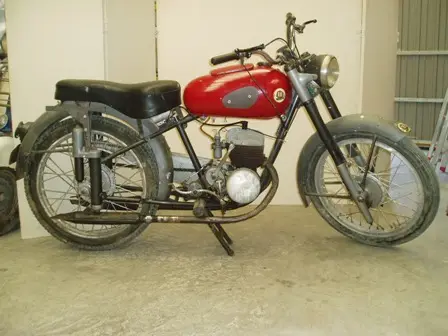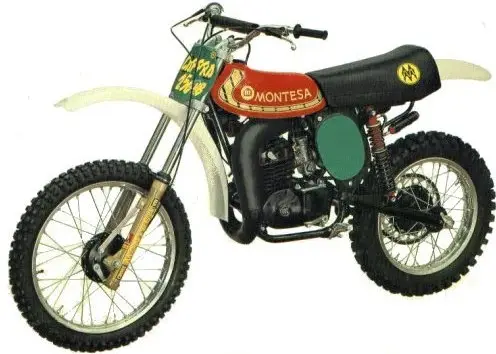
The Montesa Cappra was a motocross motorcycle built by Montesa from 1967 to 1982. Over its life it appeared in capacities from 125 to 414 cc, became one of the most successful motocross machines of its time and was the model with which Montesa fought the European factories at home and abroad.
Montesa Cappra at a glance
| Maker | Montesa, Barcelona |
|---|---|
| Production | 1967–1982 |
| Type | motocross |
| Capacities | 125, 250, 360 and 414 cc |
| Engine | two-stroke single, air-cooled |
| Frame | single cradle; double cradle on later versions |
| Front suspension | conventional fork |
| Rear suspension | telescopic shock absorbers |
| Brakes | drum |
| Predecessor | La Cross 66 |
| Rivals | CZ, Jawa, Husqvarna, Maico, KTM, Puch, Bultaco |
The Cappra is described only in the Catalan Wikipedia; this page is based on that single source.
History of the Montesa Cappra
Montesa became interested in motocross in the mid-1950s, but had no top-level rider until the early 1960s, when it signed Pere Pi from Derbi. Pi’s contribution, first as a works rider and later as head of development, shaped the firm’s off-road models. Starting from a road-going Brío 110 that was hardly modified, he took part in the creation of the first Brío Cross and Impala Cross prototypes, with which he won Spanish championships and international events.
In 1966, at the head of the development department, Pi designed the firm’s first motocross model for the international market, the La Cross 66, based on the prototype he raced. Like the earlier Impala Cross and the later Cappra, it used the frame and engine of the Impala with important changes for motocross. The Cappra line began in 1967 with the first model to carry that name, a considerable advance on the La Cross 66. From then on every Montesa motocross model was called Cappra.
The Cappra was one of the most successful motocross bikes of the 1960s, 1970s and early 1980s, and a commercial success in Spain and for export. Abroad it fought for supremacy with the Czechoslovak CZ and Jawa, the Swedish Husqvarna, the German Maico and Wabeha, the Austrian KTM and Puch and the Catalan Bultaco Pursang. Most of those European marques disappeared from the scene once Suzuki, Yamaha, Kawasaki and Honda concentrated on the discipline from the late 1970s.
In competition the Cappra won many national championships and international events, although no one took the world motocross championship on one. Its best-known riders were Kalevi Vehkonen, Raymond Boven and Håkan Andersson; one of the model’s best results came in 1977 at the Circuit del Vallès, where Boven won the Grand Prix on a Cappra VB ahead of Jaroslav Falta and Harry Everts.
Around 1972 the development department, then known as DID, designed a new motocross engine of its own. Jordi Ros, who had designed the engines of the Cota 74 and 123, started from scratch on an engine nicknamed the xuclat (sucked-in) because it was compact next to the bulkier Impala unit. The gearbox output sprocket was placed lower for better swingarm operation, the crankshaft was stiffer, the carburettor was float-mounted against vibration and the cylinder and head fins had a curled design claimed as a world first. Two versions were built, of 250 and 360 cc and air-cooled, the first ridden by Raymond Boven in Belgium; a second, smaller water-cooled 250 was made for Toni Arcarons and appeared only at the 1981 Spanish Grand Prix, on a Cappra VG that also had a single-shock rear end. Neither engine reached production.
Design and features
- A wide range: the Cappra was sold from 125 to 414 cc, with 250 and 360 cc the mainstays.
- Impala foundations: the first Cappras used the frame and engine of the Impala, adapted for motocross.
- The xuclat engine: a compact works design of 1972 with a low output sprocket and curled fins.
- Export success: the Cappra competed abroad against CZ, Husqvarna, Maico and Bultaco.
Montesa Cappra versions
- Cappra (1967): the first model to carry the name.
- Cappra VB: the machine with which Raymond Boven won the 1977 Grand Prix at the Circuit del Vallès.
- Cappra VG (1981): the experimental bike with a water-cooled engine and single-shock rear suspension.
- 414 cc versions: the largest capacity reached by the range, built up to 1982.
The Cappra shared its Impala basis with the Montesa Impala, and the firm’s road-going off-roader was the Montesa Enduro. More machines are in the Montesa collection.
Video: 1980 Cappra 414 VF Montesa. 15 DEC 13 Broadford Victoria
Video on YouTube.
Sources
- Montesa Cappra, Catalan Wikipedia: history, capacities, rivals, riders, engine