The MCW Metroliner was an integral coach manufactured by Metro Cammell Weymann between 1983 and 1988. Launched in April 1983 ahead of the 1984 tourist season, it was part of MCW’s attempt to diversify away from orders from the British passenger transport executives, and it was sold mainly to National Bus Company and Scottish Bus Group subsidiaries.
MCW Metroliner at a glance
| Maker | Metro Cammell Weymann (MCW) |
|---|---|
| Production | 1983–1988 |
| Launched | April 1983 |
| Construction | integral coach |
| Bodies | single-deck and tri-axle double-deck |
| Variants | CR126, DR130, HR131, DR140 |
| Total built | 172 |
| Main customers | National Bus Company, Scottish Bus Group |
| Main services | National Express, Scottish Citylink |
| Double-deck basis | tri-axle MCW Metrobus chassis |
| Rarest variant | DR140 400GT, three built |
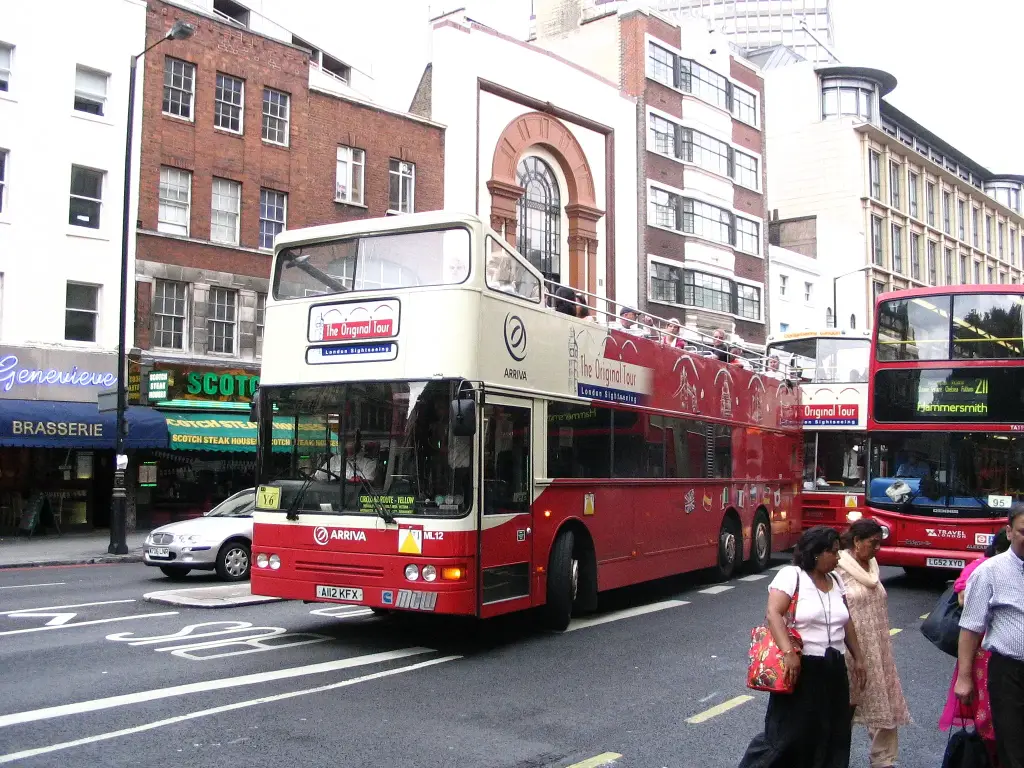
| Double-deck conversions | many became open-top sightseeing buses |
Based on one source, the English Wikipedia article on the Metroliner.
History of the MCW Metroliner
A diversification from bus orders
The Metroliner was launched in April 1983, ahead of the 1984 tourist season, as MCW tried to move its manufacturing business away from orders placed by the passenger transport executives of the United Kingdom. It was offered as a standard single-deck coach or as a tri-axle double-deck coach based on the tri-axle MCW Metrobus chassis, and it went predominantly to the nationalised National Bus Company and Scottish Bus Group for their National Express and Scottish Citylink express services.
CR126 and DR130
Only 21 of the original style single-deck CR126 were built in 1983 and 1984. Fifteen went to the NBC subsidiaries East Kent and Eastern National for the National Holidays package holiday divisions, four to the SBG subsidiaries Eastern Scottish and Northern Scottish, and the remaining two to Strathclyde PTE, modified with wheelchair lifts for two twice-weekly accessible services between Glasgow city centre and Paisley and the south-western suburbs until early 1985. The final ten CR126s had a revised front with less angular styling.
The most numerous type was the double-deck DR130, designed specifically for express coach work in Britain. Most double-deck coaches are built under four metres high to meet the continental European limit, which limits headroom; the DR130 was higher, giving a much more spacious interior but making it unsuitable for continental tours and limiting its secondhand appeal. A total of 127 were built between 1983 and 1987: the first went to the SBG as a demonstrator for Scottish Citylink between London and Glasgow, eleven more followed for Eastern Scottish, Northern Scottish and Western Scottish, and 102 were built for NBC subsidiaries for National Express and National Holidays work, most to the company’s Rapide specification. Outside the two groups, seven went to the London Buses and West Midlands Travel London Liner joint operation between London and Birmingham, and six to Tyne & Wear PTE’s Armstrong Galley Clipper service between London and Newcastle upon Tyne via Washington. Because demand for older double-deck coaches was limited, many DR130s were later converted to open-top buses by Ensignbus, mainly for its London Pride Sightseeing operation.
Metro Hi-Liner and 400GT
Marketed as the Metro Hi-Liner, the single-deck HR131 was built on an integral high-floor chassis rather than the body-on-frame CR126, and all 21 examples built between 1983 and 1988 carried revised frontal styling that was later applied to the CR126. MCW kept the first as a demonstrator; Northern Scottish took seven, the NBC subsidiaries East Kent, East Midland and Wessex six, Premier Travel four, Grampian Regional Transport two and WMT Central Coachways one. The rarest variant was the DR140, sold as the Metroliner 400GT: a four-metre-high double-decker with sleeker styling, of which only three were built in 1987 and 1988. Two went to Central Coachways, one of them initially a demonstrator, and the third to Yorkshire Traction.
Design and features
- Integral construction: the coach was built as a complete MCW product rather than a chassis with a separate body.
- Two layouts: single-deck coaches and tri-axle double-deckers on a Metrobus chassis.
- Tall double-deck body: over four metres high, giving generous headroom for British express work.
- Rapide specification: most National Express coaches were built to NBC’s Rapide standard.
- Second life as open-toppers: many DR130s were converted for sightseeing in London.
MCW Metroliner versions
- CR126 (1983–1984): single-deck coach, 21 built, the last ten with a revised front.
- DR130 (1983–1987): tall double-deck express coach, 127 built.
- HR131 Metro Hi-Liner (1983–1988): single-deck coach on an integral high-floor chassis, 21 built.
- DR140 Metroliner 400GT (1987–1988): four-metre-high double-decker with sleeker styling, three built.
The double-deck Metroliner used the tri-axle chassis of the MCW Metrobus, and the smaller Metrorider midibus was the other MCW product of the period. More buses are in the MCW collection.
Video: Kelvin Valley Metroliner
Video on YouTube.
Sources
- MCW Metroliner, English Wikipedia: variants, production numbers, operators