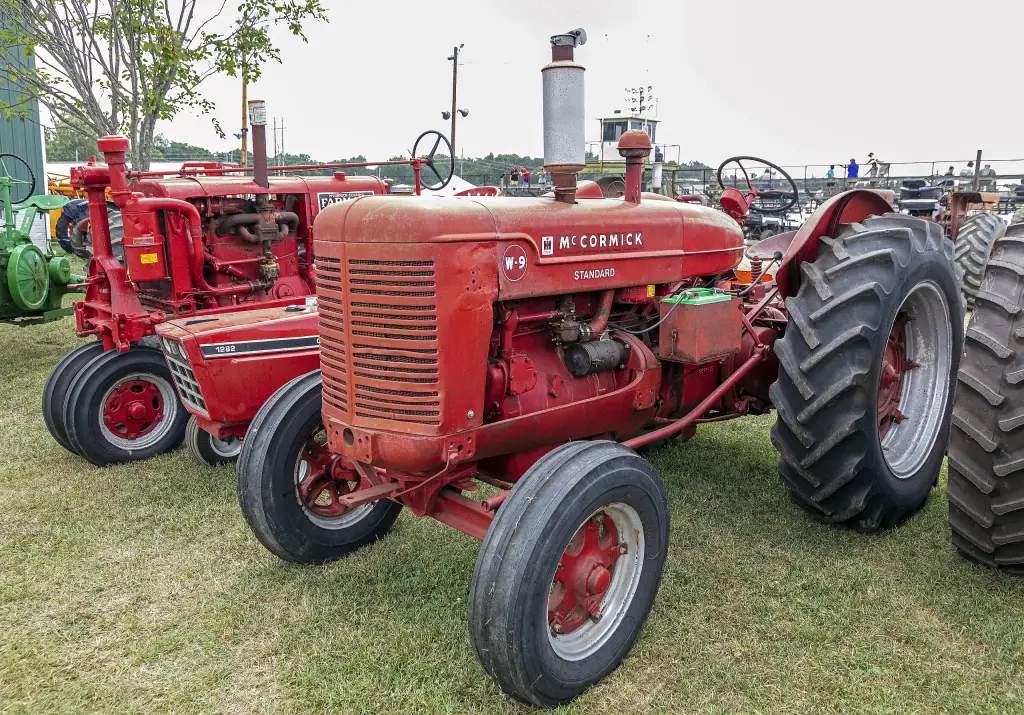
The McCormick-Deering W-9 was the heavyweight of International Harvester’s standard-tread W series. Where the W-4 and W-6 were standard-tread versions of the Farmall H and M, the W-9 took its engine and drivetrain from the company’s crawler tractors and was built for the heaviest field work.
McCormick-Deering W-9 at a glance
| Maker | International Harvester, McCormick-Deering brand |
|---|---|
| Production started | 1940 |
| Engine | International C335, the engine of the T-9 crawler |
| Layout | four-cylinder, gasoline, distillate or kerosene |
| Power | 44 hp (33 kW) |
| Operating weight | over 10,000 lb (4,500 kg) |
| Diesel version | WD-9, same displacement |
| Industrial versions | International I-9 and ID-9 |
| Rice-field version | WR-9 and WDR-9, on steel wheels |
| Super version | Super W-9 / WD-9, 1953, with more torque |
| Predecessor | McCormick-Deering W-40, 1934–1940 |
| Successor | International 600, 1956–57, 1,516 built |
History of the McCormick-Deering W-9
The W series was International Harvester’s answer to farmers who did not need a row-crop tractor. Where the Farmall letter series straddled rows with high clearance and adjustable axles, the W tractors had fixed wheel widths, wide front axles and a lower build, and were meant for ploughing, orchards and wheat. They carried the McCormick-Deering badge and the same red paint and Raymond Loewy styling as the Farmall line.
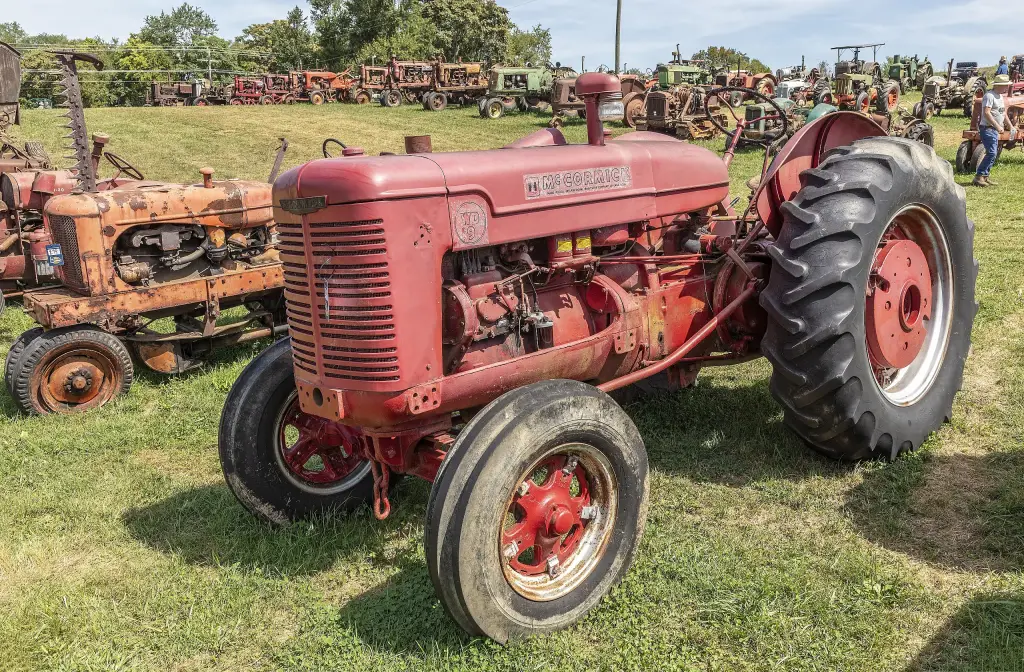
The W-9, first produced in 1940, was the exception in the range. Instead of scaling up a Farmall, it borrowed from International Harvester’s crawler tractors: the C335 engine of the T-9, a much more powerful unit than the ones in the W-4 and W-6, and a heavier drivetrain to match. Running on gasoline, distillate or kerosene it produced 44 horsepower (33 kW), and the tractor weighed more than 10,000 pounds (4,500 kg). A diesel version of the same displacement, the WD-9, was also offered.
As with the smaller W models, the works built specialised versions. The industrial tractors were the International I-9 and ID-9, and a steel-wheeled variant for rice fields was sold as the WR-9 and WDR-9. In 1953 the Super W-9 and Super WD-9 arrived with greater torque.
The W-9 had grown out of the McCormick-Deering W-40, a bigger six-cylinder version of the International W-30 that was itself a wide-front-axle version of the Farmall F-30. Built from 1934 to 1940 and available as the diesel WD-40, it was also sold as an industrial tractor in I-30 and ID-30 form. At the other end, the W-9’s own successor came in 1956, when International Harvester renamed the Super W-9 as the International 600 and dropped the McCormick-Deering badge; 1,516 of them were built in 1956 and 1957, followed by 4,933 of the International 650, and the restyled International 660 in 1959.
Design and features
- Crawler-derived engine: the C335 from the T-9 crawler gave the W-9 far more power than the Farmall-based W models.
- Three fuels: gasoline, distillate or kerosene from the same engine.
- Heavy build: more than 10,000 lb (4,500 kg) working weight and a drivetrain to match.
- Standard-tread layout: fixed wheel widths and a wide front axle for ploughing and heavy field work.
- Works variants: industrial I-9/ID-9 and steel-wheeled rice-field WR-9/WDR-9 versions.
McCormick-Deering W-9 versions
- W-9 (1940): the standard gasoline, distillate or kerosene tractor, 44 hp.
- WD-9: the diesel version of the same displacement.
- I-9 and ID-9: industrial versions with different gearing and a foot throttle.
- WR-9 and WDR-9: steel-wheeled tractors for rice fields.
- Super W-9 / WD-9 (1953): more torque from the same layout.
- International 600 and 650 (1956–57): the W-9 line renamed and rebadged as International.
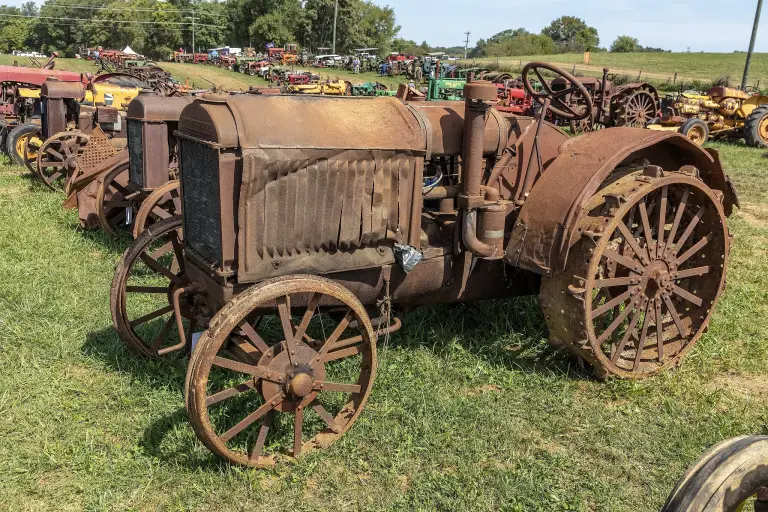
The W-9 followed the McCormick-Deering standard-tread tradition that began with the 10-20, and stood alongside the row-crop Farmall line. More tractors are in the McCormick collection.
Video: IH McCormick W9 ride-along
Video by Farmall Doctor on YouTube.
Sources
- McCormick-Deering W series tractors, English Wikipedia: W-9 engine, power, weight, versions, successors
- Farmall, English Wikipedia: row-crop layout of the letter series
- International Harvester, English Wikipedia: company background