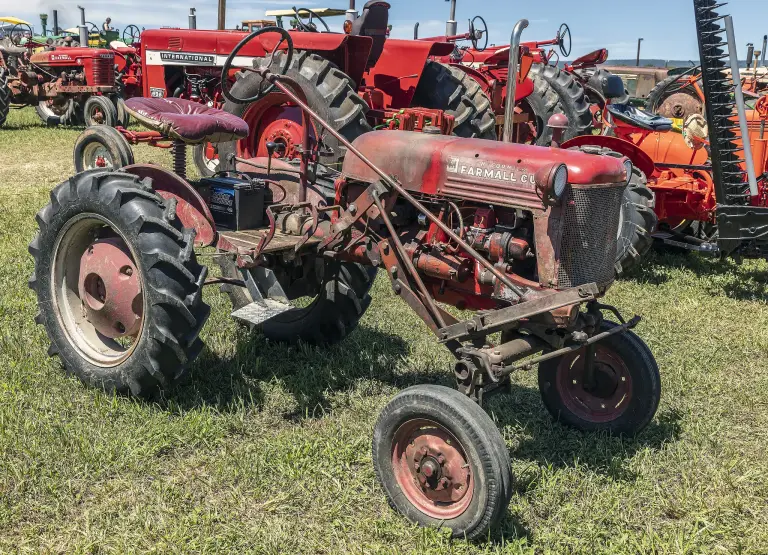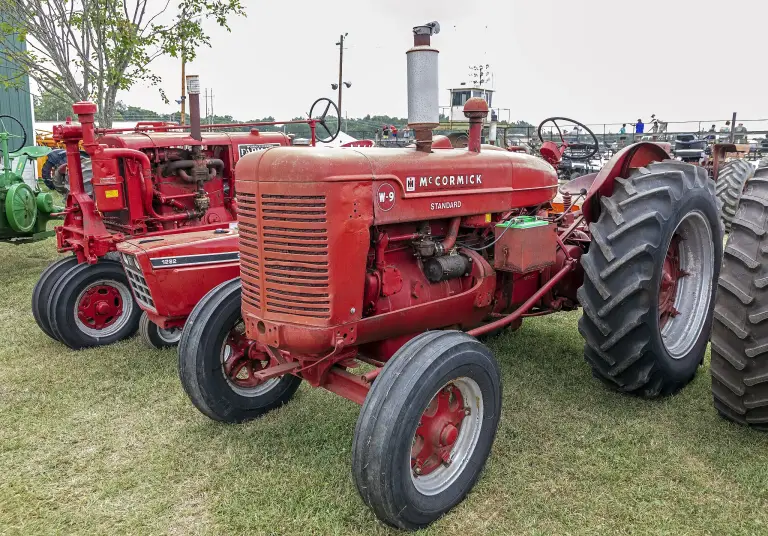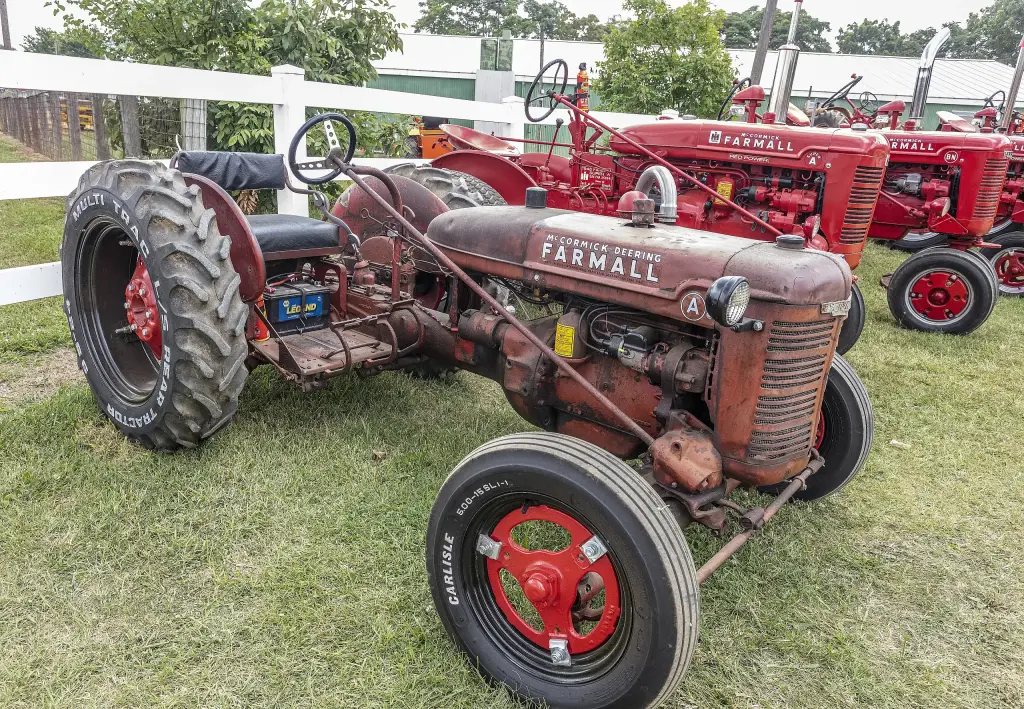
Farmall was first a model name and then a brand for the tractors of International Harvester. The original Farmall is widely seen as the machine that pulled together the parts of the row-crop tractor — tricycle front end, high clearance, adjustable axles and light weight — and it turned into the company’s best-selling tractor line.
Farmall at a glance
| Maker | International Harvester Company, Chicago |
|---|---|
| Name | model name first, then a brand |
| Brand form | McCormick-Deering Farmall, later McCormick Farmall |
| Production | 1920s to the 1980s |
| First plant | Farmall Works, Rock Island, Illinois, from 1926 |
| 100,000th Farmall | built by 1930 |
| Letter series | 1939, styled by Raymond Loewy |
| Distinctive colour | bright red from 1936 |
| Main work | row-crop cultivation on family farms |
| Also built | orchard, fairway and other variants |
The article on Wikipedia covers the whole Farmall line; this page follows the brand and the early row-crop tractors.
History of the Farmall
International Harvester came to the Farmall through competition. The Fordson was the first truly mass-produced, light and affordable tractor and had opened the market of small and medium family farms, but it struggled to cultivate between rows of young plants. International Harvester, formed in 1902 from the merger of the McCormick and Deering harvesting companies with three smaller firms, saw motorised cultivating as an unmet need. Its first answer was a motor cultivator, a self-propelled version of a horse implement; the Farmall was the more complete machine that followed.
The original Farmall is widely viewed as the first tractor to combine the traits that would define the row-crop category, even though it was not the first to have any single one of them. It had a tricycle front end, either a single front wheel or a narrowly spaced pair, high ground clearance, axles whose track could be adjusted quickly, good visibility all round and under the machine, and light weight. It had enough power for ploughing and harrowing and a belt pulley for belt work, and it was cheap enough to undercut a team of horses. The result was a tractor that could cultivate rows accurately and still do every other job a farmer had used horses for.
The name prospered with the machine. International Harvester opened a new Farmall Works plant at Rock Island, Illinois, in 1926, and by 1930 the 100,000th Farmall had been built there. Farmall was usually presented as McCormick-Deering Farmall and later as McCormick Farmall, following the company’s brand architecture; during the first decade of sales the advertising even had to stress the link with International Harvester to stop the name becoming generic. A bright, distinctive red colour scheme introduced in 1936 made the tractors easy to recognise, and the red became the brand’s badge.
The letter series of 1939, styled by Raymond Loewy, was a huge success and International Harvester dominated the tractor market through the 1950s despite competition from Ford, Allis-Chalmers, Massey Ferguson and John Deere. The brand was ubiquitous on North American farms in the 1940s and 1950s. Trends after the 1960s — the decline of cultivation in favour of herbicidal weed control and the consolidation of farming into fewer, larger farms — ended the Farmall era, but many of the tractors remain at work or are restored and collected, and the return of interest in organic farming has brought a limited revival of cultivating.
Design and features
- Row-crop layout: tricycle front end, high clearance and quickly adjustable axle track.
- All-purpose work: ploughing, harrowing and belt work from one machine, with a belt pulley as standard.
- Low cost: mass production in the spirit of the Ford Model T and Fordson made it affordable for family farms.
- Red paint: the bright colour adopted in 1936 became the brand’s most obvious sign.
- Loewy styling: the 1939 letter series gave the range the shape it kept into the 1950s.
Farmall versions
- Farmall and the F-series: the original row-crop tractors of the 1920s and 1930s.
- Letter series (1939): the A, B, H, M and their relatives, styled by Raymond Loewy.
- Farmall Cub (1947): the smallest tractor in the line, built at Louisville.
- Orchard and fairway versions: specialised variants alongside the row-crop machines.
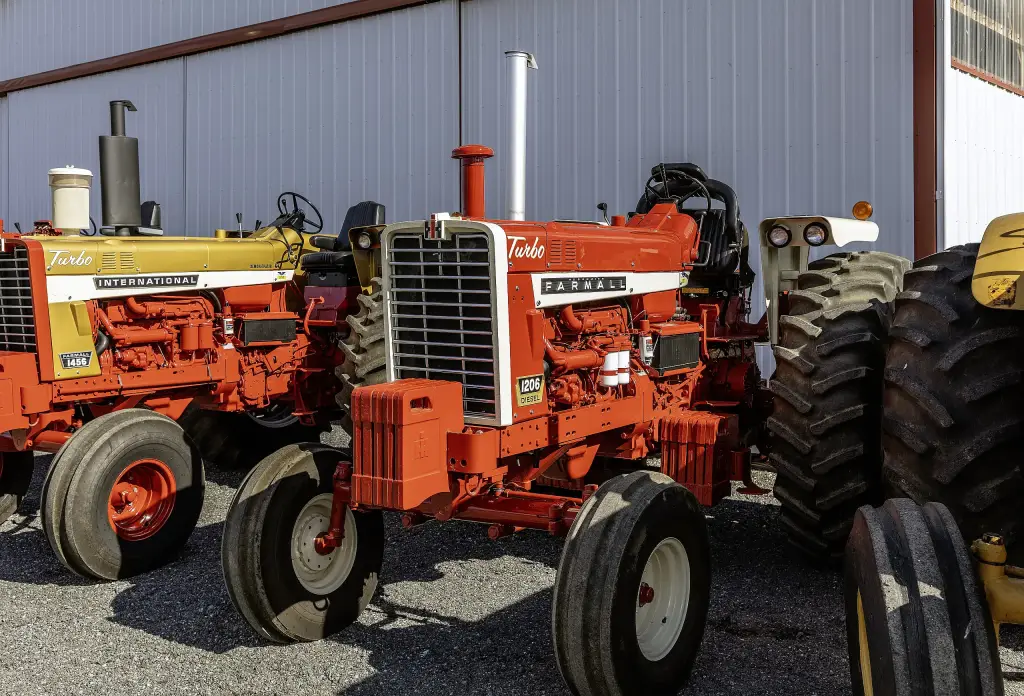
- Numbered tractors: the later 1206, 856 and other models that carried the Farmall name.
The smallest member of the family has its own page, the Farmall Cub, and the standard-tread side of the range is covered by the McCormick-Deering W-9. More tractors are in the McCormick collection.
Sources
- Farmall, English Wikipedia: origins, layout, brand history, letter series
- International Harvester, English Wikipedia: company history and plants
- International Harvester, German Wikipedia: introduction of the Farmall brand in 1924