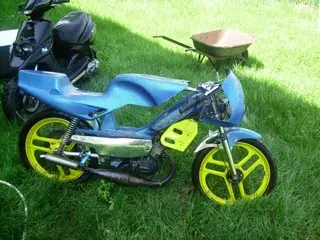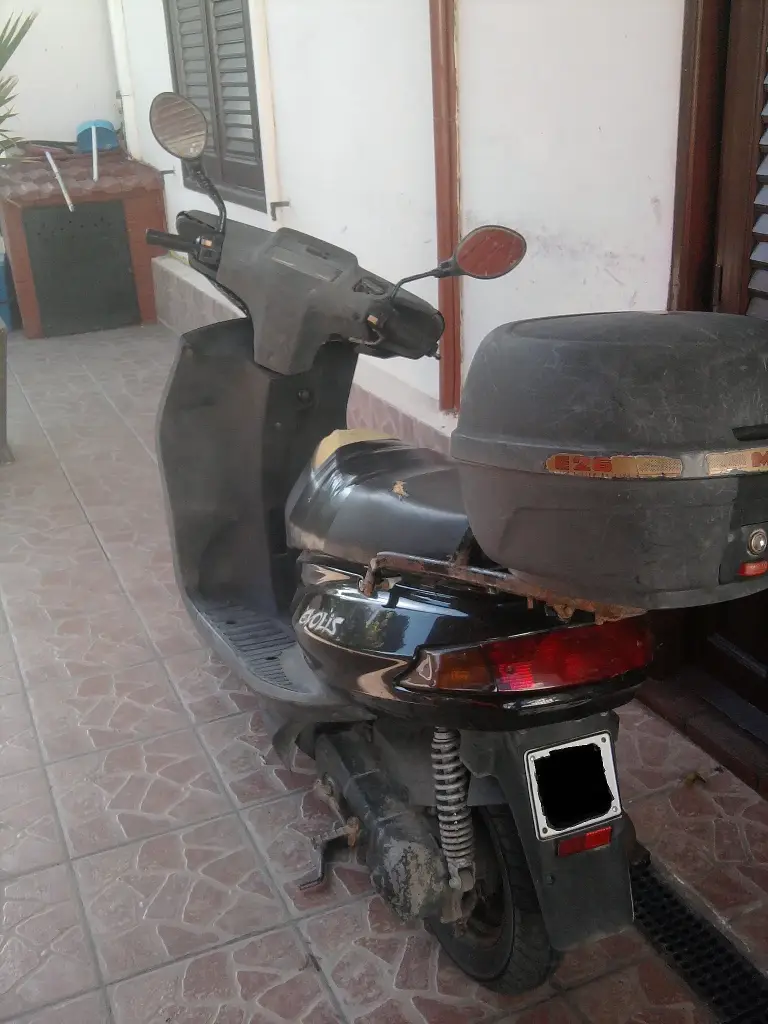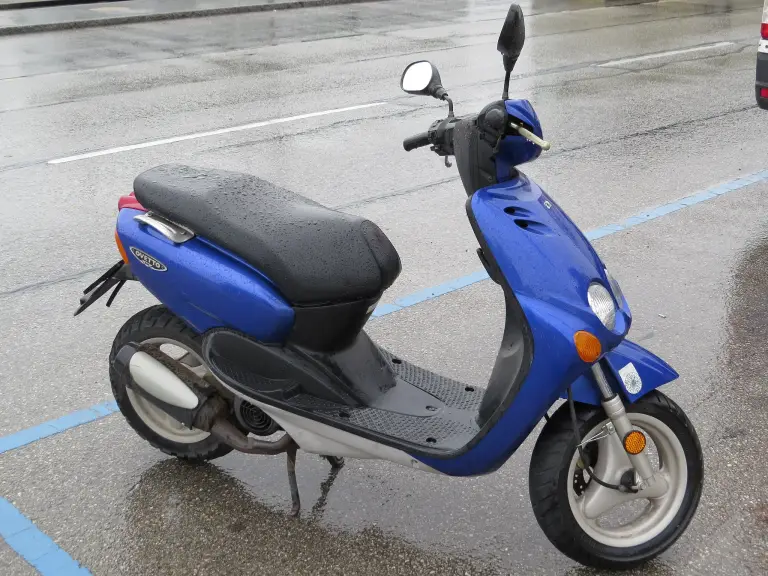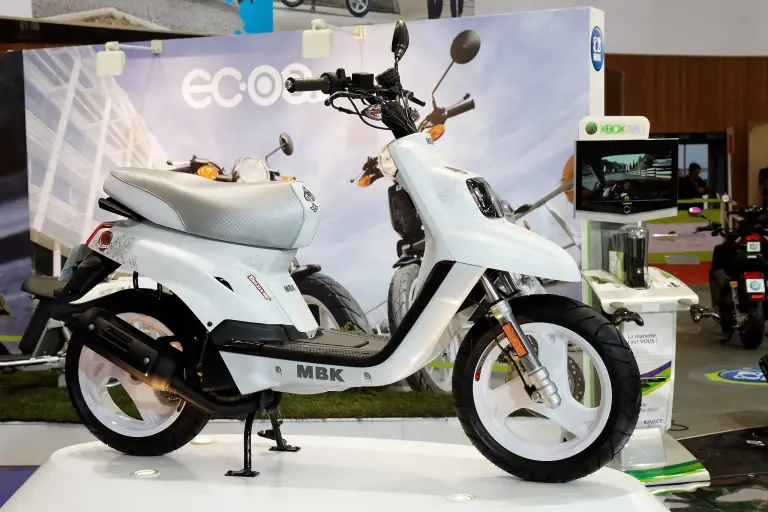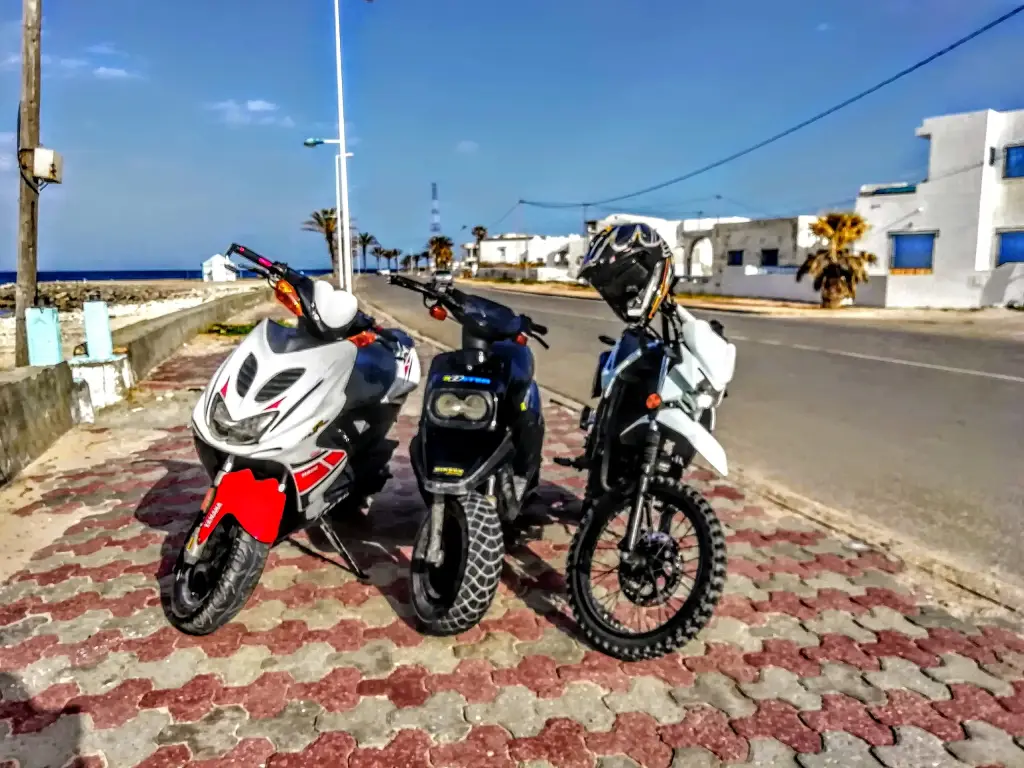
The MBK Nitro was the French version of the Yamaha Aerox, one of the best-selling sporty 50 cc scooters in Europe. Both names were used for the same machine, built at MBK’s Saint-Quentin factory, and only the second generation dropped the MBK badge.
MBK Nitro at a glance
| Maker | MBK (Yamaha), Saint-Quentin, France |
|---|---|
| Also sold as | Yamaha Aerox |
| Production | 1997–2013 (first generation) |
| Engine | 49 cm³ liquid-cooled two-stroke Minarelli (YQ50) |
| 100 cm³ version | 1999–2001, air-cooled (YQ100) |
| Rated power | 2.72 PS in restricted form |
| Dry weight | 92 kg |
| Fuel tank | 7 litres |
| Consumption | about 3.5 l/100 km (3.6 in a test of the Naked) |
| Front suspension | Paioli fork, 80 mm travel |
| Brakes | Brembo discs front and rear (disc and drum on the 100) |
| Tyres | Pirelli |
History of the MBK Nitro
Yamaha’s sporty 50 for Europe (1997)
Yamaha introduced the Aerox in Europe in 1997, and for France and the other MBK markets the same machine was badged MBK Nitro. The first generation was completely identical to the Yamaha, and it was built at MBK’s French factory in Saint-Quentin. The 50 cm³ version, known internally as the YQ50, used a horizontal liquid-cooled Minarelli two-stroke with a 12 mm carburettor and automatic oil injection from a separate tank, and it left the factory restricted to 45 km/h to meet European moped law. A 100 cm³ model with an air-cooled Minarelli engine was added in 1999 and sold until 2001.
A chassis built for speed
The Nitro was a sporty scooter rather than a shopping machine. Brembo supplied the brakes, with discs on both wheels on the 50 before 2013, and Pirelli the tyres; the front Paioli fork had 80 mm of travel and a single shock at the rear offered 60 mm. Dry weight was 92 kg, the variator ran on 15 × 12 mm rollers and the clutch measured 107 mm across. Yamaha quoted about 3.5 litres of fuel per 100 km; a German road test of the sister machine in Naked form, without the handlebar fairing, averaged 3.6 litres.
Special editions
MBK made much of limited versions. The Nitro Naked had a downhill handlebar and a digital dashboard, the Jaguar Edition came in British Racing Green with Jaguar stickers, and there was a McLaren Edition as well. Yamaha’s equivalents were sold in other countries under names such as Race Replica, Max Biaggi, Valentino Rossi and Tech 3. A facelift in 2003 brought a new exhaust, a tachometer and a revised ignition and CDI unit, and the 100 cm³ model was dropped at the same time.
The Yamaha badge takes over
In Italy the Aerox took the place of the MBK Nitro when Yamaha decided to stop distributing the French brand there. From the second generation, launched in 2013 as the Aerox R with an entirely new body, a digital dashboard and a larger seat, the scooter was sold under the Yamaha name only. The Euro 4 rules of 2018 left just the four-stroke Aerox 4 in the range.
Design and features
- Liquid-cooled Minarelli engine: a horizontal two-stroke with automatic oil injection from its own tank.
- Brembo brakes: discs at both ends on the 50, a combination rare among 50 cc scooters of the period.
- Paioli fork: 80 mm of travel at the front, with a single rear shock and 60 mm at the back.
- Light weight: 92 kg dry, with a 7-litre tank and about 3.5 l/100 km.
- Restricted as delivered: 2.72 PS and 45 km/h in standard European form.
MBK Nitro versions
- Nitro 50 (1997–2013): the standard liquid-cooled two-stroke.
- Nitro 100 (1999–2001): air-cooled 101 cm³ with a front disc and rear drum.
- Nitro Naked: downhill handlebar, no handlebar fairing and a digital dashboard.
- Jaguar and McLaren editions: paint and stickers inspired by the car makers.
- Aerox R (2003): the facelifted version with a new exhaust and a tachometer.
- Aerox R (2013): second generation, sold under the Yamaha name only.
The Nitro was the sporty member of the family that also included the MBK Booster, while the city scooter of the range was the MBK Ovetto. More machines are in the MBK collection.
Video: MBK Nitro with a Stage6 Pro Replica exhaust
Video on YouTube.
Sources
- Yamaha Aerox, English Wikipedia: launch, engines, market history
- Yamaha Aerox, German Wikipedia: MBK link, dimensions, road test
- Yamaha Aerox, Italian Wikipedia: the Nitro name in Italy, versions