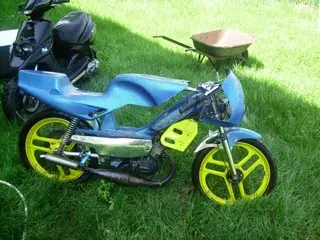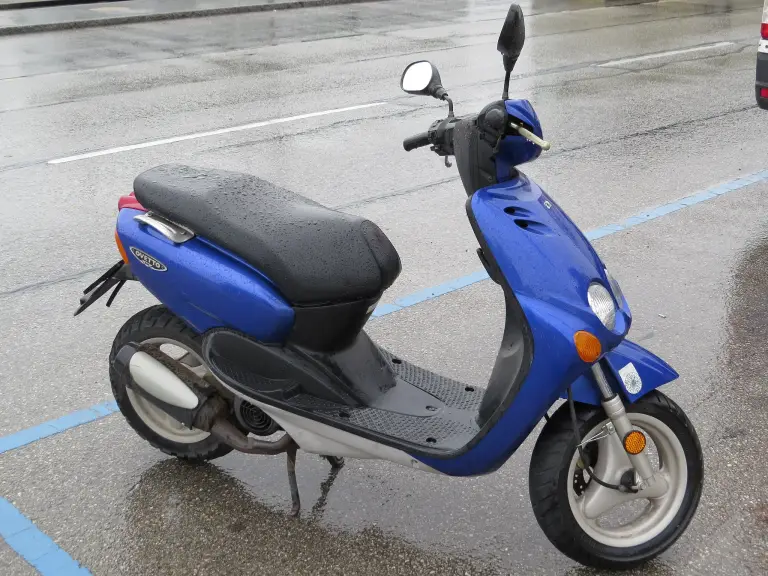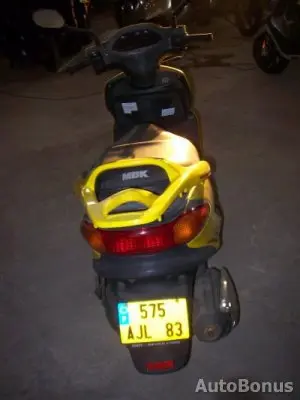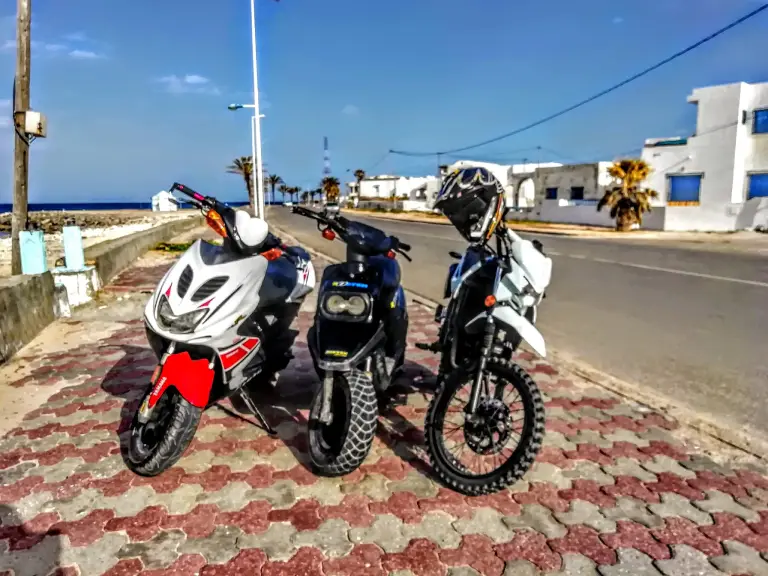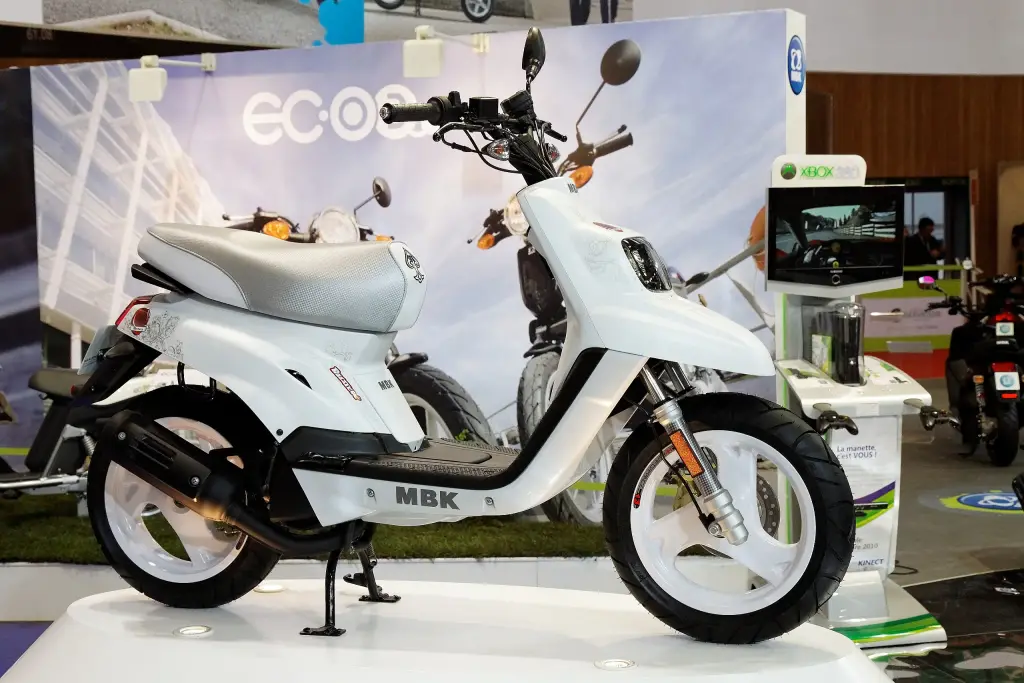
The MBK Booster was the French version of the Yamaha BW’s, a small-wheeled scooter with oversized tyres built at MBK’s Saint-Quentin factory. Introduced in 1989, it became one of the best-selling two-wheelers in Europe and stayed in production in one form or another for more than twenty years.
MBK Booster at a glance
| Maker | MBK (Yamaha), Saint-Quentin, France |
|---|---|
| Also sold as | Yamaha BW’s |
| First shown | Tokyo, 1988; Paris, October 1989 |
| Engine | 49 cm³ air-cooled two-stroke |
| Larger engines | 100 cm³ two-stroke (1999–2003), 125 cm³ four-stroke (2010) |
| Power | 1.7 hp (49 cm³), 8 hp (100), 9 hp (125) |
| Wheels | 10-inch, 120/90-10 front and 130/90-10 rear |
| Front brake | drum until 1998, then a 155 mm hydraulic disc |
| Fuel system | 14 mm Teikei carburettor, automatic oil injection |
| Weight | 70 kg (Booster Spirit, 1996) |
| Sold | more than two million in just over twenty years |
The Booster and the Yamaha BW’s are one machine under two badges: the French article covers the MBK version and its history, the English one the technical description.
History of the MBK Booster
Born in Japan, built in France
The scooter was drawn up in Yamaha’s design offices in Japan in the mid-1980s for a young audience. Its big tyres gave it the name BW’s, short for Big Wheels. Sold only in Japan at first, it found few buyers. MBK and Yamaha France were convinced it could revive the French market and offered to take over its manufacture; Yamaha bought MBK, and production began at the Saint-Quentin factory. For MBK the scooter was renamed Booster so that the French maker kept an identity of its own. The two versions were otherwise identical, apart from badges, colours and the protective grilles on the lights that MBK called bumpers. The first examples were shown at the Tokyo show in 1988 and at the Paris motorcycle show in October 1989.
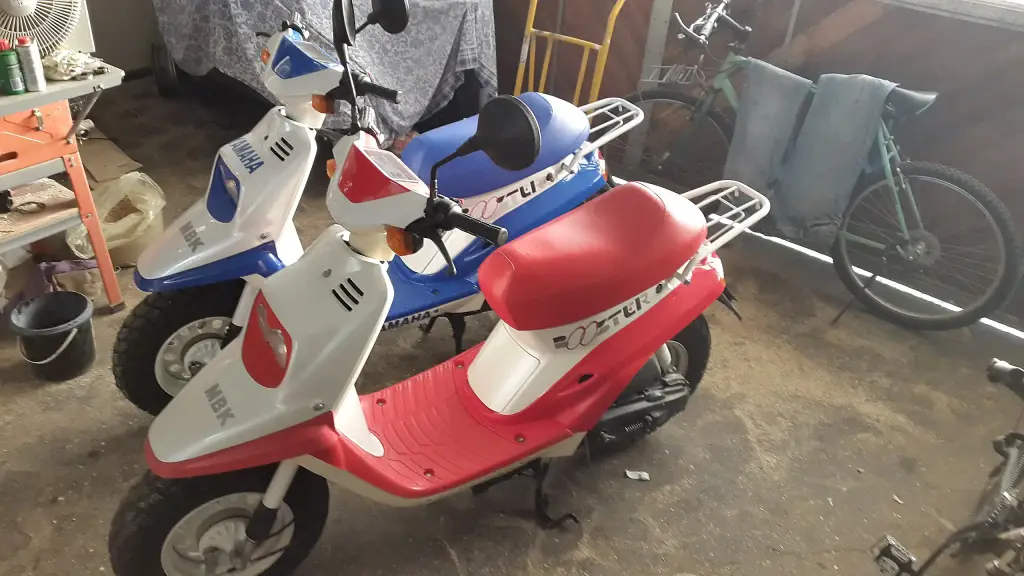
The bet paid off at once. In the first months 4,138 Boosters and BW’s were sold in Italy and 5,582 in France, and sales climbed to more than 20,000 in 1992 and 26,000 in 1993. In 1993 MBK was able to announce that, for the first time, more scooters than mopeds had been sold in France in a year, with 25,000 Booster and BW’s among them. The market was maturing and rivals were reacting, so in 1994 the Booster Road and BW’s R arrived with a hydraulic fork, a front disc brake, cast wheels and a transmission giving better acceleration.
In 1995 MBK and Yamaha widened the range with the Next Generation and the Rocket and Spy on 12-inch wheels. The Booster Spirit of 1996 weighed 70 kg and claimed the best power-to-weight ratio on the market, and a modified Next Generation became the Booster Track and BW’s Bump, sold as extreme scooters. The sporty Nitro and Aerox followed in 1997. The Saint-Quentin factory built its millionth Booster in 1999, by then on 12-inch wheels, and that year also brought the BW’s 100 with a 100 cm³ two-stroke of 8 hp and more than 90 km/h.
Later versions
The Track and Bump were dropped in 2000, when a limited anniversary series marked ten years of the Spirit and Original. The BW’s 100 was killed off by the Euro 2 emission rules in 2003. In 2010 came a BW’s 125 with a 125 cm³ four-stroke of 9 hp and 100 km/h, styled after the Japanese BW’s 50 of a year earlier but priced at €3,000, as much as a Majesty 125; it was not a success. In April 2013, facing cheap Chinese scooters, MBK and Yamaha returned to basics with the Booster one and BW’s easy: 10-inch steel wheels, drum brakes front and rear and analogue instruments. In just over twenty years the two names accounted for more than two million machines.
Design and features
- Oversized 10-inch wheels: the feature that gave the BW’s its name and its sure-footed feel in town.
- Simple two-stroke: a 14 mm Teikei carburettor, reed-valve induction, fan-assisted cooling and automatic oil injection with a low-oil warning light.
- Easy starting: electric starter with a kick starter as backup.
- Practical details: a dual seat with room for one full-face helmet and a rear rack that doubles as grab rails.
- Disc brake from 1998: earlier models had a drum at the front, later ones a 155 mm hydraulic disc.
MBK Booster versions
- Booster (1989 onwards): the original 10-inch-wheel scooter.
- Booster Road / BW’s R (1994): hydraulic fork, front disc brake and cast wheels.
- Booster Spirit / BW’s Original (1996): 70 kg and the best power-to-weight ratio in its class.
- Booster Track / BW’s Bump (1996–2000): off-road-styled extreme scooters based on the Next Generation.
- BW’s 100 (1999–2003): 100 cm³, 8 hp, over 90 km/h.
- Booster one / BW’s easy (2013): a back-to-basics version with steel wheels and drum brakes.
The Booster shared its mechanical layout with the sportier MBK Nitro, and its small-wheel city cousin was the MBK Ovetto. More scooters and mopeds are in the MBK collection.
Video: Streetrox Story feat. MBK Booster High End 2013
Video on YouTube.
Sources
- MBK Booster – Yamaha BW’s, French Wikipedia: history, sales, versions
- Yamaha BW’s, English Wikipedia: engine, cycle parts, equipment