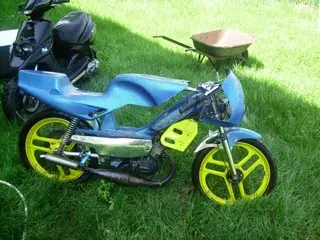
The 51 was the moped with which Motobécane replaced its long-running type 50 in 1978, and it survived the collapse of its maker to be built by MBK until 2002. With the new AV10 engine it was the most modern French moped of its day, and it remains one of the best remembered.
MBK 51 at a glance
| Maker | Motobécane, then MBK |
|---|---|
| Launched | 1978 |
| Name change | MBK 51 after 1985 (MBK Industrie from 1984) |
| Production ended | 2002, after 24 years |
| Engine | AV10, 49 cm³ two-stroke |
| Induction | reed valve in the crankcase, three transfer ports |
| Power | 2 to 3 DIN hp |
| Transmission | Mobymatic automatic variator, except the entry-level S |
| Brakes | cable-operated drum brakes |
| Rear suspension | shocks, more inclined than on the 50 |
| Wheels | spoked; cast aluminium on the 51 Super from 1979 |
There is no English article on the 51; this page is based on the French article, which describes the moped’s history and construction in detail.
History of the MBK 51
Replacing the 50 (1978)
At the end of the 1970s Motobécane, which had taken over Vélsolex in 1974, was in vigorous form and set out to renew a range that dated from the beginning of the decade. The 51 appeared in 1978 as the flagship of that new line and replaced the 50, which stayed in production until 1979. Advertising concentrated on the new AV10 engine with its three transfer ports and crankcase reed valve, and the rival in Motobécane’s sights was Peugeot’s 103 of 1971. The frame was inherited from the proven 50, and the new model was offered in light blue, orange, yellow, grey or white depending on the version and the year.
A whole range around the 51
The 51 was not alone. Alongside it Motobécane sold the 41, a light version with the same AV10 engine available with a variator (V) or without (S) and with no rear suspension or plastic tank surround; the M7, a light youth model with the tank under the luggage rack and the older AV7 engine; the 92GT with the AV10 and a double variator; the 99Z, the best-equipped model, with a counter-piston engine; the off-road 95TT with the 99Z engine and the D55TT with a five-speed gearbox; and the classic AV88 and AV89.
Motobécane’s end and the MBK years
Motobécane went bankrupt in 1983. The firm was renamed MBK Industrie in 1984 and taken over by Yamaha in 1986, and the 51 stayed in the catalogue until 2002, a career of twenty-four years. Seen in retrospect it was the swan song of the largest French maker of bicycles and motorcycles.
How it was built
The frame was a steel monocoque derived from the 50 family, with an oval, elongated tank in the diagonal tube and a reserve supply of fuel. All versions had rear shock absorbers, set at a greater angle than on the 50; some high-grade series came with hydraulic shocks and separate gas reservoirs. The swingarm was round in section and gained a bar-type anti-theft lock in the 1980s, while sporting versions used a stiffer rectangular arm. Standard forks were an evolution of the 1950s pattern with sliders close to the wheel axle and a trapezoidal headlight; from the late 1970s a Sport fork with a round headlight appeared, and some sporting versions had a body kit and a faired headlamp cowl. The forks were not hydraulic, grease alone damping the travel. Early and utility models had spoked wheels; cast aluminium Polymécanique wheels made by Motobécane appeared on the 51 Super in 1979, followed later by Leleu and Grimeca wheels. Brakes were cable-operated drums whose diameter grew over the years, with discs only on a few racing machines.
Design and features
- AV10 engine: a distant derivative of the 1950s AV7, with crankcase reed-valve induction and three transfer ports, raising output from 2 to 3 DIN hp.
- Mobymatic transmission: an automatic variator with automatic belt tension from the floating engine, fitted to every 51 except the entry-level S of 1978–1980 and some Club models.
- Steady development: electronic ignition from the mid-1980s, liquid cooling on some ranges, and carburettors that grew from 12 to 14 mm.
- Cobra exhaust: the tromblon silencer of early cars gave way to an expansion chamber of the Cobra type.
- Kick start: sporting versions dropped pedalling for a kick starter in the mid-1980s, once moped regulations allowed it.
MBK 51 versions
- 51 (1978–2002): the standard moped with the AV10 engine and Mobymatic transmission.
- 51 S (1978–1980): the entry-level version without a variator.
- 51 Super (1979): cast aluminium wheels and sporting trim.
- Magnum: one of the best-known later versions.
- West and New West: chopper-styled models.
- Club: versions sold without the automatic variator.
The 51 was the moped that carried Motobécane into the MBK years, before the company turned to scooters such as the MBK Booster and the MBK Evolis. More machines are in the MBK collection.
Video: MBK 51 second test
Video on YouTube.
Sources
- MBK 51, French Wikipedia: history, range, frame, engine, versions