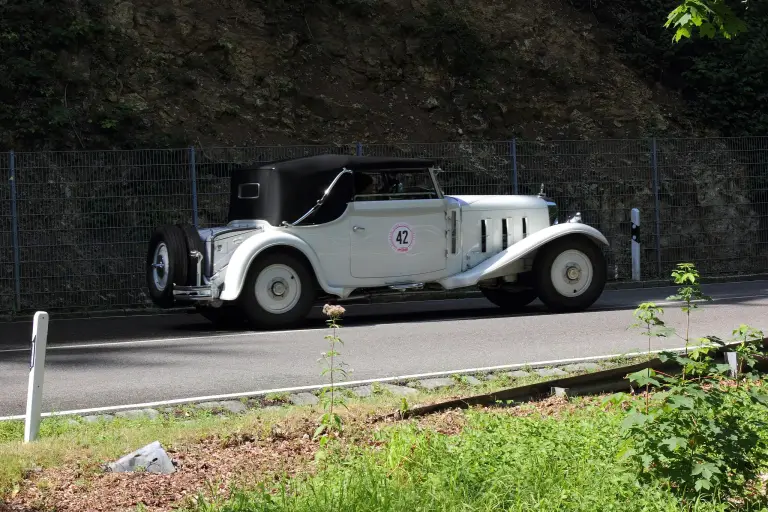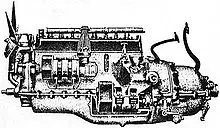
The Maybach W3 was the first car the company put on sale, presented at the Berlin motor show in September 1921 and built until 1928. It was a large, expensive chassis sold without bodywork, with a 5.7-litre six-cylinder engine and, unusually for a German car of its time, brakes on all four wheels.
Maybach W3 at a glance
| Also known as | 22/70 PS |
|---|---|
| Production | 1921–1928 |
| First shown | September 1921, Berlin |
| Engine | 5,740 cc straight-six |
| Power | 70 PS at 2,200 rpm |
| Ignition | dual ignition, two spark plugs per cylinder |
| Gearbox | two-speed planetary plus reverse |
| Brakes | drums on all four wheels, cable operated |
| Top speed | 105–110 km/h |
| Chassis weight | 1,650 kg |
| Chassis price | 22,660 marks |
| Built | 400 |
There is no English Wikipedia page for the model; this article uses the Italian page on the W3 and the German company page.
History of the Maybach W3
An accident of history
The W3 owes its existence to another company’s trouble. The Dutch maker Spyker ordered 1,000 engines from Karl Maybach’s works and then could not pay for them, so Maybach built several hundred chassis to use the engines himself. The first complete car, the W3, was shown in September 1921 at the Berlin show, two years after the company’s experimental W1 of 1919. It was the first Maybach that customers could buy.
Engineering
The engine was a 5,740 cc straight-six giving 70 PS at 2,200 rpm, with dual ignition and a two-speed planetary gearbox. The chassis was pressed steel with a U-section profile, the suspension used rigid axles at both ends with leaf springs, and the brakes were cable-operated drums on all four wheels — the W3 is regarded as the first German car with four-wheel brakes, and it also had one of the earliest brake-force distributors.
Bodies and price
Like other luxury cars of the period, the W3 left the factory as a chassis, and buyers chose a body: roadster, torpedo or limousine. The bare chassis weighed 1,650 kg and cost 22,660 marks, and a finished car could cost up to 13,000 marks more, which put it among the cars of a very small and very wealthy group. Top speed depended on the body and was between 105 and 110 km/h. Production ended in 1928 after 400 cars, and the W3 had no direct successor, because the later Maybachs belonged to an even more exclusive class.
Design and features
- Dual ignition: two spark plugs per cylinder for more reliable combustion.
- Four-wheel brakes: rare in Germany in 1921, with a brake-force distributor.
- Planetary gearbox: a two-speed unit with reverse and no conventional sliding gears.
- Coachbuilt bodies: roadster, torpedo and limousine bodies on the same chassis.
Maybach W3 versions
- W3 (1921–1928): the standard chassis, 400 built.
- Roadster, torpedo and limousine: body styles offered by coachbuilders.
The W3 began the line that led to the SW series and the Zeppelin. More cars are in the Maybach collection.
Sources
- Maybach W3, Italian Wikipedia: origin, engine, chassis, brakes, price, production
- Maybach-Motorenbau, German Wikipedia: W1, Berlin show date, chassis-only deliveries