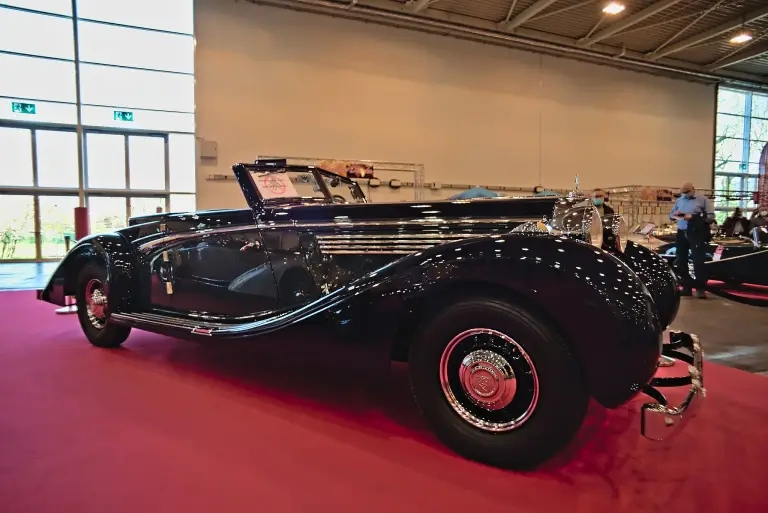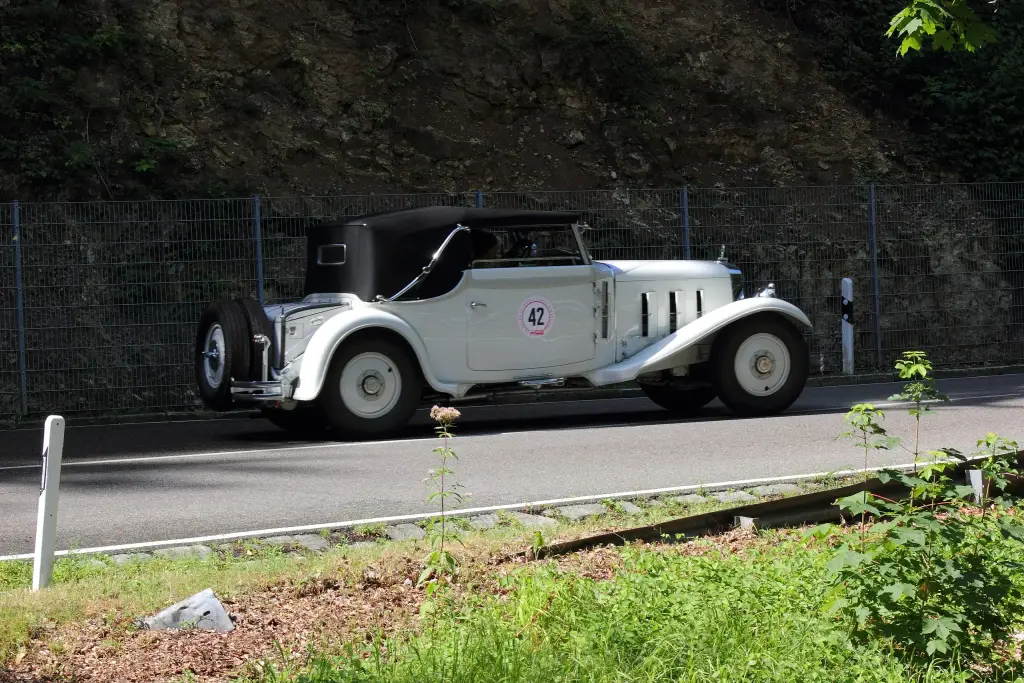
The Maybach Zeppelin was the company’s flagship from 1928 to 1938, named after the Zeppelin engines that had made Maybach famous before and during the First World War. It was an enormous car of about three tonnes, so heavy that German drivers needed an extra licence for goods vehicles.
Maybach Zeppelin at a glance
| Production | 1928–1938 (some sources 1940) |
|---|---|
| Models | DS7 and DS8 |
| DS7 engine | 6,971 cc V12, 150 PS |
| DS8 engine | 7,978 cc V12, 200–203 PS |
| DS7 top speed | 140–150 km/h |
| DS8 top speed | up to 171 km/h |
| DS7 wheelbase | 3.66 m |
| DS8 wheelbase | 3.66 m, 3.735 m from 1938 |
| Weight | about 3,000 kg |
| DS8 gearbox | Variorex, eight speeds with pre-selection |
| Bodies | Spohn, Gläser and others |
| Licence | goods vehicle licence required in Germany |
History of the Maybach Zeppelin
Maybach 12 and DS7
Work began in 1928 on a car called simply the Maybach 12, which went on sale in 1929 with a 7.0-litre V12. In 1930 it was renamed DS7 and a Zeppelin badge appeared on a bar between the headlamps; the name was taken up universally, although it was never the official model designation. The engine, with 6,971 cc and 150 PS at 2,800 rpm, was a long-stroke design of 86 by 100 mm with eight main bearings, one of them a small outrigger at the rear carrying the camshaft gears, which were made of Novotext to reduce noise. The DS7 used a semi-automatic three-speed gearbox with overdrive, a wheelbase of 3.66 m and a chassis that weighed about 1,840 kg.
DS8
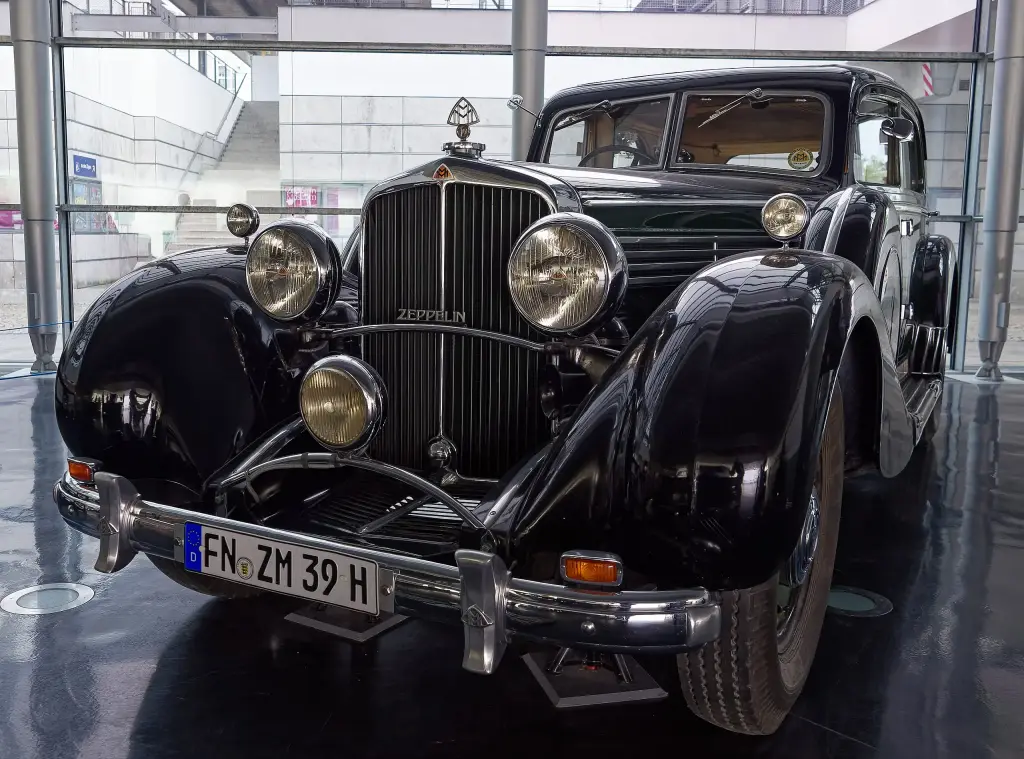
The DS8 joined it in 1930 with an 8.0-litre V12 of 7,978 cc and 200–203 PS at 3,200 rpm, which made it one of the most powerful production cars in the world. Top speed reached 171 km/h depending on the body. Its most notable technical feature was the Variorex transmission: an eight-speed pre-selector with vacuum operation, where the clutch pedal was used only for stopping and starting and the driver pre-selected a gear with a stalk on the steering column. It may have been the first car with eight forward gears, and its later development went into German tanks and half-tracks. The DS8 also had a twin-plate dry clutch instead of the single-plate unit of the DS7.
Updates and the end
The DS8 was revised in 1938 to answer the new Mercedes-Benz 770: the wheelbase grew to 3.735 m, the gearbox became a five-speed with two overdrives, the bare chassis weighed 2,110 kg and top speed fell to 160 km/h. French sources list a more aerodynamic DS8 Streamline of 1932–1935 and a lighter two-seat DS8 Sport Cabriolet of 1937–1939 capable of 180 km/h. Production stopped in 1940 as the works turned to engines for the war. In August 2012 a 1938 DS8 Roadster with Variorex sold for €1.3 million; it is thought to be one of only about 100 built. Maybach revived the name in 2009 for a special edition of the 57 and 62.
Design and features
- V12 power: 7.0 or 8.0 litres, up to 203 PS at a low 3,200 rpm.
- Variorex gearbox: eight pre-selected gears, later used in tanks and half-tracks.
- Quiet engine: Novotext camshaft gears and four-bolt main bearing caps on selected bearings.
- Coachbuilt luxury: chassis delivered to Spohn of Ravensburg or Gläser, bodies to order.
Maybach Zeppelin versions
- Maybach 12 (1929): the first version, renamed DS7 a year later.
- DS7 (1929/30–1934): 7.0-litre V12, 150 PS.
- DS8 (1930–1940): 8.0-litre V12, 203 PS, Variorex gearbox.
- DS8 Streamline (1932–1935): more aerodynamic body, same engine.
- DS8 Sport Cabriolet (1937–1939): lighter two-seater, up to 180 km/h.
- Zeppelin edition of the 57 and 62 (2009): a modern special series sharing only the name.
The Zeppelin followed the SW series as the flagship, and its name returned on the 2009 Maybach 57 and 62 Zeppelin. More cars are in the Maybach collection.
Sources
- Maybach Zeppelin, English Wikipedia: engines, Variorex, auction, production
- Maybach DS7 e DS8, Italian Wikipedia: chassis, gearboxes, dimensions, 1938 update
- Maybach Zeppelin, German Wikipedia: model years, 2009 edition
- Maybach Zeppelin, French Wikipedia: Streamline and Sport Cabriolet versions