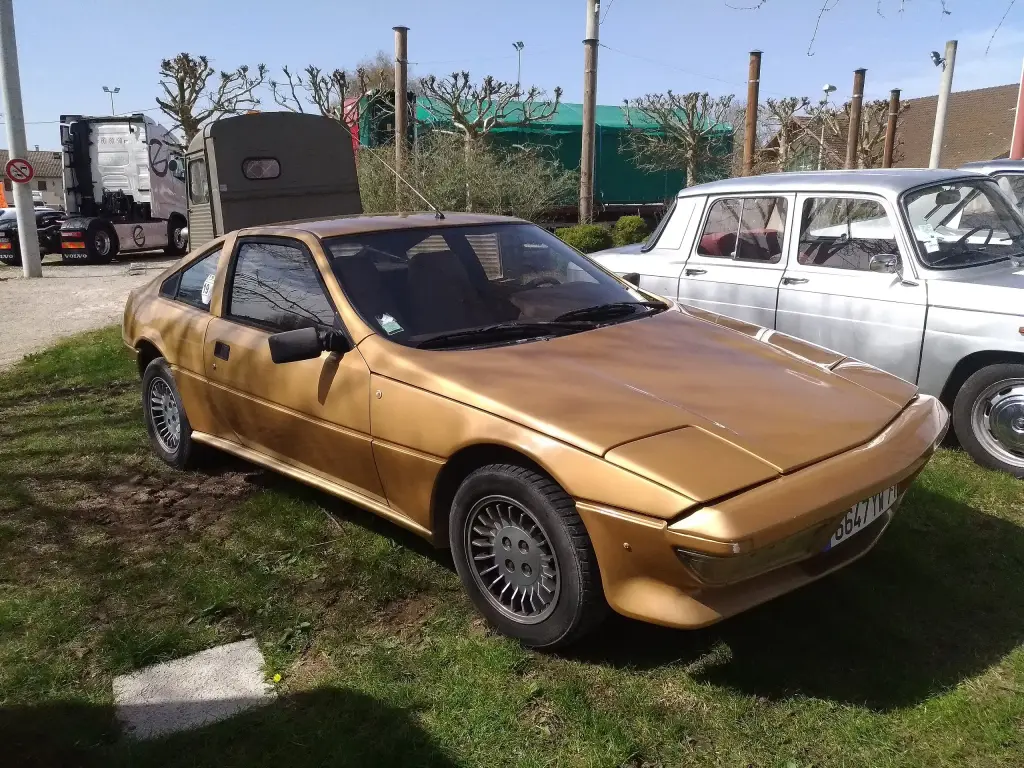
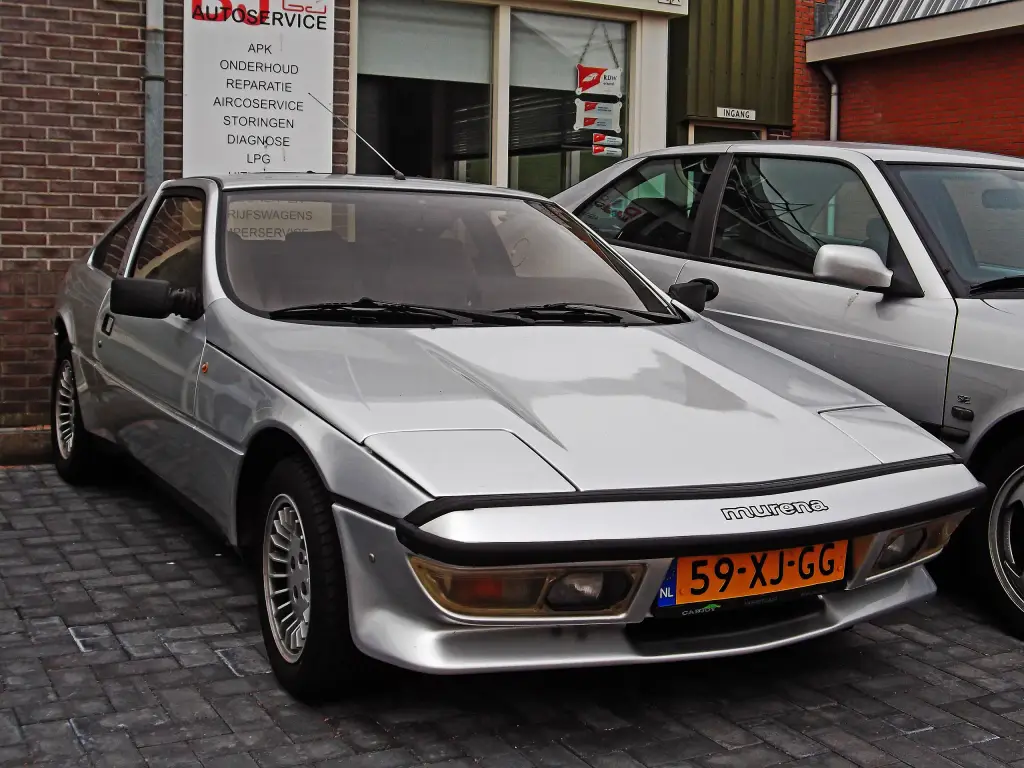
The Matra Murena was the last sports car Matra developed with Simca, by then part of Talbot. Built from 1980 to 1983, it followed the shape and the three-abreast layout of the Bagheera but cured its predecessor’s two weaknesses: a chassis that rusted and an engine range that lacked power.
Matra Murena at a glance
| Maker | Matra, sold as Matra and later Talbot-Matra |
|---|---|
| Production | 1980–1983, model years 1981–1984 |
| Body | two-door coupé, fibreglass-epoxy panels |
| Layout | mid-engine, rear-wheel drive |
| Engines | 1.6-litre Poissy four; 2.2-litre Type 180 |
| Power | 118 PS in the 2.2, 142 PS in the Murena S |
| Gearbox | five-speed transaxle from the Citroën CX |
| Chassis | fully galvanised steel |
| Drag coefficient | 0.328 |
| Seats | three in one row, middle seat folding into an armrest |
| Luggage | 232 dm³ (2.2) to 290 dm³ (1.6) behind the engine |
History of the Matra Murena
The Murena, whose name is Italian for moray, replaced the Matra Bagheera. Development ran under two project codes, M551 for the 1.6-litre version and M552 for the 2.2, and the design was headed by the Greek industrial designer Antonis Volanis, who had worked on the Bagheera’s interior and designed the Rancho. Matra addressed the Bagheera’s problems directly: the new car had more power, a five-speed gearbox and a chassis protected against rust.
Its chassis was the Murena’s most important advance. The whole structure was hot-dip galvanised, making it, according to the English Wikipedia article, the first production car to use galvanised steel for all chassis parts; the French source notes that twenty kilograms of zinc were deposited in a 65-micrometre layer and that the process added about 45 per cent to the chassis’s rigidity. With composite body panels, the car was essentially immune to rust apart from the rear suspension’s trailing arms.
The styling was new but kept the family features: hidden headlamps, a very large glass area, a hatch giving access to the engine and luggage space, and three individual seats in one row, with the middle one folding down to become an armrest. The drag coefficient of 0.328 was very low for a mid-engined car of the period.
Two engines were offered. The 1.6-litre Poissy unit was imposed by Talbot’s marketing to keep volumes up, while the 2.2-litre Type 180 came from the Talbot Tagora. A dealer-fitted “Préparation 142” option raised the 2.2 from 118 to 142 PS, and the last 480 cars left the factory with this engine as the Murena S, which also carried a black polyester rear spoiler. Production of the 1.6 and 2.2 ended in July 1983, and the S served as the final edition for the 1984 model year.
Design and features
- Galvanised chassis: a hot-dip galvanised steel structure that made rust a non-issue, a first for a production car’s chassis.
- Three-abreast cabin: three separate seats with a folding middle backrest that doubled as a wide armrest.
- Aerodynamic body: a drag coefficient of 0.328, hidden headlamps and a steeply raked windscreen.
- Practical hatchback: a large glass hatch over the engine and a luggage compartment of up to 290 dm³.
- Parts-bin engineering: Citroën CX transaxle, Talbot Solara steering and front suspension, Peugeot 505 door handles and Renault 12 lights.
Matra Murena versions
- Murena 1.6 (1980–1983): the base model with the 1.6-litre Poissy engine.
- Murena 2.2 (1981–1983): 2.2-litre Type 180 with 118 PS.
- Préparation 142 (from 1982): a dealer-installed kit raising output to 142 PS; 74 cars were officially converted.
- Murena S (1984 model year): the last 480 cars, built with the 142 PS engine and a rear spoiler.
- Right-hand drive: none built at the factory; a small number were converted by Wooler-Hodec.
The Murena succeeded the Matra-Simca Bagheera and was the last sports car of the Matra-Simca partnership that also produced the Rancho; the earlier Matra 530 began the line. More are in the Matra collection.
Sources
- Matra Murena, English Wikipedia: chassis, bodywork, engines
- Talbot-Matra Murena, French Wikipedia: galvanising, versions, market