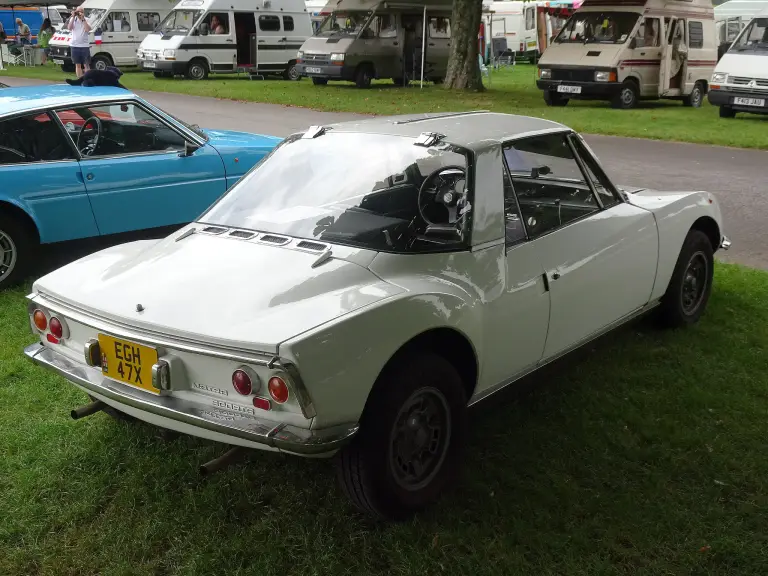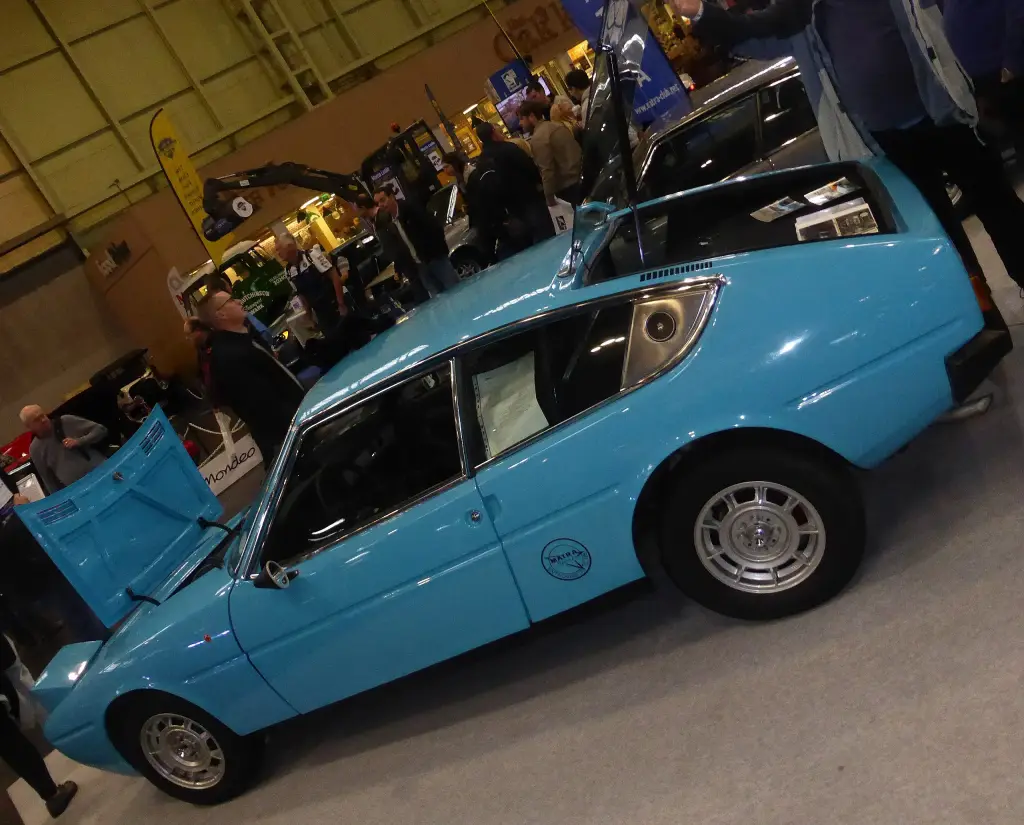
The Matra-Simca Bagheera was the first car developed jointly by Matra and Simca after their 1969 agreement. Built from 1973 to 1980, it kept the mid-engine layout and the hidden headlamps of the 530 but replaced the 2+2 cabin with three seats in a single row, an idea its designer Philippe Guédon defended as more useful in everyday driving.
Matra-Simca Bagheera at a glance
| Maker | Matra with Simca, France |
|---|---|
| Production | 1973–1980 |
| Project code | M550 |
| Body | two-door coupé, fibreglass-reinforced polyester |
| Layout | mid-engine, rear-wheel drive |
| Engine | 1,294 cc Simca “Poissy” four (1,442 cc from 1975) |
| Power | 84 DIN hp; 90 hp in the S |
| Top speed | about 180 km/h |
| Seats | three abreast, 2+1 |
| Drag coefficient | 0.33, 0.35 after the 1976 restyle |
| Built at | Romorantin-Lanthenay, Loir-et-Cher |
History of the Matra-Simca Bagheera
In December 1969 Matra and Simca signed an agreement that rebranded Matra’s racing cars as Matra-Simcas and gave Matra access to the Simca dealer network. The first joint project was a replacement for the Matra 530, which had fallen well short of its sales targets. Work started in 1970 under the code M550, led by Matra’s head of engineering Philippe Guédon with the Chrysler-Simca planner Jacques Rousseau. Simca’s planners pointed to the 1.3–1.5-litre class as the company’s strongest market, so the new car used the engine, gearbox and much of the suspension of the Simca 1100, moved to a mid-engine layout.
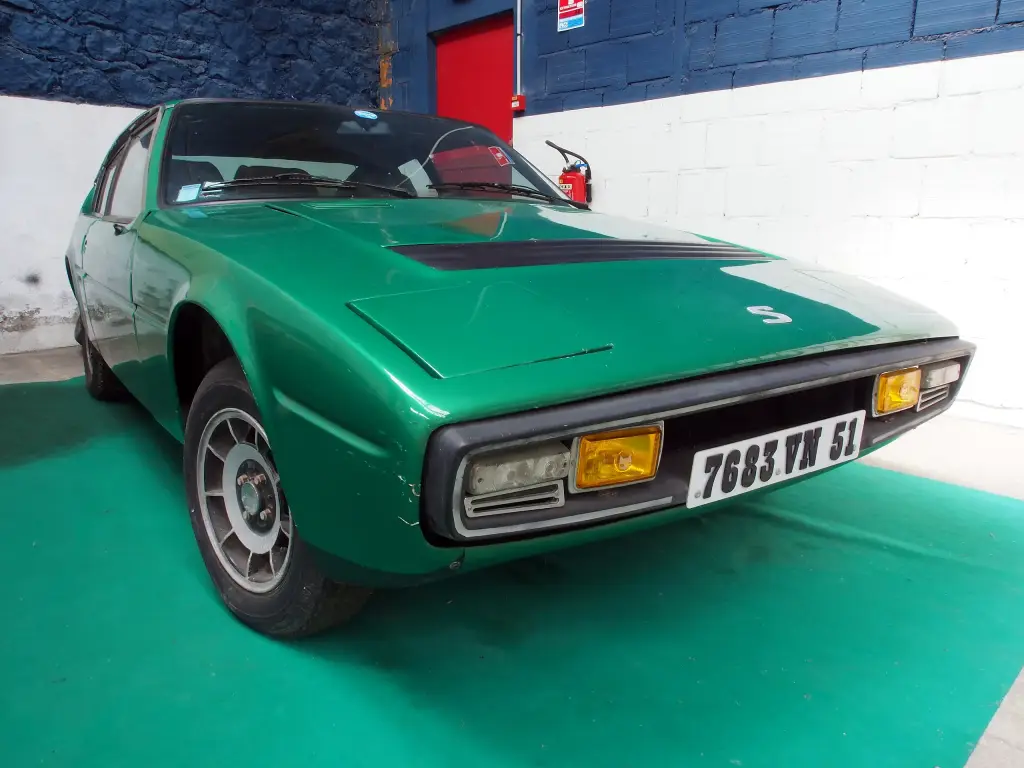
Guédon wanted more than two seats but rejected the 530’s cramped 2+2. The answer, he said, came on a long trip in a Ford Taunus estate when three of them had to sit abreast in the front. The M550 was therefore built with three seats in one row: a normal driver’s seat and, on the passenger side, a two-place bench with two separate backrests modelled on a lounge chair Guédon had found in a Paris shop.
Eleven prototypes were tested from Mauritania to Lapland and crash-tested, and development was finished by the end of 1972. The car was named after the panther in Kipling’s The Jungle Book and unveiled to the press beside Lake Annecy on 14 April 1973, with its public launch at that year’s Le Mans 24 Hours; Simca arranged to have 500 yellow Bagheeras waiting at its dealers. Production reached 65 cars a day by the end of 1973, and more than 10,000 had been sold within eighteen months.
From 1975 the S version used the 1,442 cc engine of the Simca 1308 GT with 90 DIN hp, and a Courrèges limited edition finished entirely in white was offered. The car was restyled in July 1976 for the 1977 model year with more enveloping bumpers, a larger rear glass area and a renewed interior. In its final year, after Chrysler Europe passed to PSA, it was marketed as the Talbot-Matra Bagheera.
Design and features
- Three abreast: a 2+1 layout that made the mid-engined coupé usable for a family, with slightly convex body sides to make room for shoulders.
- Fibreglass body: nineteen panels made by the low-pressure, high-temperature “LP” process, a technique Matra introduced at the development stage.
- Aerodynamics: a drag coefficient of 0.33 in early form, which helped the modest engine reach about 180 km/h.
- Practical hatch: the rear hatch opened onto the engine bay and a luggage space behind the passenger compartment.
- Simca 1100 underpinnings: front suspension with longitudinal torsion bars and an anti-roll bar, and a pressed-steel chassis closer to a unitary body than a space frame.
Matra-Simca Bagheera versions
- Version I and Version II (from October 1973): the basic and better-equipped trim levels, priced at 24,450 F and 26,550 F.
- S (1975): 1,442 cc engine with 90 hp, bonnet and rear-wing air intakes, tweed interior and alloy wheels.
- Courrèges (1975): a limited edition finished in white by the couturier André Courrèges.
- 1977 restyle: single model replacing Version I and II, with a larger rear window and revised trim.
- Bagheera U8 prototypes: two cars built from 1973 with two 1,294 cc engines coupled in a U configuration, 2,588 cc and 168 hp; abandoned after the first oil crisis.
The Bagheera replaced the Matra 530 and was itself succeeded by the Matra Murena. Matra’s other leisure model of the period was the Matra-Simca Rancho; more are in the Matra collection.
Sources
- Matra Bagheera, English Wikipedia: development, bodywork, chassis
- Matra-Simca Bagheera, French Wikipedia: versions, prices, U8 prototype