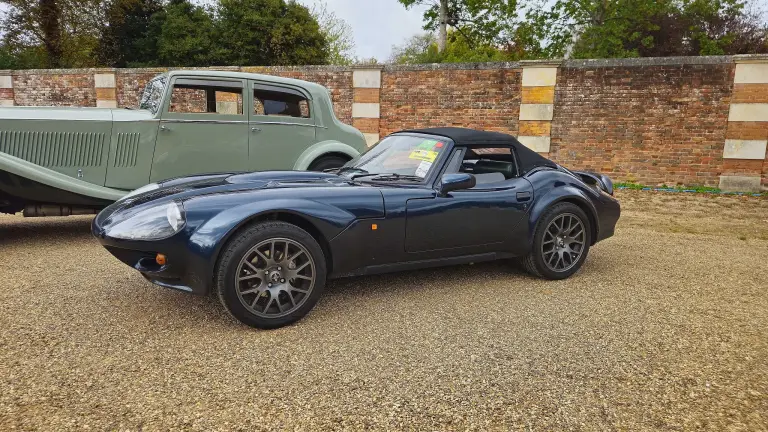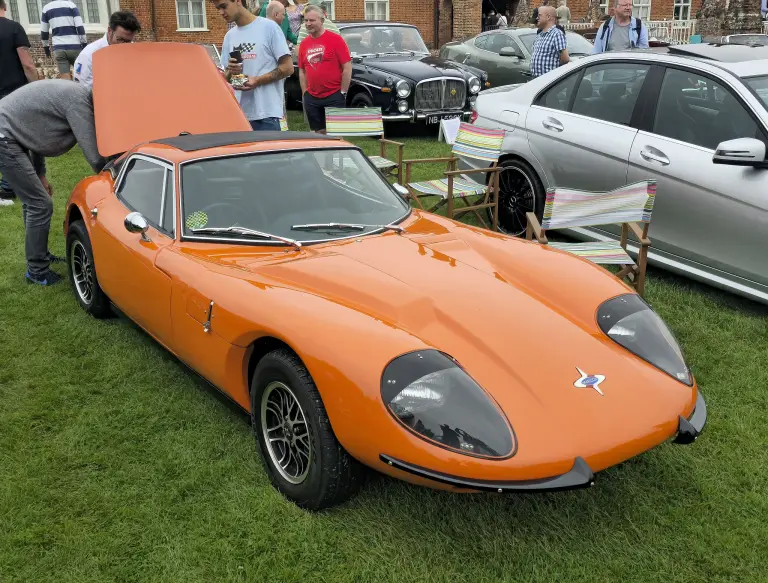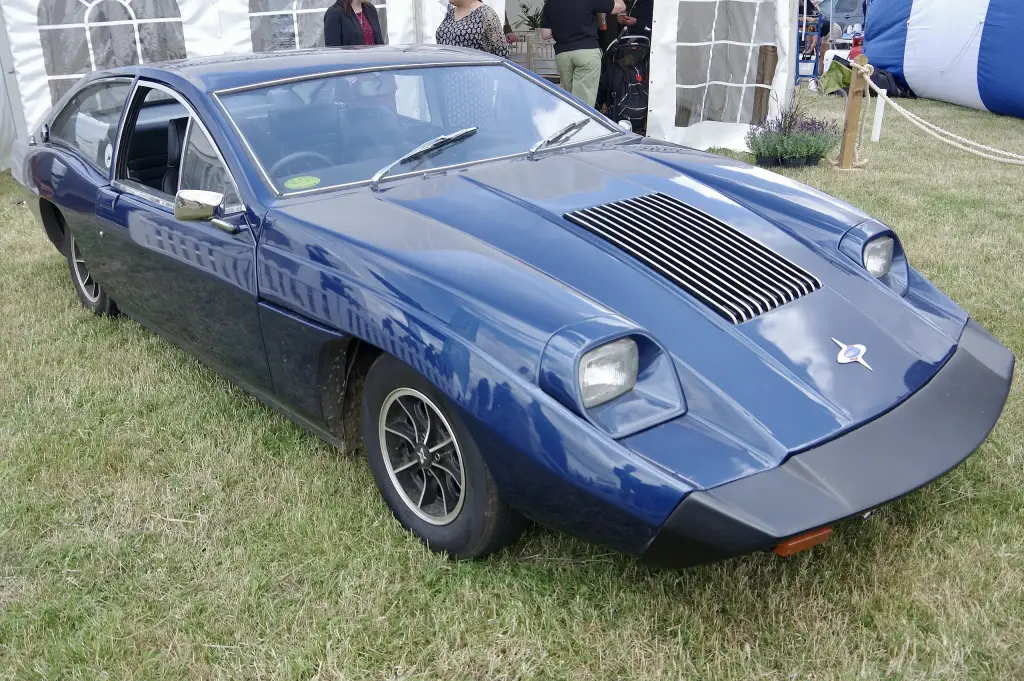
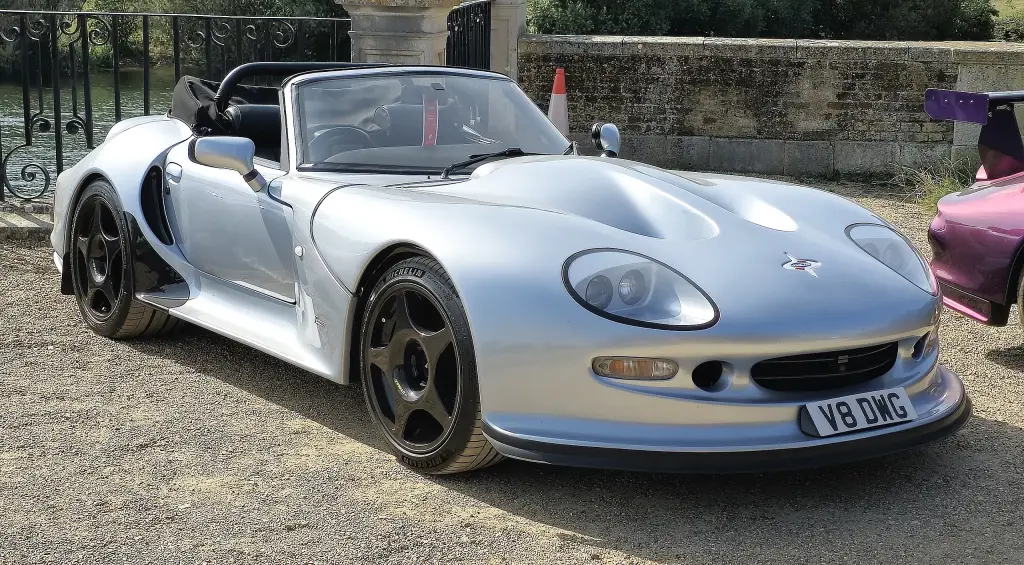
The Mantis name was used by Marcos for several quite different cars: a gullwing racing prototype of 1968, a Triumph-engined road coupé of 1970 and, from 1997, a new two-seater with a Ford V8, supercharged in the Mantis GT.
Marcos Mantis at a glance
| Maker | Marcos Engineering |
|---|---|
| First Mantis | Mantis XP racing car, 1968 |
| XP engine | mid-mounted Repco V8 |
| XP chassis | plywood monocoque |
| XP built | one car |
| XP race | 1968 1,000 km at Spa, retired |
| Road Mantis | from 1970, Triumph 2.5-litre six |
| Road Mantis price | £3,185 factory built; £425 as a kit (1971) |
| Road Mantis built | 32 |
| Dimensions | 4.72 m long, 1.17 m high |
| 1997 Mantis engine | 4.6-litre Ford Modular V8 |
| Mantis GT | supercharged, 506 hp (377 kW) |
| Performance, GT | 0–60 mph in 3.7 s; 179 mph (288 km/h) |
This page is based on English Wikipedia only, so the figures could not be cross-checked against a second source. It covers the gullwing Mantis XP, which has no page of its own.
History of the Marcos Mantis
Mantis XP, 1968
The first Mantis was the Mantis XP, a racing car designed for the Group 6 Prototype class with a mid-mounted Repco V8. Like earlier Marcos cars it used a plywood monocoque chassis, though different from that of the GT. Only one car was made and its only race was the 1968 1,000 km event at Spa, where it retired with electrical problems in heavy rain. Marcos had intended to race it at Le Mans in 1968, but the race was postponed from June to September and by then the car was in America with a Buick V8 engine fitted.
Mantis M70, 1970
The road cars followed in 1970, powered by the Triumph 2.5-litre six-cylinder engine also used in the Triumph TR6 and by TVR. Announced as a luxurious 2+2 for the younger English executive market, the Mantis M70 had a claimed top speed of 120 mph, coil springs on all four wheels and a live rear axle with trailing links and an A bracket. At 4.72 m long and 1.17 m high it was a lengthy car but one of the lowest coupés on the market.
In February 1971 Marcos announced that the Mantis could also be bought in component form for £425 against a recommended retail price of £3,185 for the factory-built car. With Marcos running into financial trouble and closing later in 1971, only 32 examples were produced, although Motor magazine reported another 35 unsold cars in the United States. Autotune UK later acquired the moulds and sold a few more kits as Autotune Mirages.
Mantis and Mantis GT, 1997
The Mantis name returned in 1997 on a completely new two-seater with a 4.6-litre Ford Modular V8, and in 1998 the Mantis GT added a supercharger taking output beyond 500 bhp. In final form the engine produced 506 hp and 452 lb·ft of torque, enough for 0–60 mph in 3.7 seconds and 179 mph, with power-assisted rack and pinion steering and AP ventilated disc brakes of 284 mm at the front and 240 mm at the rear. Production of the road cars was 51, of which 16 were supercharged GTs, plus 38 Mantis Challenge race cars; a further development was the Marcos Mantis Marcorelly.
Design and features
- Three different cars: a racing prototype, a Triumph-engined 1970 coupé and a 1990s supercharged V8 two-seater share only the name.
- Repco V8 and plywood: the XP followed the early Marcos formula of a plywood monocoque.
- Very low body: the M70 was 1.17 m high, one of the lowest coupés of its time.
- Supercharged GT: the 1998 Mantis GT reached 179 mph from a 4.6-litre Ford V8.
Marcos Mantis versions
- Mantis XP (1968): one-off Group 6 prototype with a mid-mounted Repco V8.
- Mantis M70 (1970–1971): Triumph six-cylinder 2+2, 32 built.
- Autotune Mirage: 1980s kits built from the acquired Mantis moulds.
- Mantis (1997): new two-seater with a 4.6-litre Ford V8.
- Mantis GT (1998): supercharged, over 500 bhp, 16 built.
- Mantis Challenge: racing version, 38 cars.
The Mantis followed the Marcos GT and was itself replaced in the range by the Mantara. The racing branch of the family ended with the LM600. More cars are in the Marcos collection.
Sources
- Marcos Mantis, English Wikipedia: all three cars, engines, production numbers