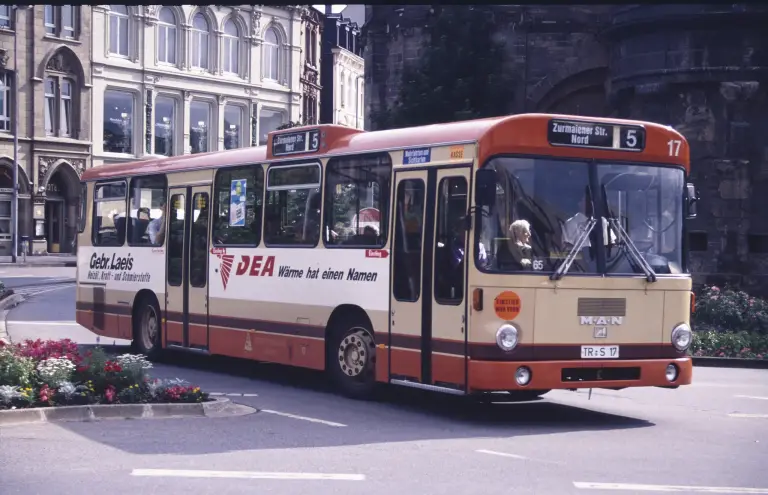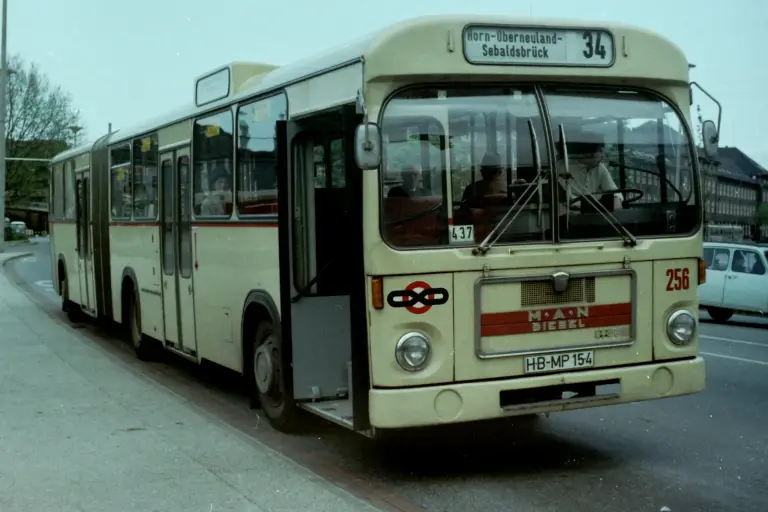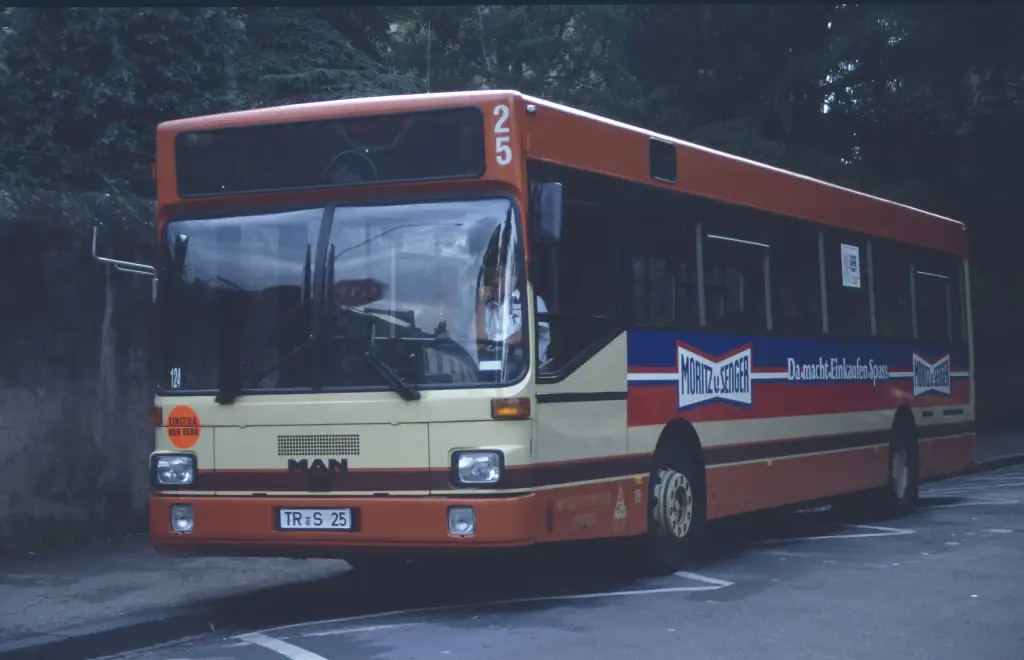
The MAN SL202 was a single-decker city bus built in Salzgitter from 1983 to 1993. It succeeded the SL200 as MAN’s second-generation VöV standard bus and was also sold as a chassis for external bodywork in Australia and New Zealand.
MAN SL202 at a glance
| Production | 1983–1993 |
|---|---|
| Class | standard city bus (VöV second generation) |
| Predecessor | MAN SL200 |
| Successor | MAN NL202 |
| Engines | D2566UH 11.413 L, 155 kW (211 PS); D2866 from about 1990, 11.967 L |
| Gearboxes | Renk Doromat and Voith DIWA automatics; ZF Ecomat 4HP500 and 5HP500 |
| Built in | Salzgitter, Germany |
| Exports | chassis for Australia and New Zealand |
| Related | MAN Americana SL40-102 |
The English article dates production from 1983, the German one from 1984.
History of the MAN SL202
The SL202 succeeded the SL200 in 1983. It was built to the updated VöV specification, with the double-width entrance and the large front destination display reaching almost the full width of the body, though it could also be ordered with the narrow front display of the Ü80 intercity bus. The SL 202 was far less successful than its predecessor because from 1989 it faced competition from the low-floor MAN NL 202, which is regarded as its successor; production ended around 1993. For suburban traffic and eastern European markets with poorer roads MAN offered the low-entry MAN EL 202 from 1992.
Engines and transmissions
The SL202 came with a wide choice of transmissions: three- and four-speed Renk Doromat automatics, three- and four-speed Voith DIWA units, and four- and five-speed ZF Ecomat 4HP500 or 5HP500 gearboxes. One bus has since been retrofitted with an Allison World Series B300R4 transmission. The engines were replaced around 1990, from the older, smaller 2566 series to the larger 2866 series. Most pre-1990 SL202s have a 155 kW (211 PS) D2566UH engine with about 755 Nm at 1,400 rpm and a capacity of 11.413 litres; post-1990 buses have the D2866 of 11.967 litres with higher power and torque.
Exports and gas trials
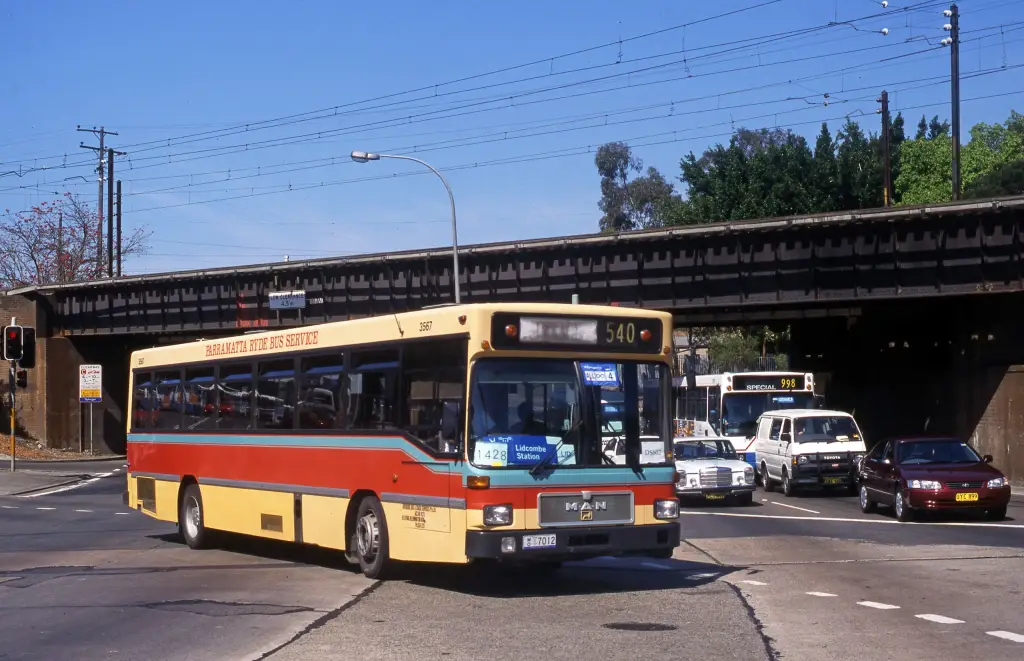
Much of the design was used in the North American version, the MAN Americana SL40-102. The SL202 was mainly sold in Germany, but chassis versions went to Australia, where Sydney Buses bought 50 with Pressed Metal Corporation bodies in 1989 and Adelaide took 125 PMCA-bodied examples between 1992 and 1996, and to New Zealand, where four cities ordered 162 buses with Coachwork International bodies between 1986 and 1989. In Germany, a Nuremberg SL 202 was converted to natural gas in 1993 and tested in service, becoming the first gas-powered city bus in the country; MAN used the results to develop the NL 202 CNG. The bus is now kept in the Nuremberg transport museum.
Design and features
- Second-generation standard bus: built to the updated VöV specification with a double-width entrance.
- Engine change: from the 11.413-litre D2566 to the 11.967-litre D2866 around 1990.
- Many gearboxes: Renk, Voith and ZF automatics were offered.
- First German gas bus: a 1993 natural gas conversion in Nuremberg led to the NL 202 CNG.
MAN SL202 versions
- SL202 with VöV display: the standard city bus.
- SL202 with Ü80 display: narrow front destination display.
- Pre-1990: D2566UH engine of 155 kW.
- Post-1990: D2866 engine of 11.967 litres.
- Chassis for export: PMCA bodies in Australia and Coachwork International bodies in New Zealand.
- Natural gas test bus: the 1993 Nuremberg conversion.
The SL202 replaced the MAN SL200 and was followed by the low-floor MAN NL202. More MAN buses are in the MAN collection.
Sources
- MAN SL202, English Wikipedia: production, engines, transmissions, exports
- MAN SL 202, German Wikipedia: VöV specification, gas bus, end of production