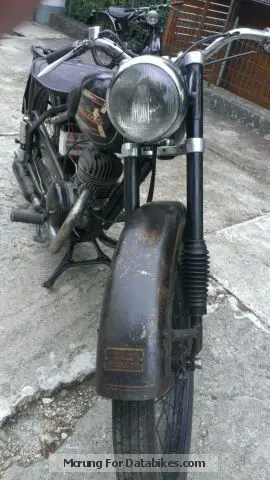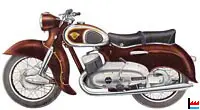
The Maico Taifun was the top model of the Swabian motorcycle maker Maico from 1953 to 1957. It was an innovative two-cylinder two-stroke offered with 350 or 400 cc, and the larger version produced 22.5 PS at 5,200 rpm.
Maico Taifun at a glance
| Maker | Maicowerk A.G., Pfäffingen, Germany |
|---|---|
| Production | 1953–1957 |
| Engine | two-cylinder two-stroke |
| Capacities | 350 cc and 400 cc |
| 400 cc output | 22.5 PS at 5,200 rpm |
| Final drive | chain, tension constant under suspension movement |
| Rear suspension | swingarm pivoting in the axle of the drive sprocket |
| Place in range | top model from 1953 |
| Production ended | 1957, as the motorcycle market shrank |
Based on one source: the Maico company article, which has a section on the Taifun. There is no separate Wikipedia article on the model.
History of the Maico Taifun
Maico was a family company of the Swabian town of Pfäffingen near Tübingen. It was founded in 1926 by Ulrich Maisch as Maisch & Co and began with small two-stroke engines before growing into a maker of complete motorcycles, bicycles and, briefly, microcars.
By 1953 Maico had redesigned its engines. The new unit, known as the Rundmotor, kept the main dimensions of the earlier design but moved the generator inside the casing and smoothed the outside; it was used in the M 175, the M 200 Fanal and Passat, the M 175 S and M 200 S, the M 250 and M 277 Blizzard, the Maicomobil MB 200 scooter and the Maicoletta.
The top model from 1953 was the Taifun, an innovative two-cylinder two-stroke available with either 350 or 400 cc. The 400 cc version produced 22.5 PS at 5,200 rpm, enough to make it the most powerful machine in the Maico range. Chain tension on the Taifun stays constant as the rear suspension moves, because the pivot of the rear swingarm lies in the axle of the drive sprocket.
The Taifun did not last long. The motorcycle market was shrinking dramatically in the second half of the 1950s, and Maico stopped production of the model in 1957. The single-cylinder M models continued, and the company went on to become far better known for its motocross and enduro racing machines.
Design and features
- Two-cylinder two-stroke: an unusual layout for a German 1950s motorcycle, and the basis of the Taifun’s position at the top of the range.
- 22.5 PS from 400 cc: quoted at 5,200 rpm for the larger of the two versions.
- Constant chain tension: the swingarm pivot sits in the axle of the drive sprocket, so the chain does not tighten or slacken as the suspension works.
- Short production life: built from 1953 to 1957, when the collapsing motorcycle market ended it.
Maico Taifun versions
- Taifun 350: the smaller-engined version of the twin.
- Taifun 400: the 400 cc model with 22.5 PS at 5,200 rpm, described on its own page as the Maico 400.
The Taifun sat above the single-cylinder M series and shared the range with the 250 cc Blizzard. More machines are in the Maico collection.
Sources
- Maico, English Wikipedia: company history, model range
- Maico, German Wikipedia: Taifun, 1953 engine range, output