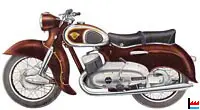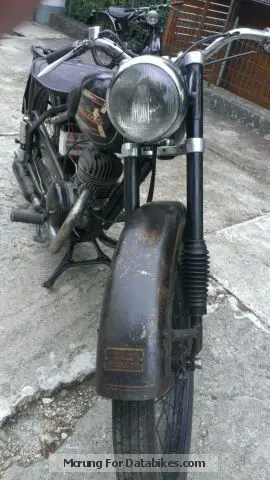
The Maico M series was the Swabian firm’s post-war line of single-cylinder two-stroke motorcycles. It started with the M 125 of 1948, whose engine was Maico’s own design, and expanded through the 1950s into the M 175, M 200 Fanal and Passat and the M 250 Blizzard.
Maico M at a glance
| Maker | Maicowerk A.G., Pfäffingen, Germany |
|---|---|
| First model | M 125, 1948 |
| First engine | Maico-Spitzmotor, designed by Willi Tetzlaff |
| Gearbox | three-speed twist-grip (Magura) at first |
| From 1952 | four-speed foot gearbox for the M 175 and Maicomobil MB 175 |
| 1953 engine | the Rundmotor, with the generator inside the casing |
| Models using it | M 175, M 200 Fanal and Passat, M 175 S, M 200 S, M 250 and M 277 Blizzard |
| Rear suspension | swingarm from 1953 on the M 175 S and M 200 S |
| Scooters | Maicomobil MB 151, MB 175 and MB 200 |
Based on one source: the Maico company article, which describes the M models in its history sections. There is no separate Wikipedia article on the M series.
History of the Maico M
After the Second World War Maico could not restart vehicle production at once. The brothers Otto and Wilhelm Maisch moved a basic set of tools to Herrenberg in the American occupation zone and founded Maico Fahrzeugfabrik GmbH there, beginning again with bicycles. After the 1948 currency reform demand for two-wheelers rose quickly and the firm returned to motorised bicycles, at first with the 98 cc Sachs engine.
In the autumn of 1948 Maico presented its own engine for the new M 125. Designed by Willi Tetzlaff, the so-called Maico-Spitzmotor looked like the ILO unit it replaced but was in fact a new design; its distinguishing feature was a three-speed twist-grip gearbox from Magura. Larger versions of the engine went into the M 150 and M 151 and into the Maicomobil MB 151 and MB 175 scooters. From the beginning of 1952 the M 175, the MB 175 and a few M 151s could be had with a new four-speed foot gearbox.
In 1953 the engines were redesigned again. The main dimensions stayed the same, but the generator moved inside the casing and the exterior was smoothed; this Rundmotor remained almost unchanged for about twenty years. It appeared in the M 175, the M 200 Fanal and Passat, the M 175 S and M 200 S, the M 250 and M 277 Blizzard, the Maicomobil MB 200 and the Maicoletta, as well as in many sports machines.
The same year brought a modern rear swingarm, developed by chief designer Ulrich Pohl and first shown on the M 175 S and M 200 S. Above the single-cylinder models stood the twin-cylinder Taifun, and the M range continued alongside it until the market for road motorcycles collapsed in the late 1950s.
Design and features
- Spitzmotor: Maico’s own 1948 engine, designed by Willi Tetzlaff and fitted with Magura twist-grip gears.
- Rundmotor: the 1953 redesign with the generator inside the casing, used across the range for two decades.
- Four-speed gearbox: available on the M 175 and Maicomobil from 1952.
- Rear swingarm: Ulrich Pohl’s design of 1953, first used on the M 175 S and M 200 S.
Maico M versions
- M 125 (1948): the first model with the Spitzmotor.
- M 150 and M 151: larger-capacity versions of the same engine.
- M 175 and M 200 Fanal and Passat: the main 1950s road models.
- M 175 S and M 200 S: the sports versions that introduced the 1953 swingarm.
- M 250 and M 277 Blizzard: the largest single-cylinder road models, covered on the Maico 250 page.
The M series was joined at the top of the range by the twin-cylinder Taifun, and its 250 cc version is described as the Maico 250. More machines are in the Maico collection.
Sources
- Maico, English Wikipedia: company history, post-war engines
- Maico, German Wikipedia: M models, gearboxes, Rundmotor, swingarm