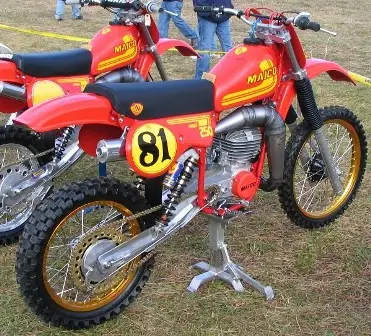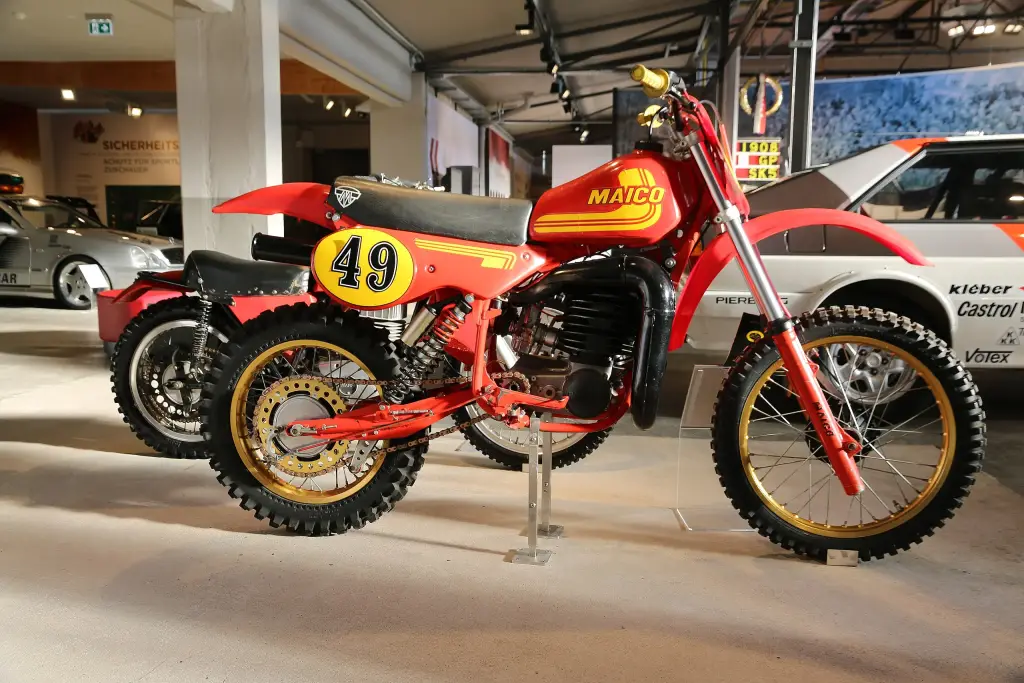
The Maico 500 was the open-class motocross machine at the top of the Swabian firm’s racing range. From 1992–93 it became a true 500 cc rather than a 490, and the Maico name continued through a succession of owners into the 2000s.
Maico 500 at a glance
| Maker | Maicowerk A.G., Pfäffingen, Germany |
|---|---|
| Type | motocross (MC), open class |
| Predecessor | 490 cc, including the Mega 2 of 1981 |
| Change for 1992–93 | a true 500 cc, with a longer stroke |
| Gearbox | new shifting cam mechanism from 1992–93 |
| US name | M-Stars, after the 1983 bankruptcy |
| Later production | Koestler, Germany, from the late 1990s |
| Related models | Maico 620 and 685 of 2003 |
Based on one source: the Maico company article, which covers the racing models and the 490-to-500 change. There is no separate Wikipedia article on the 500.
History of the Maico 500
Maico’s motocross (MC) and enduro (GS) racing models proved very successful in European and American competition through the 1970s. Without the budgets of Honda, Yamaha, Suzuki and Kawasaki, Maico riders such as Adolf Weil, Åke Jonsson and Willy Bauer still produced numerous top-three finishes in the Motocross World Championships.
The open-class machine was the firm’s flagship. In 1981 the Maico Mega 2, a 490 cc bike, was called the greatest open-class motocross bike of all time by the American magazine Motocross Action. A large contribution to motocross suspension came in 1974, when the Wheelsmith team in the United States and the Gunther Schier teams in Europe forward-mounted the rear shocks on Maico factory-backed motorcycles, increasing travel and forcing rival teams to follow.
Maicowerk AG filed for bankruptcy in 1983 but kept building small numbers of motocross and enduro models through 1986, re-badged as M-Stars in the United States for legal reasons. The brand was then sold to Lorenz Merkle, who made Maicos until the mid-1990s; it was during this period that the plastics changed from red to blue, after the British distributor Bill Brown ordered a batch naked and fitted blue bodywork himself because the new bikes looked the same as the previous year’s.
In 1992–93 the 500 became a true 500 cc instead of a 490: the connecting rod was moved on the crank to increase the stroke and raise the capacity, and a new shifting cam mechanism was fitted. Merkle later sold the company; the Dutch firm Rodem built Maicos from 1995 to 1997, went bankrupt, and its largest shareholder, Brouwer, took control. No Maicos were released in 1998; the tuner Hermann Walgenbach reworked the engine and a new bike with a hydraulic clutch appeared in 1999. Brouwer then stopped selling Maicos and Koestler in Germany picked up production, building the Maico 620 and 685 for a supermoto team in 2003.
Design and features
- Open-class two-stroke: the biggest motocross engine in the Maico range.
- Long-stroke 500: from 1992–93 the crank was altered to make a true 500 cc rather than a 490.
- Hydraulic clutch: added to the reworked 1999 model.
- Cult following: vintage Maicos are still restored for display and for the track.
Maico 500 versions
- Mega 2 490 (1981): the open-class model praised by Motocross Action.
- 500 (1992–93 onwards): the true 500 cc version with the new shifting cam.
- M-Stars: the name used for Maicos sold in the United States after 1983.
- 620 and 685 (2003): larger engines built by Koestler for a supermoto team.
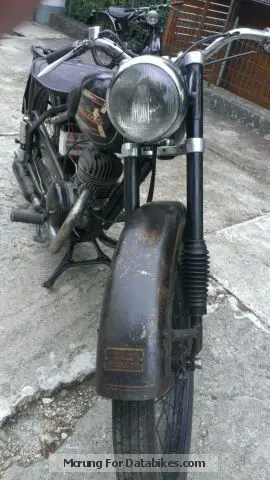
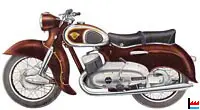
The 500 was the largest of the racing Maicos, alongside the road-going Taifun and 250 of the 1950s. More machines are in the Maico collection.
Sources
- Maico, English Wikipedia: racing history, 490 to 500 change, owners
- Maico, German Wikipedia: company history