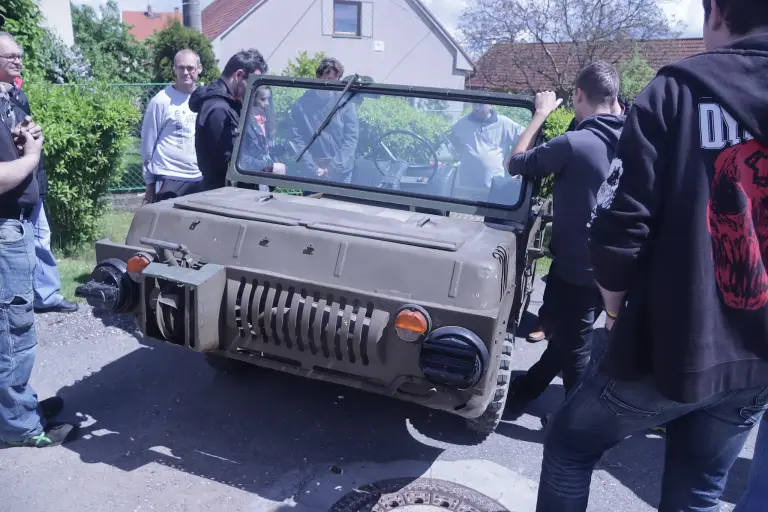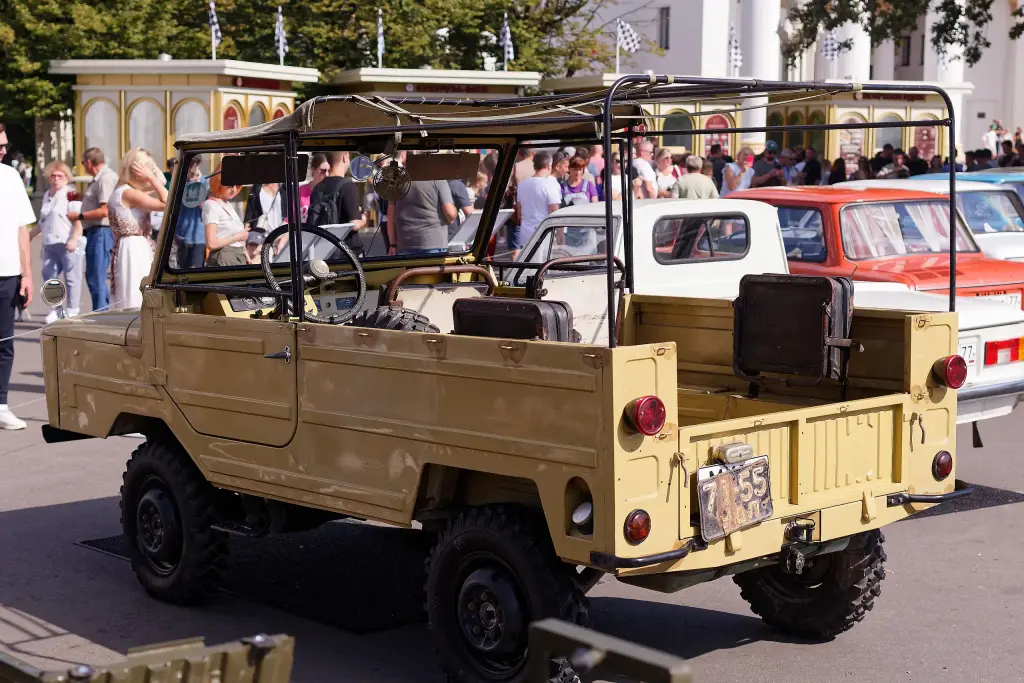
The LuAZ-969 Volyn was a family of small, simple four-wheel-drive cars built at the Lutsk automobile plant for Soviet country dwellers. Its first version, the 969V of 1966, was the first Soviet front-wheel-drive car, and later versions, the 969A and 969M, carried the design into the 1990s, while the related LuAZ-1302 lasted until 2002.
LuAZ-969 at a glance
| Maker | Lutsk automobile plant, later LuAZ |
|---|---|
| Production | 1966–2002 for the family; 969 until 1996 |
| First version | ZAZ-969V, front-wheel drive, 1966–1972 |
| Four-wheel drive | ZAZ-969 / LuAZ-969 from 1971 |
| Later versions | LuAZ-969A (1975), LuAZ-969M (1979) |
| Engine (1967) | MeMZ-969, 887 cc air-cooled V4, 30 hp |
| Engine (969A) | 1.2 litres, 40 hp |
| Drive | front, rear axle selectable; rear differential lock |
| Body | two-door, four-seat, open, canvas or plastic roof |
| Payload | 300 kg with two people, or four people |
| Top speed (NAMI-049) | 80 km/h |
| Built (969V) | 7,438 |
There is no English Wikipedia article on the LuAZ-969. This page is based on the Russian article on the 969 family and the Ukrainian article on the 969M, which give slightly different production dates for the 969M.
History of the LuAZ-969
From the NAMI-049 Ogonyok
In the mid-1950s NAMI drew up a plan of small cars for the Soviet economy, including a light multi-purpose vehicle able to carry four people, or two people and 200–250 kg of goods. Work began in 1958 on the NAMI-049 Ogonyok, which followed the military NAMI-032G: steel frame and floor with fibreglass outer panels, independent suspension on torsion bars, permanent drive to the front axle with a disconnectable rear axle, locking differentials and wheel reduction gears. The car weighed only 752 kg, reached 80 km/h with the 22 hp MD-65 engine and used 6.7–7.1 litres per 100 km. The work then moved to the Kommunar plant in Zaporizhzhia, where the NAMI-049A Tselina and the ZAZ-969 were created around the running gear of the ZAZ-965.
Front-wheel drive first
A pilot batch of 50 ZAZ-969 cars was built in Zaporizhzhia in 1964, but production was then handed to the mechanical plant at Lutsk, which had made trailers and refrigeration equipment. Prototypes were assembled there in 1965 and a pilot batch followed in 1966. Mass production started in 1967, and because drive parts for the rear axle were in short supply the first series car, the ZAZ-969V (also called LuMZ-969V), had front-wheel drive only, with a power take-off shaft for attachments. Its 887 cc MeMZ-969 engine produced 30 hp and differed from the MeMZ-966 of the ZAZ-965A mainly in using a blower fan instead of an extractor. Some 7,438 of these cars were built. At the end of 1967 the plant was renamed the Lutsk automobile plant, though its products still carried the ZAZ badge.
Four-wheel drive and the 969M
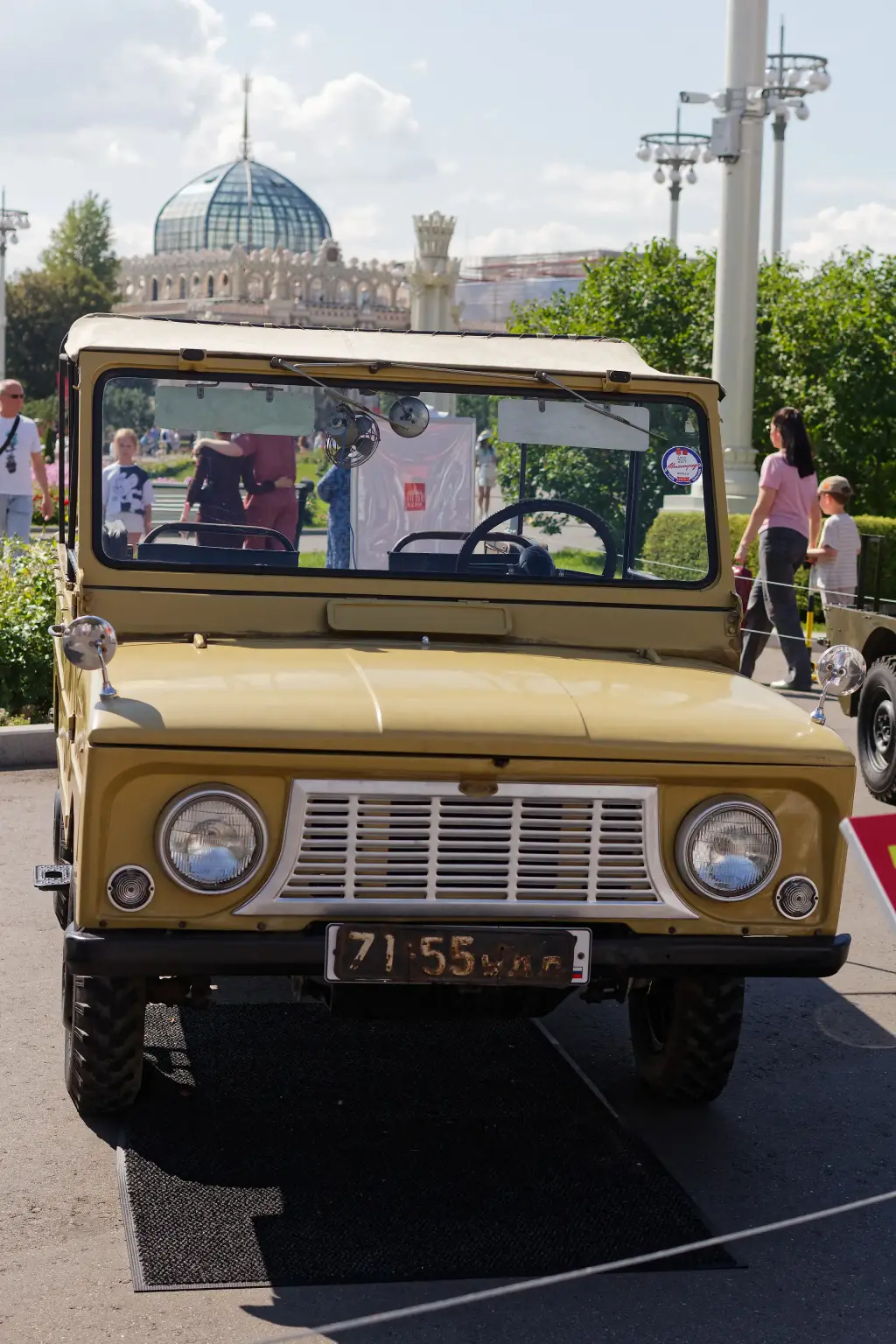
In 1971 the supply of rear-axle parts was solved and the full four-wheel-drive ZAZ-969, rarely called LuAZ-969, went into production. The LuAZ-969A of 1975 brought a 1.2-litre engine of 40 hp. Work on its successor began in 1977; the LuAZ-969M was shown at the Turin motor show in 1978, entered the top ten four-wheel-drive cars of Europe, and won a gold medal in July 1979 at an exhibition in Czechoslovakia. It had separate brake circuits and a new exterior and interior. From 1983 the Italian firm Mortarelli exported it to Western Europe, fitting a more powerful Ford engine and a modified interior in Italy rather than at the factory. By 1989 some 126,893 cars had been built. The 969M was made until 1992 or 1996 depending on the source, and the family ended with the LuAZ-1302 of 1990, a 1.1-litre, 53 hp development.
Design and features
- Made for the countryside: the first Soviet off-roader officially sold for personal use, and the first series Soviet car designed for villagers.
- Compact open body: two doors, four seats, a drop tailgate and a canvas or plastic roof; with the rear seats folded the platform measured 1.4 m².
- Simple mechanical layout: independent torsion-bar suspension with wheel reduction gears, selectable four-wheel drive and a lockable rear differential.
- Light and economical: the early car weighed 752 kg and used 6.7–7.1 litres per 100 km.
- Hatches in the floor: access to the gearbox, rear axle filler, fuel lines and sender without lifting the body.
LuAZ-969 versions
- ZAZ-969V / LuAZ-969V / LuMZ-969V (1966–1972): front-wheel drive with a power take-off shaft.
- ZAZ-969 / LuAZ-969 (1971–1975): four-wheel drive with a locking rear differential.
- LuAZ-969A (1975–1979): modernised, with a 1.2-litre 40 hp engine.
- LuAZ-969M (1979–1996): new exterior and interior, separate brake circuits.
- LuAZ-1302 (1990): further modernisation with a 1.1-litre, 53 hp engine.
- LuAZ-2403: a closely related model of the same family.
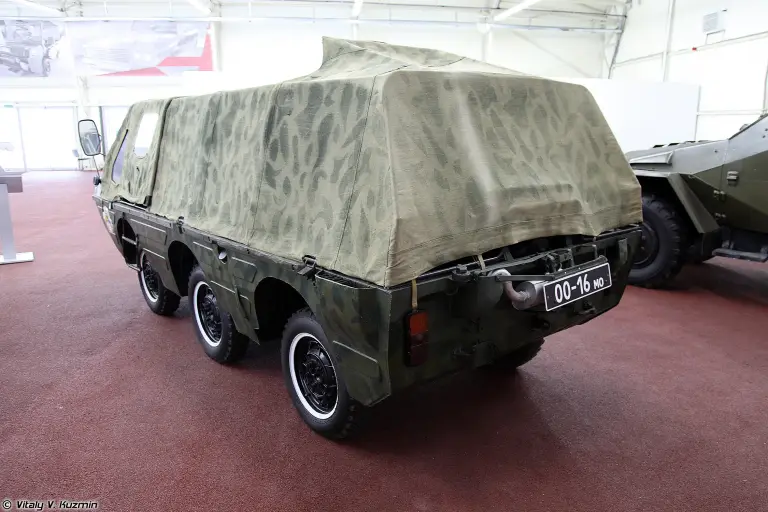
The Volyn was the civilian descendant of the military LuAZ-967, and the six-wheeled LuAZ-1901 was a later attempt at a bigger off-roader. More cars are in the LuAZ collection.
Sources
- ЛуАЗ-969, Russian Wikipedia: family, history, versions
- ЛуАЗ-969М, Ukrainian Wikipedia: 969M, Turin show, export, output