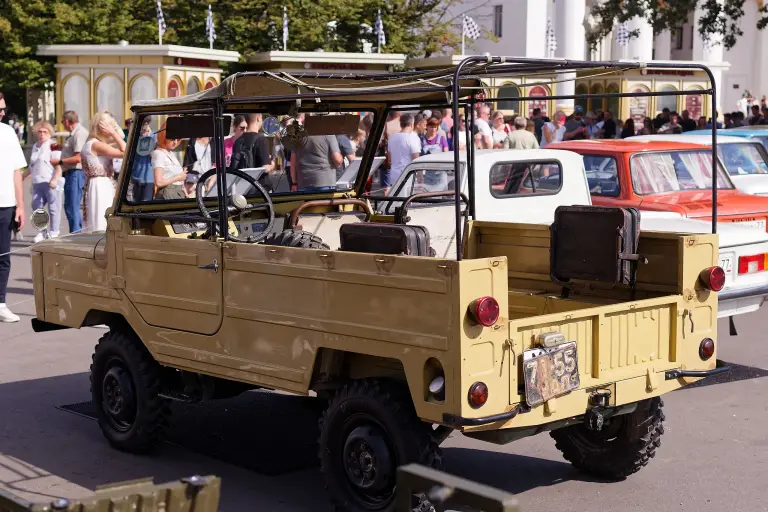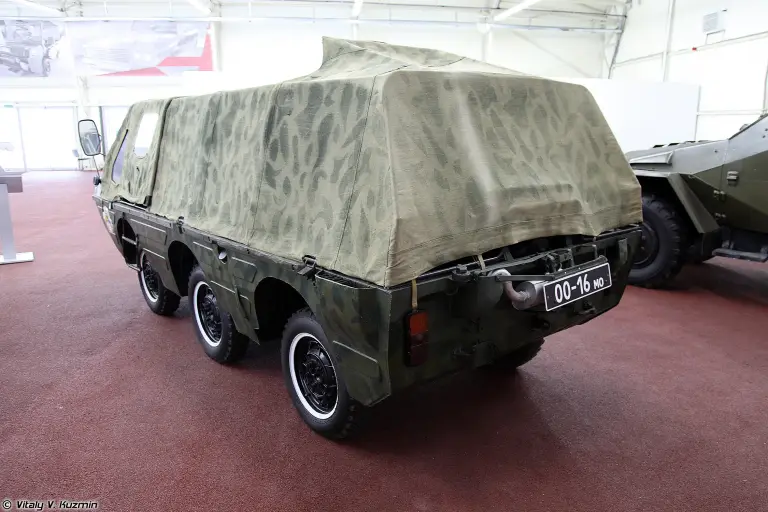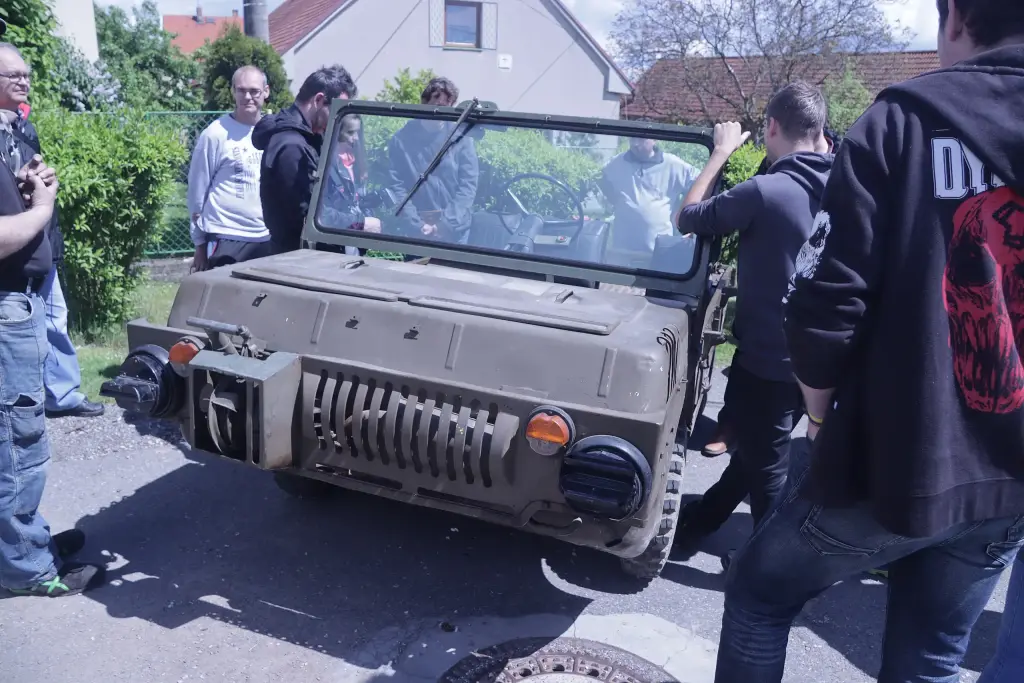
The LuAZ-967, known in Russian as the Transportyor Perednego Kraya or Transporter of the Front Line, was a small amphibious four-wheel-drive vehicle designed for Soviet airborne troops. Light enough to be carried by air and able to swim, it could take a 400 kg payload over most terrain, and its driver sat on the centreline behind a steering column that folded down.
LuAZ-967 at a glance
| Maker | Lutsk Automobile Plant (LuAZ), Ukrainian SSR |
|---|---|
| Also known as | TPK, Transporter of the Front Line |
| Designed at | NAMI, from the mid-1950s |
| First prototype | NAMI-049, 1958 |
| Series production | 1975–1989 (967M) |
| Engine (967M) | MeMZ-967A, 887 cc air-cooled V4, 37 hp |
| Transmission | 4 speeds plus crawl gear, front drive with selectable rear axle |
| Payload | 400 kg |
| Ground clearance | 285 mm |
| Wheelbase (NAMI-049) | 1,800 mm |
| Top speed | 80 km/h |
| Built | about 7,940 |
The English article is comparatively short; the details of production, annual output and the later changes come from the Russian and Ukrainian articles.
History of the LuAZ-967
Lessons of the Korean War
After the Korean War the Soviet armed forces saw a need for a light off-road vehicle comparable to the American Jeep, to supplement the large and heavy GAZ-69 then in service. The new machine was intended for the airborne forces, for casualty evacuation, the supply of ammunition and the transport of light armaments. Work began at NAMI, the national automobile institute, and the first prototype, the NAMI-049, was completed in 1958. It had a fibreglass body, independent suspension on torsion bars, permanent four-wheel drive with locking hubs, a 1,800 mm wheelbase and 280 mm of ground clearance, and it was powered by a 22 hp MD-65 motorcycle engine. Trials showed it to be underpowered, and its body proved too fragile.
A second prototype
The NAMI-049A followed with a 746 cc V4 MeMZ-965 engine, the unit chosen for the ZAZ-965, a steel body and rear-wheel drive with optional drive to the front wheels; the torsion bars gave way to coil springs. It weighed 1,350 kg, used a 37 hp MeMZ-967A engine, could pull a 300 kg trailer, climb a 58 per cent gradient and reach 80 km/h. The work was then passed to Zaporizhzhia, where prototypes were built on the NAMI-032M, and in 1967 the design went to the Lutsk automobile plant. The military asked for a 1.2-litre MeMZ-968 engine, several more prototypes were built at Lutsk and eleven reference samples were made between 1968 and 1972. In 1972 the vehicle, by then the LuAZ-967M, was recommended for series production, but a lack of tooling funds delayed it; a pilot batch appeared in 1973 and full production could start only in 1975.
Production and changes
About ten experimental machines of the 967 and 967A types were built between 1965 and 1975, and the 967M was made in series from 1975 to 1989. A total of about 7,940 vehicles was built, usually some 650 a year, though only 80 were made in 1975. The design was constantly updated: early vehicles had no bilge pump and could sink quickly without one, the so-called blind version without headlights was built until 1980 and had no canopy, in 1985 the rear lights became horizontal and a partition appeared between the engine bay and the cab, and in 1988 the battery cover and the fuel filler flap changed shape. In 1985 a further modification, the 967MP, appeared; its wholesale price in 1989 was 4,690 roubles.
Design and features
- Central driving position: the seat and the steering column were mounted on the centreline, and the column folded down so that the driver could steer in a semi-reclining position.
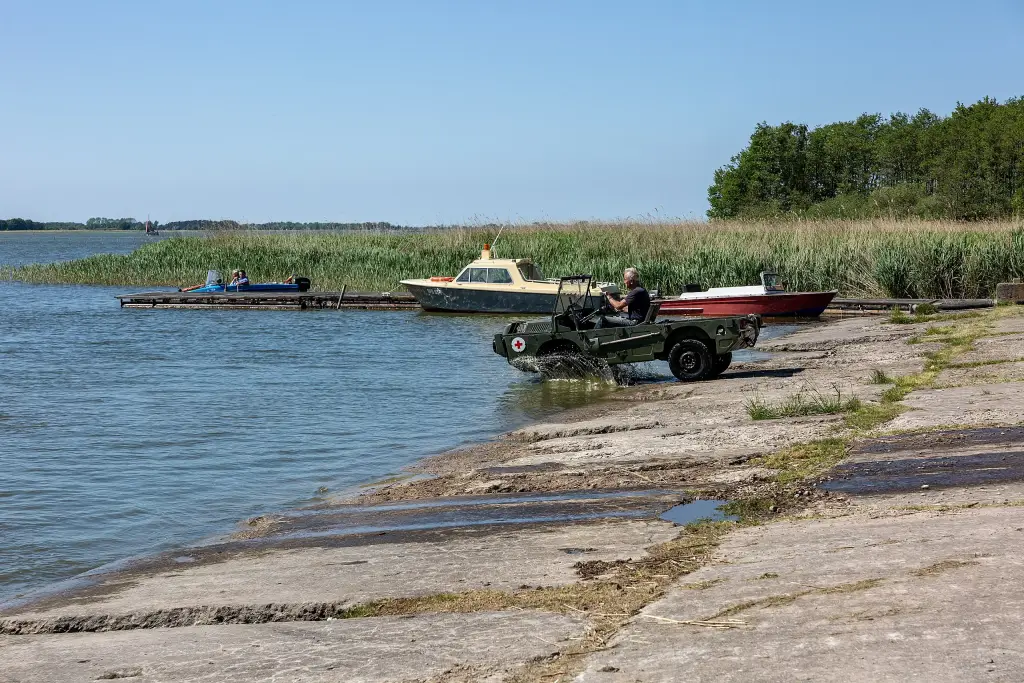
- Swimming without a propeller: the LuAZ had no screw; in the water it moved by turning its wheels, which made it less capable afloat than a true amphibian but better on land.
- Unusual transmission: a four-speed gearbox with a separately engaged crawl gear, front-wheel drive in normal use and a rear axle engaged only when four-wheel drive was needed.
- Watertight steel body: independent suspension on torsion bars all round, 285 mm of ground clearance, and controls and windscreen that folded down for a lower profile.
- Air-transportable: small and light enough to be carried by aircraft and used by airborne troops.
LuAZ-967 versions
- LuAZ-967: the original experimental vehicle of the mid-1960s.
- LuAZ-967A: an improved version with the more powerful MeMZ-967A engine.
- LuAZ-967M: the series version of 1975–1989, with electrical equipment standardised with UAZ vehicles and hydraulics with Moskvich cars.
- LuAZ-967MP: a modification introduced in 1985.
- Geolog: a specialised six-wheel version.
The LuAZ-967 was the military ancestor of the civilian LuAZ-969 Volyn, and its six-wheel idea returned years later in the LuAZ-1901 Geolog. More vehicles are in the LuAZ collection.
Sources
- LuAZ-967, English Wikipedia: design, prototypes, mechanical details
- ЛуАЗ-967, Russian Wikipedia: production history, output, modifications
- ЛуАЗ-967, Ukrainian Wikipedia: modifications, production years